
Essays · Photography
Zoe Leonard. Analogue (1998.2009).
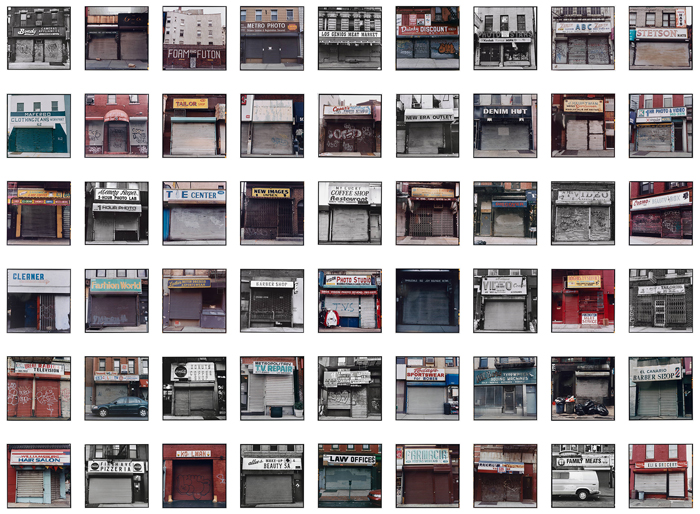
Zoe Leonard. Analogue. 1998.2009. Chromogenic color prints and gelatin silver prints, each 11 × 11" (27.9 × 27.9 cm).
A photographic archive of disappearing storefronts and shifting economies
Between 1998 and 2009, American artist Zoe Leonard created Analogue , a large-scale photographic project that documents the changing landscape of urban life and small-scale commerce. Over more than a decade, Leonard photographed storefronts, signage, window displays, and street details in New York City.particularly in neighborhoods facing rapid gentrification, economic restructuring, and the spread of chain retail.
Shot using a vintage 1940s Rolleiflex camera and traditional analog film, the project deliberately resists the slickness of digital photography. Leonard’s use of square-format black-and-white and color prints creates a sense of quiet observation and archival intent. The photographs, often centered on fading shop signs, handwritten price tags, mannequins, and modest store interiors, reveal what is being lost: individual character, economic diversity, and local histories.
Over time, Leonard expanded the project beyond New York, photographing street markets and storefronts in Africa, Eastern Europe, and the Middle East.mapping a global pattern of disappearing small economies in the face of globalization. The full installation consists of 412 photographs , arranged in a grid or linear sequence, highlighting the scale and repetition of this transformation.
Analogue is both documentary and elegy.a visual record of everyday life that is vanishing, and a critique of the systems that drive such change. It asks viewers to look slowly and consider what survives, what is displaced, and what it means to remember through images.
Photography