
Essays · Contemporary Art
Anish Kapoor. Ishi's Light.
Some things can only be seen from inside.
Tate · Tate
An egg cut open
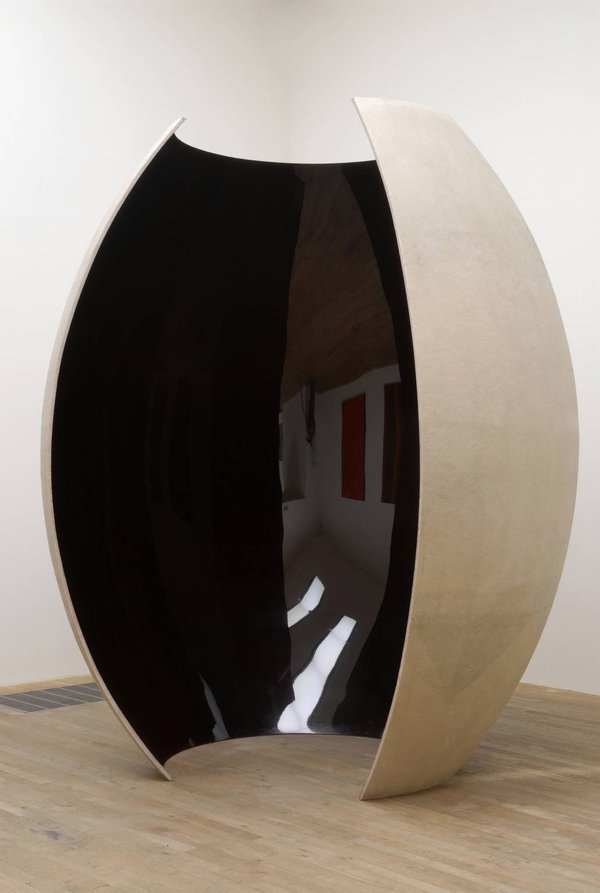
Ishi's Light is a floor standing sculpture more than three metres tall. Seen from above, its plan is a crescent. Seen from the side, it is shaped like an egg. But an incomplete egg: sliced off at the top and at the base, with a wide opening on one side.
The opening is wide enough for a person to step through. At its widest the form is about two and a half metres across. Kapoor wants the viewer to do exactly that: not to look from outside, but to go in and stand in the middle.
The work was completed in 2003, in fibreglass, resin and lacquer. The outside is a pale stone colour, slightly translucent, like a real eggshell held to a lamp. The inside is another matter: a red so deep it is almost black, glossy like the lid of a grand piano.
Two faces of one shell, one quiet, one reflecting. The work lives in the passage between them.
Standing inside
Stepping in, the viewer finds themselves in the red lacquer. But not as a familiar image. The curve distorts the reflection, turns it upside down, stretches it. The surrounding space shifts too: how near the wall is, where the floor begins, becomes hard to say.
Light entering through the opening and the cut top forms a bright band along the hollow. Kapoor has described this band as almost a real object, with a body, not just something lying on a surface. For him, what happens with the reflections is what matters.
Sound is affected as well. Tate notes that inside the hollow, noises seem far away. The work bends hearing as much as seeing.
The dark red interior feels warm and sheltering, like a womb. The person standing there is in an in between place: not quite in a room, no longer in the gallery.
Two names, two reds
The title has two layers. According to Tate, Ishi refers to Ishan, Kapoor's son. And the phrase deliberately recalls Anna's Light, a 1968 painting by the American abstract painter Barnett Newman, named after his mother. It is Newman's largest painting, a field of bright red.
The two reds are very different. Newman's glows outward. Kapoor's is dark and draws in. Yet both do the same thing: they are large enough that the viewer no longer sees a picture or a sculpture, only the fact of being surrounded.
Newman's hold on Kapoor goes back a long way. As an art student Kapoor stood before Vir Heroicus Sublimis, another vast red Newman canvas. He has said that the painting stopped being a picture, that it wrapped around him, and that it showed him art could leave narrative behind and still reach the things that matter most.
Ishi's Light is Kapoor's answer to that painting in sculpture. No story. Only a place to stand.
Void and mirror
In Kapoor's career, Ishi's Light sits between two major directions. From the late 1980s to the mid 1990s he made what Tate calls void sculptures: blocks of stone with a dark recess, funnel shapes that seem to sink into walls and floors. From the mid 1990s, mirrors and reflective surfaces became central to his work, as in Sky Mirror, which later brought the sky down to eye level.
Ishi's Light holds both. It has the emptiness of the earlier voids. And it has the gloss in which the viewer sees themselves undone.
In 2005 the Tate International Council gave the work to Tate. It has been shown beside Newman at Tate Modern, and travelled with Tate's exhibition Light to Shanghai, Seoul, Auckland, Tokyo and Osaka between 2021 and early 2024. Everywhere, it does the same thing: it invites one person in, and returns to them an image of themselves they have never seen.

Contemporary Art