
Essays · Contemporary Art
Bharti Kher. confess.
The walls have ears.
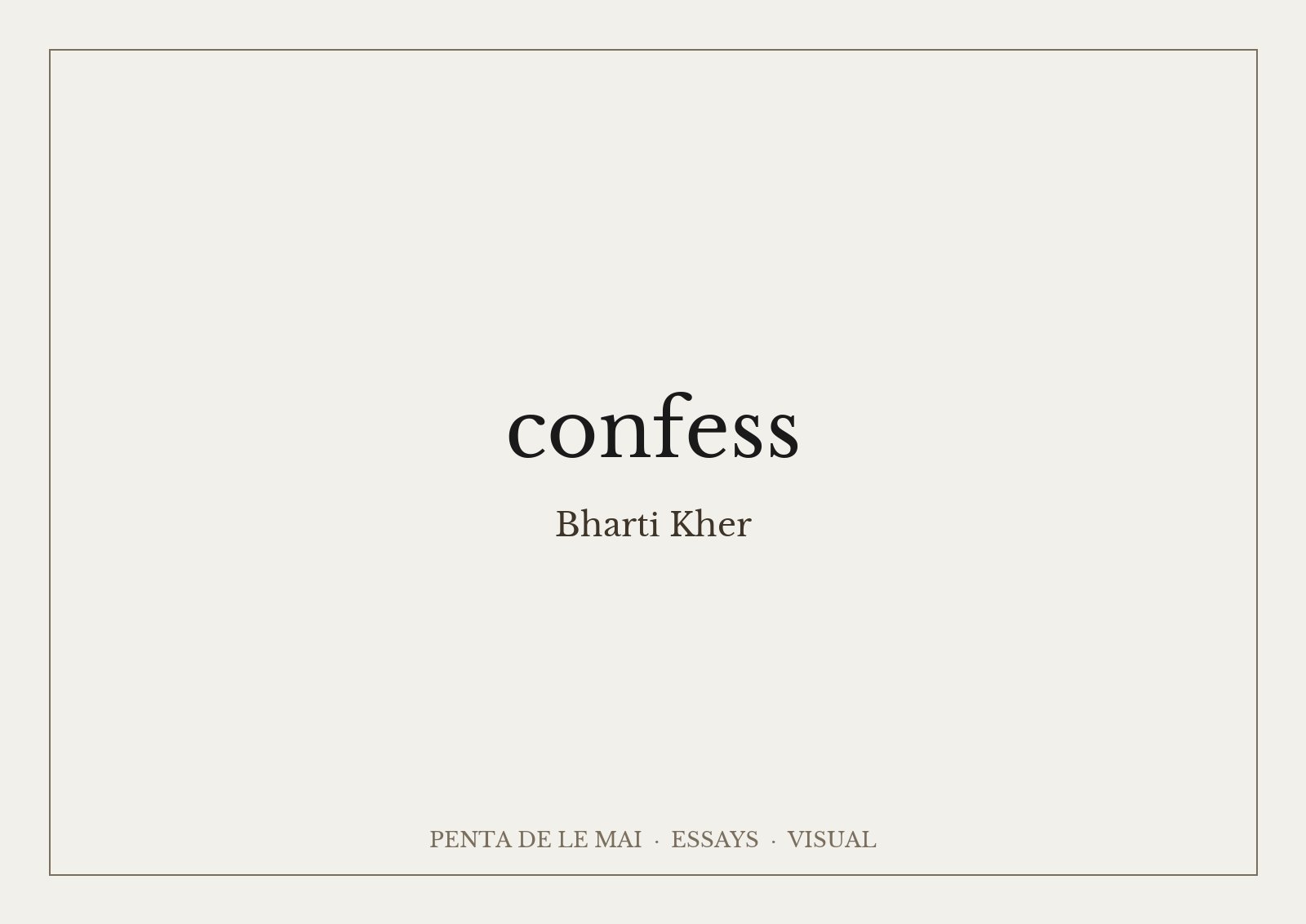
A room standing inside a room
confess is a nearly cubic structure of dark wood, about two metres tall and about three metres along each side. It looks like a small room built inside a larger one. There is a door. There are windows. Along the top of the walls runs a regular pattern of holes. The architectural detail is lightly ornate, enough to suggest an old interior, not enough to name a place.
Bharti Kher, born in 1969, made the work across 2009 and 2010. In 2010 she and the gallery Hauser & Wirth presented it to Tate. The title is written in lower case, like a verb said quietly.
From outside, the wooden block is almost plain. It does not invite. The viewer has to come close, lean in, look through a window to see what is inside.
Inside, the dots of colour
The entire interior is covered with bindis, the forehead ornament worn by many women and girls in South and Southeast Asia. Kher arranges them in dense, whirling, colourful patterns that move like water circling a centre.
From the ceiling hangs a single light bulb. No shade, no ornament. Tate notes that this bare bulb recalls a prison cell, and the possibility of forced confession.
So the title suggests a private place, a confessional. The interior suggests a bridal chamber, full of colour. The light suggests an interrogation room. Three images overlap in one narrow space, and none of them fully wins.
Tate's gallery label puts the question to the viewer: is this a sanctuary where a woman shares her thoughts, or a closed cell where confessions are extracted? The work does not choose. It lets both be true.
The bindi as writing
In Hindu tradition the bindi is a mark of red pigment on the forehead, standing for the third eye, for wisdom. In recent decades it has also become a coloured sticker sold by the sheet and worn as a fashion accessory. Kher works between those meanings. For her, the bindi is a third eye linking the real and the spiritual.
She has used bindis across many works, on paintings and sculptures, in their thousands. Speaking to The Times of India, she said that through repetition she had made them her own language. On the outside of an object, she explained, they act like a skin. On the inner walls of the bridal chamber in confess, they act like text.
This is worth pausing on. A small, cheap, everyday thing tied to a woman's body, repeated until it becomes a surface that remembers. No sentence is written. Yet the room is full of words.
The familiar signs of South Asian culture can be reread in many ways. Bagh-e Hind by Bharti Lalwani rereads the gardens of Mughal and Rajput painting through smell. Kher rereads the mark on the forehead through repetition.
Looking through the window
How confess is seen decides what it means. Viewers do not enter. They stand outside and look through small windows. They are guests and eavesdroppers at once. The room does not open to them; they are only allowed a glimpse.
That is the position of an outsider before someone else's private life. We know things are happening in there. We see the colour, the density. But the confession belongs to the person in the room, not to us.
Kher does not say who the woman is. There is no figure, no photograph, no furniture. Only walls, dots and a bulb. That absence makes the room heavier. Anyone could have lived there.
confess is a work about surfaces that keep things. The outer surface keeps silence. The inner one keeps everything that was said.
Contemporary Art