
Essays · Olfactory Art
Bharti Lalwani. Bagh-e Hind: Scent Translations of Mughal and Rajput Garden Paintings.
A garden in a painting can be smelled again.
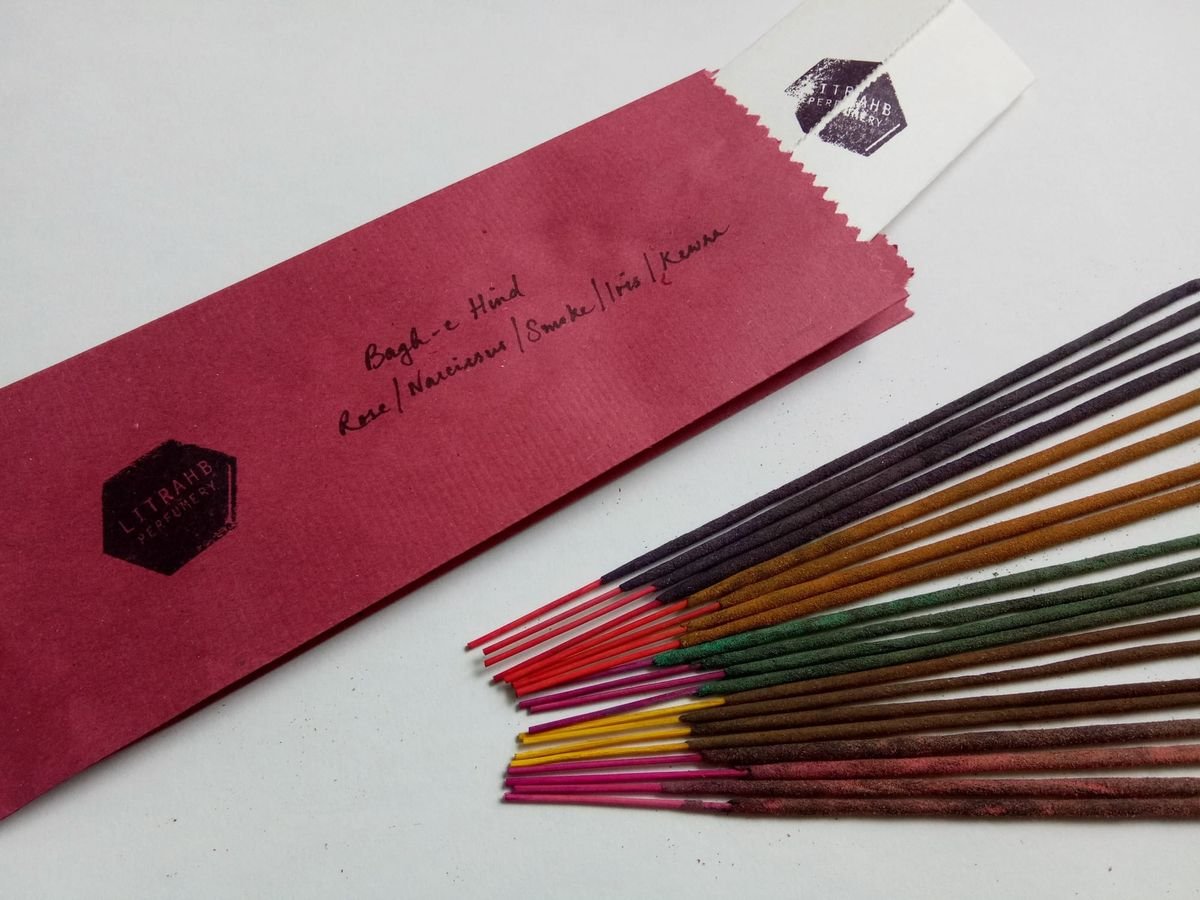
Courtesy Bharti Lalwani / Hyperallergic · Hyperallergic
A viewer at a distance
Bharti Lalwani studied at Central Saint Martins in London and at Sotheby's Institute. Before working with scent, she spent years designing carpets for a company in West Africa, then wrote criticism on contemporary Southeast Asian art. Carpets, words, then smell. Three materials, one habit: looking closely at a surface and asking what it carries.
The starting point for Bagh-e Hind was a small painting at the Metropolitan Museum of Art in New York: the emperor Shah Jahan with his son Dara Shikoh, painted by Nanha around 1620, a leaf from the Shah Jahan album. Like many Indian court paintings, it left the subcontinent long ago and now lives in a Western collection.
For South Asians, these paintings are their own heritage. Yet the usual way to meet them is a digital image on a museum website. Lalwani asked a question from there: if access to these objects will always be through a screen, is there another way to bring them closer?
She spent three years developing the project, funded it herself, and launched Bagh-e Hind as a virtual exhibition in 2018. The name means the garden of India.
Five paintings, five scents
In 2021 the historian Nicolas Roth, who holds a PhD in South Asian Studies from Harvard and specialises in Mughal writing on gardens, joined as co-curator. His presence changed how the project read the paintings. Each plant in a garden is more than decoration. It has a name, a season, a place in the poetry and the gardening manuals of its time.
In July 2022 the project entered a real room: the Institute for Art and Olfaction in Los Angeles, from 15 July to 12 August. Five garden paintings from the seventeenth and eighteenth centuries were chosen, each paired with a scent, an incense and a bar of soap.
The five themes were rose, narcissus, smoke, iris and kewra, a screwpine whose fragrant flower is familiar in South Asian kitchens and temples. One painting shows Maharana Jagat Singh II at the Festival of Flowers in the Gulab Bari rose garden, 1750, now at the National Gallery of Victoria in Melbourne. One shows a nobleman watching fireworks. One is a Kamod Ragini at the Arthur M. Sackler Gallery. There is an early seventeenth century garden scene from Harvard's fine arts library, and a prince giving audience from the Museum of Fine Arts, Boston.
Lalwani made the incense and soaps. The perfumes were composed by Miss Layla, a self-taught perfumer. They sat in hand-blown glass bottles, no two alike. The project also included edible perfumes, boxes Lalwani calls synaesthesia boxes, and eighteenth century poetry.
Translating, not copying
The key word in the title is translation. Lalwani does not claim to rebuild the smell of a garden in 1750. Nobody knows that smell exactly. She says she translates. A painting of fireworks becomes smoke. A rose garden becomes rose. A musical mode painted as a picture becomes, in turn, a scent. Every step is a choice.
This puts the visitor in an odd position. They stand before a reproduction of the painting, but the smell is real, here, in the room. The image is far away; the scent is close. Perhaps that is the point: smell does not need the museum's permission. The Mughal court was itself a culture of smell, from rose gardens to the rosewater sprinklers used to welcome guests.
Bagh-e Hind also speaks about ownership without raising its voice. These paintings left India by many routes, through trade and through colonial rule. The project does not demand them back. It only reminds us that a garden does not fit entirely inside a frame. The rest of it, soil, flowers, smoke, still belongs to the place where it grew and to the people who still live there.
From a virtual exhibition in 2018 to a room in Los Angeles in 2022, Bagh-e Hind keeps one question. When the image has travelled far away, can the nose still find the way home?
Olfactory Art