
Essays · Olfactory Art
Wolfgang Laib. Wax Room.
A room whose walls are a smell.
The Phillips Collection · The Phillips Collection
A chamber in a house
On 2 March 2013, The Phillips Collection in Washington, D.C. opened a new room: Wolfgang Laib's Wax Room. Its full German title is Wohin bist Du gegangen, wohin gehst Du?, meaning: where have you gone, where are you going?
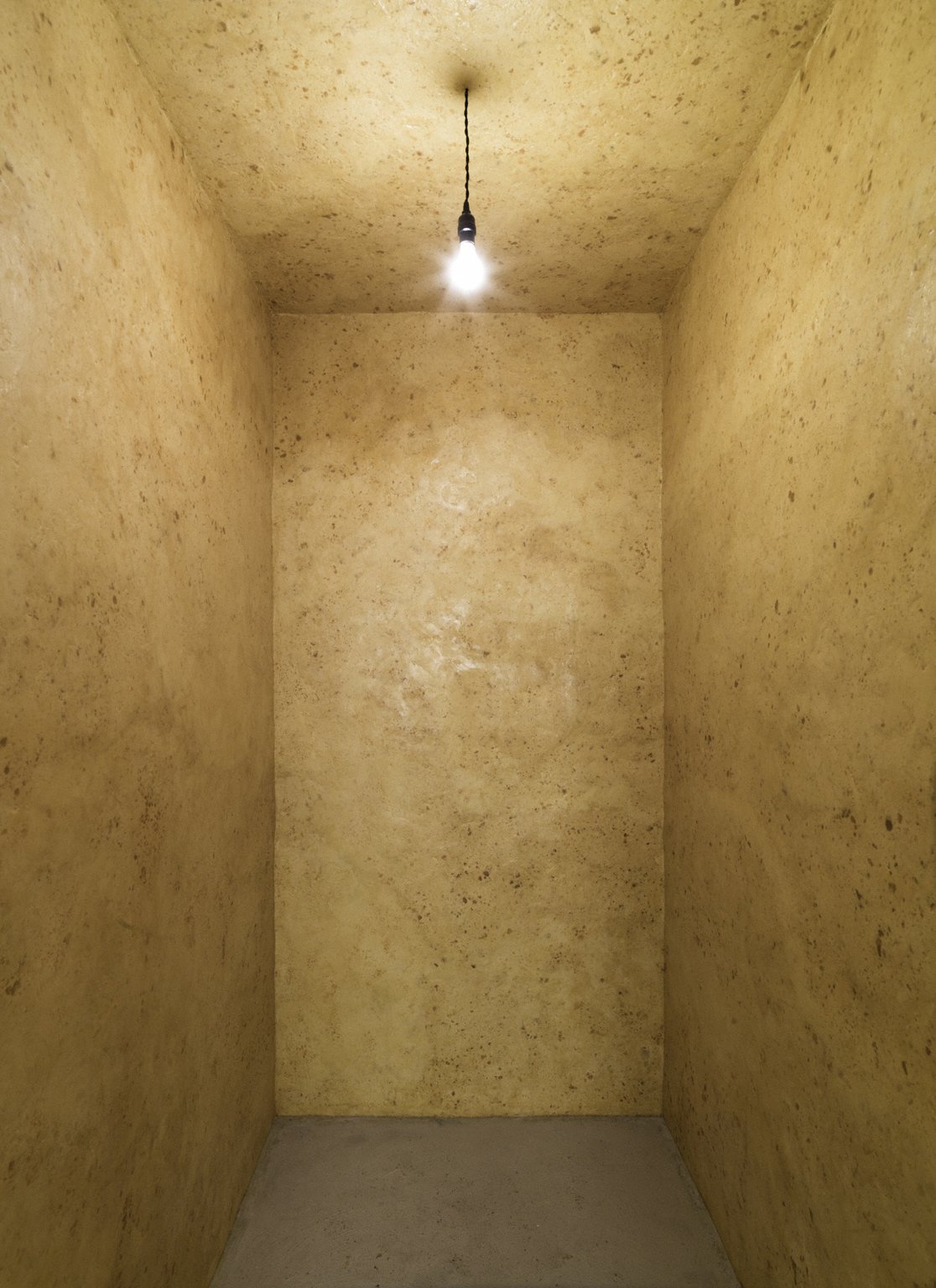
The room sits in the museum's original house, the Phillips family home before it became a museum. It is a small chamber, its floor only about two metres each way. The walls and ceiling are covered in beeswax. A single bare bulb hangs from the ceiling.
The light touches the wax and turns honey yellow. But the first thing you notice on crossing the threshold is not colour. It is smell. Warm, thick, slightly sweet beeswax, everywhere in the chamber.
It was the Phillips's first permanent site specific installation since the Rothko Room of 1960, and Laib's first permanent wax room in a museum.
Walls of wax
Laib built the room from large blocks of beeswax. He warmed the wax and used a spatula, a heat gun and an iron to spread it layer by layer over walls and ceiling, an inch thick or less. The work was slow and even, one gesture repeated thousands of times.
Wax is soft and sensitive to warmth. It takes its shape from the hand that spreads it, and keeps the way it was laid on.
So the smell of the room comes from no device. No diffuser, no vessel of scent. It comes from the walls themselves, a property of the material, present every day the chamber is open.
The Phillips describes the chamber as intense and meditative, a place where one loses awareness of self and place. Put simply: it is small enough that you have to stop.
From medicine to pollen
Wolfgang Laib was born in 1950 in Metzingen, southern Germany. He studied medicine. In 1972 he travelled to India and began to doubt his path. After carving his first work, an egg-shaped stone he called a brahmanda, he left medicine for art.
Since then he has worked with a handful of natural materials: pollen he gathers himself from meadows near his village, milk poured onto marble, rice, and beeswax. Each is tied to life and nourishment. Each has its own smell. On pollen, see the essay on Pollen from Hazelnut.
He lives in a village near Biberach, Germany, with a second home near Madurai in southern India. Both places show in how he works: a farmer's patience, and the stillness of small shrines.
Beside Rothko
In October 2012 Laib visited the Phillips's Rothko Room for the first time, the small room hung with four paintings by Mark Rothko that Duncan Phillips arranged in 1960. Afterwards he said that a wax chamber has a deep and open relationship to Rothko's paintings.
It is easy to see why. Both rooms are small, dim, and keep the viewer close. Rothko's canvases surround the person before them with colour. Laib's chamber surrounds the person inside it with smell.
Two rooms more than half a century apart, in one museum, with one intent: a space small enough that people have to slow down. Rothko used the eye. Laib used the nose.
There is nothing to take away from the chamber. Only the smell, and the smell stays only in memory.


Olfactory Art