
Essays · Olfactory Art
Wolfgang Georgsdorf. Osmodrama / Smeller 2.0.
A smell can arrive and leave, like a note.
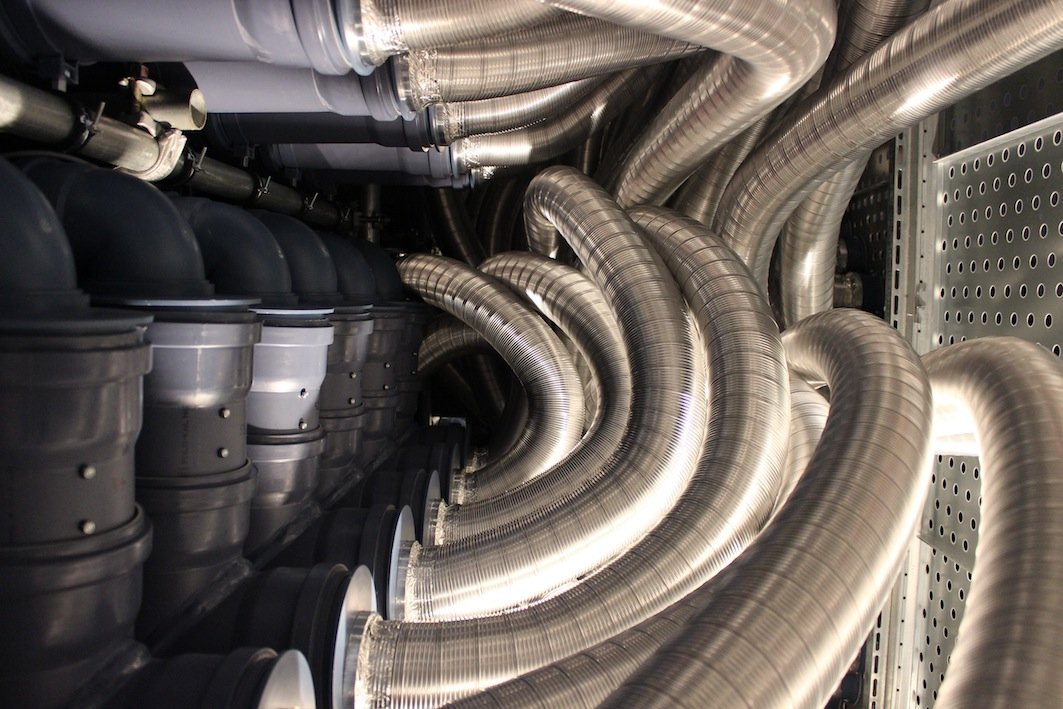
© Osmodrama / Wolfgang Georgsdorf · Osmodrama (official site)
An instrument played with air
Smeller 2.0 is an electronically controlled scent organ developed by the Austrian artist Wolfgang Georgsdorf. It weighs about 1.6 tonnes and currently has 64 smell channels. Through each channel a prepared smell can be released into a room in a predetermined sequence.
Georgsdorf did not work alone. According to the project, the machine was built together with perfumers, olfactory scientists, ventilation engineers, mechanical engineers and programmers. Each discipline solved part of one question: how to make smell behave like images on a screen.
The principle is simple to state. A continuous stream of air crosses the room at walking pace. Smells are released into that stream, spread evenly through the space, then leave with it through a window at the far end. Nothing mixes by accident. When a new smell arrives, the old one has gone.
The project notes that from eight by eight basic smells, in theory, the number of combinations reaches two to the power of sixty four. The figure is not a boast. It shows that the composer holds a palette with almost no limit.
Twenty years from prototype to church
The idea long preceded the machine. In 1996 Georgsdorf presented Smeller 1.0, a mechanically operated prototype, at the State Museum of Upper Austria, and first imagined an electronic version able to control each smell precisely.
It took sixteen years to build. In 2012 Smeller 2.0 was first installed and run at the OK Center for Contemporary Arts in Linz, as part of the exhibition Sinnesrausch. In 2013 Georgsdorf received the Outstanding Artist Award for Interdisciplinarity in Vienna.
From 15 July to 18 September 2016 the Osmodrama Festival took place in the St. Johannes Evangelist church in central Berlin, described by the project as the first festival of kinetic scent performance. Georgsdorf worked with figures such as the director Edgar Reitz, the artist Omer Fast and the actor Eva Mattes on smell compositions, alone or joined with sound, music, film and literature.
In 2017 Osmodrama received the Sadakichi Award from the Art and Olfaction Awards, shared with the perfumer Geza Schön. In 2018 it appeared at the Martin Gropius Bau in Berlin, in the exhibition Welt ohne Außen.
Telling stories in sequences of smell
Osmodrama is Georgsdorf's name for the art form the machine makes possible: storytelling and composition through sequences of smell. Smells come and go like images on a screen, swell and fade like sound in a concert hall.
Performing smell in time is not a new idea. Early in the last century, Sadakichi Hartmann attempted a trip to Japan by smell before an audience. Such experiments tended to meet the same obstacle: smells linger, pile up, and the story blurs within minutes.
Smeller 2.0 is a technical answer to that obstacle. The air moves steadily, smells are carried out of the room, and so a composer can place a second smell right after the first while the nose still tells them apart. Smell gains rhythm. Pauses. Order.
What stays with Osmodrama is not the size of the machine. It is that smell is treated as a language with a grammar. A smell on its own only names one thing. Placed in sequence, smells begin to say something none of them could say alone.


Olfactory Art