
Essays · Olfactory Art
Teardrop-shaped Perfume Container with Birds, Foliage, and Flowers.
A scent that does not stay in one place.
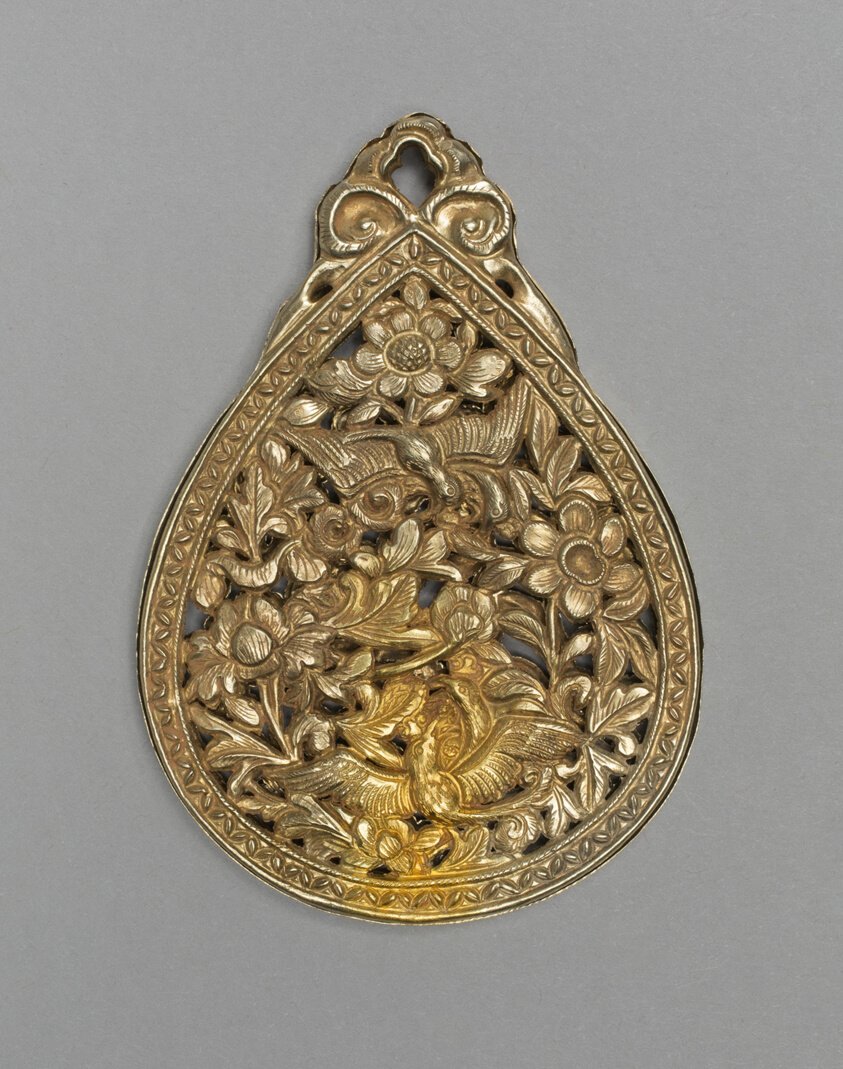
The Art Institute of Chicago, Gift of Dorothy Braude Edinburg to the Harry B. and Bessie K. Braude Memorial Collection · The Art Institute of Chicago
A flat drop of gold
The Art Institute of Chicago holds a gold perfume container made in China during the Song dynasty, that is, between 960 and 1279. The museum gives no narrower date. Its title describes nearly everything the eye sees: a teardrop shaped container with birds, foliage and flowers.
Size: 8.8 cm long, 6.2 cm wide, 0.5 cm deep. The last number is the strange one. Half a centimetre. This is not a box in the usual sense. It is flat as a leaf. Whatever space it holds inside can take only a very small amount.
The museum classifies it as jewellery, not as metalwork or a utensil. That choice says something about use: it belongs to the body more than to a room.
It came to the museum in 2013, given by Dorothy Braude Edinburg of Brookline, Massachusetts, to the Harry B. and Bessie K. Braude Memorial Collection. The record carries no text and says nothing about what it once held.
The museum records yellow gold, worked in three ways: hammered, repoussé and chased. Three words for three passes of the hand over one sheet of metal.
Hammering thins and shapes the sheet. Repoussé works from the back, pushing the metal outward so that birds and flowers rise on the front. Chasing works from the front with small tools, drawing lines, feathers, veins, petals.
Gold suits these methods because it is soft and ductile. A thin sheet can be pushed, pressed and drawn without cracking. Because it is soft, every blow stays. The surface of the container is an accumulation of many small touches.
Birds, leaves, flowers: familiar subjects in Song decoration. On a scent container they gain a closer meaning. Flowers are what smell; birds live among flowers. The images on the gold seem to speak about what was inside.
Scent carried on the body
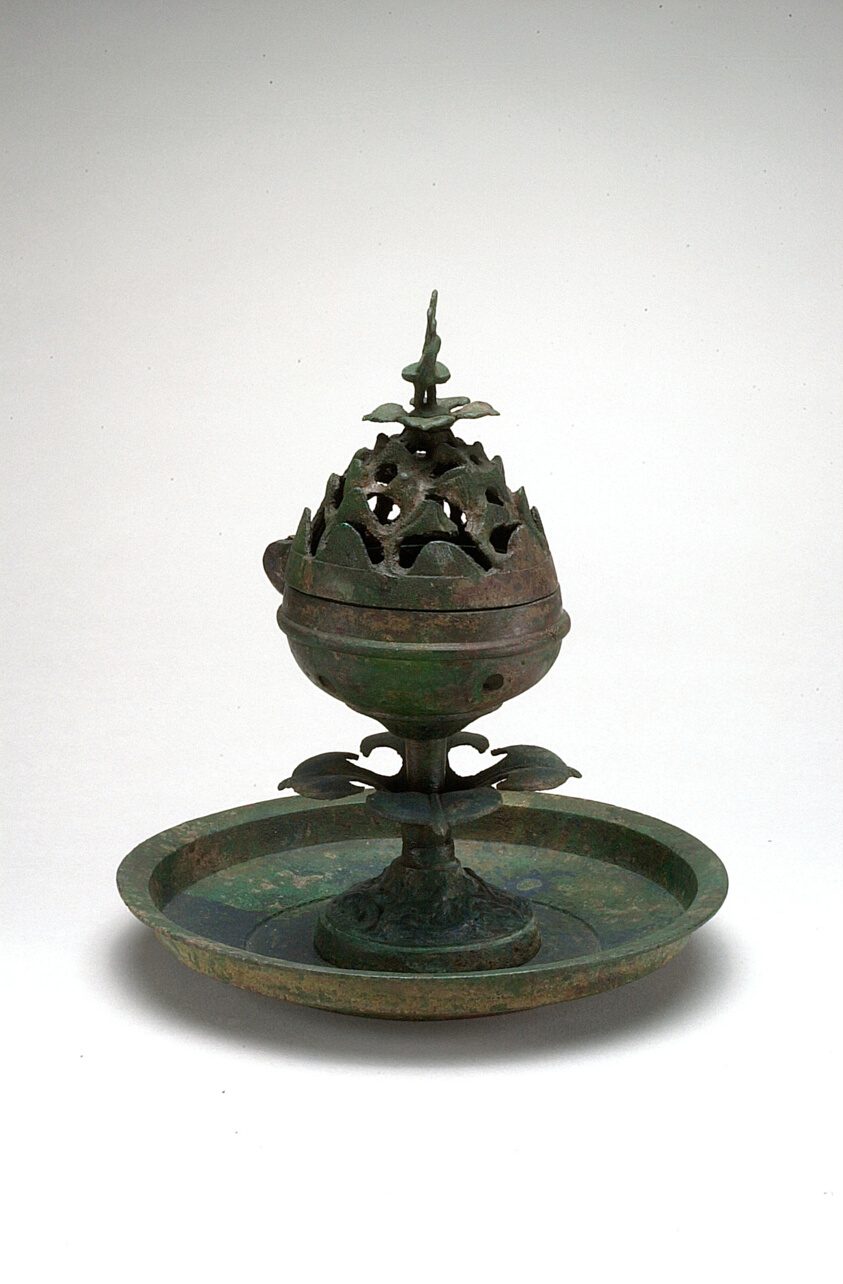
The Song was a time when incense moved out of temples into the daily lives of the educated and the well off. Burners stood on desks, in reception rooms, by beds. This gold container takes scent one step further: out of the room, onto a person walking down a street.
Penta notices two very different ways of living with a scent here. The burner is the way of place: whoever enters the room meets the scent. The container worn on the body is the way of the individual. The scent arrives before the person, lingers after, and only those close enough notice.
Flat and small, it can only have held a little. It does not fill a room. It is closer to a whisper than a statement.
In Japan, centuries later, kimono were scented with incense so that the smell would settle into the cloth and travel with the wearer, as in Yanagawa Shigenobu I's image of scenting a kimono. Two cultures, two methods, one idea: scent can be part of a body, not only of a room.
Today the container lies behind glass, no longer worn. Whatever scent it held is long gone. What remains is a flat drop of gold with birds and flowers, and a question the record does not answer: who carried it, and what scent did they carry, down which roads?

Olfactory Art