
Essays · Olfactory Art
Yanagawa Shigenobu I. Scenting a kimono with incense.
The robe carries the scent ahead of its wearer.
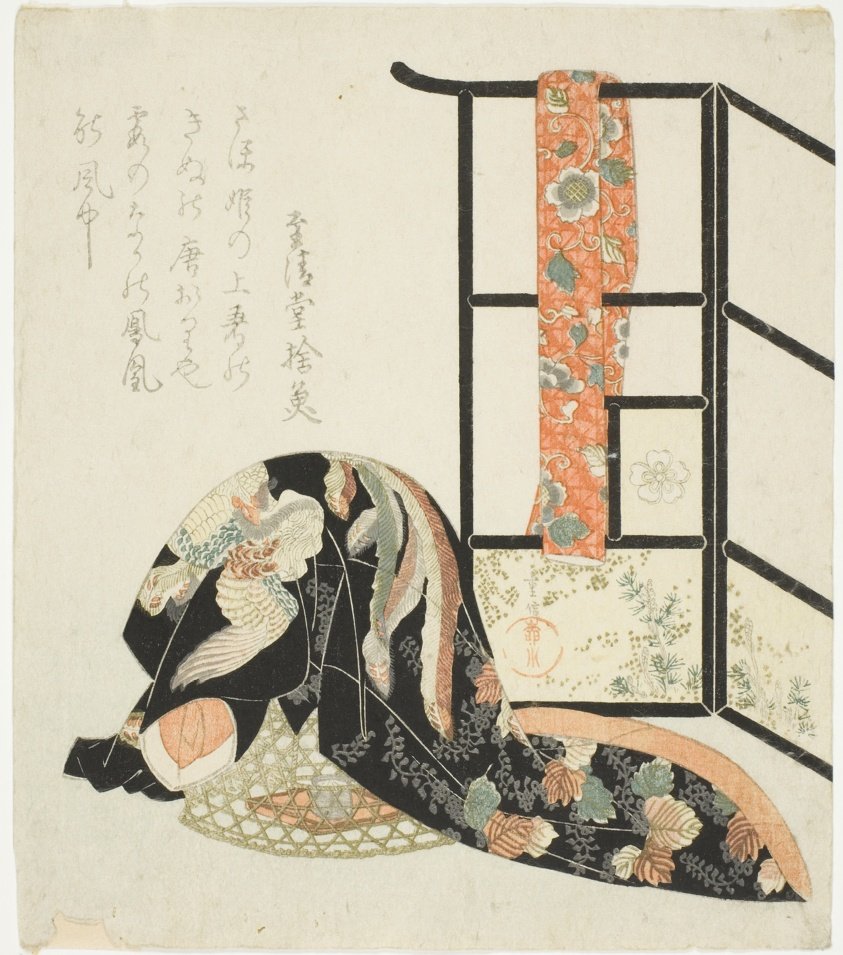
Yanagawa Shigenobu I, Scenting a kimono with incense. The Art Institute of Chicago, Gift of Helen C. Gunsaulus · Public domain
A small print, an everyday task
The print is small. According to the Art Institute of Chicago it measures about 21 by 18.5 cm, almost square. This is the shikishiban format, the square sheet also used for poems and calligraphy, and a familiar size for surimono.
The subject is named plainly in the title: scenting a kimono with incense. A woman, a robe, a thread of smoke. Not a festival, not a stage. A household task.
The museum gives no date for the work. Its maker, Yanagawa Shigenobu I, lived from 1787 to 1832, which places the print in the early decades of the nineteenth century, in the Edo period, when Edo was a large city with a townsman class that read poetry, collected prints and spent money on refined things.
The print is in the Japanese woodblock collection of the Art Institute of Chicago, a gift of Helen C. Gunsaulus.
Surimono, prints for insiders
Surimono were different from the ukiyo-e sold in shops to the public. They were usually commissioned privately, in small runs, for a circle of acquaintances: a poetry club, a group of friends, a New Year. Better paper, more elaborate colour, and recipients who understood the allusions hidden in the image.
Yanagawa Shigenobu I was a pupil of Hokusai. He made prints and book illustrations, and part of his career was tied to Osaka. Surimono asked for a particular eye: a small frame, an everyday subject, and objects placed so that an attentive viewer could read more than was drawn.
The Art Institute records no poem or inscription for this sheet. So Penta reads only what is named: a person, a robe, and a smell being put into cloth.
Scenting robes, a habit older than the print
Perfuming clothes in Japan did not begin in Edo. At the Heian court, incense was burned beneath garments so the cloth would take the smell. A person might have a personal blend of agarwood, clove and other costly imports. The scent on a sleeve introduced you before you spoke.
The Tale of Genji, written in the early eleventh century, has two characters named for scent. One is born with a fragrant body. The other works hard at perfuming his robes to keep up. The story treats smell as part of a person, like a way of walking or a hand in writing.
The usual method was to set a small burner down, cover it with a frame of bamboo or wood, and drape the robe over the frame. Smoke rises, passes through the cloth, and the cloth holds it. No large flame. Only warm embers, time and patience.
By the Edo period the habit had left the palace. Women in ukiyo-e scent robes, comb hair, get ready. Incense became part of townspeople's lives, and of the picture townspeople wanted to see of themselves.
Why the print is worth another look
Most European images of smell show someone smelling: a hand holding a flower, a nose bent down. This surimono shows the step before. The woman is not enjoying the scent. She is preparing it for another moment, perhaps for another person.
That places the image closer to work than to pleasure. Scent here has a process, tools, a waiting time. It has to be made.
And as a surimono, the sheet itself passed from hand to hand as a small gift. An image of preparing scent, given between people who knew how to look. Two centuries later it is still here, nearly square, nearly the size of a palm.
Olfactory Art