
Essays · Olfactory Art
Utagawa Kunisada. Ka ni sasou haru no tsumeoto.
The scent arrives first. The music follows.
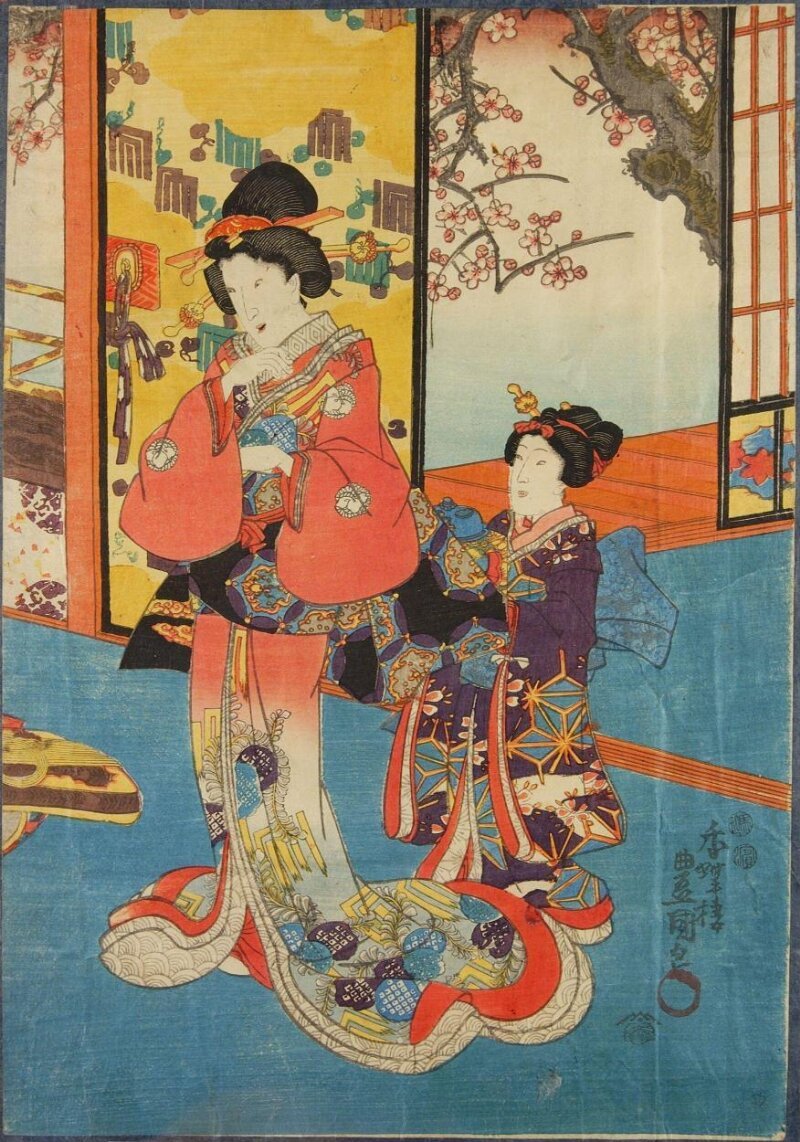
© Victoria and Albert Museum, London · Victoria and Albert Museum (V&A)
A triptych in an album
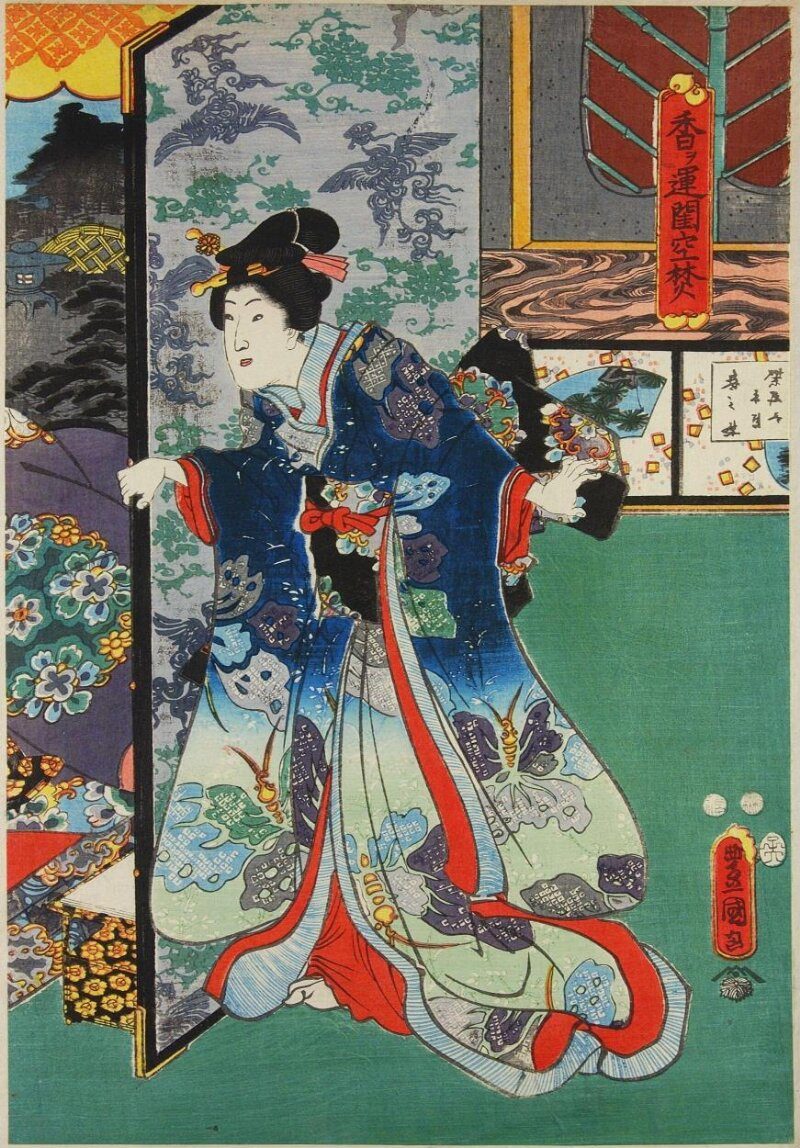
The work was printed in 1849 in Edo, today's Tokyo. It is a triptych, three sheets in ōban format, the large upright size common in ukiyo-e. Placed side by side, the sheets form one continuous scene. The technique is nishiki-e, full colour woodblock printing, with a separate block for each colour.
The triptych is now at the Victoria and Albert Museum in London. It belongs to an album of prints the museum bought and registered in 1879. Only thirty years after it was printed in Edo, it had reached Europe, at a time when Western collectors were hunting for Japanese prints.
The artist was Utagawa Kunisada, who lived from 1786 to 1865. By the time he made this set, he was one of the most published names in Edo, known for kabuki actors and beautiful women, and had taken his teacher's name, Toyokuni.
A title like a line of verse
The Japanese title is Ka ni sasou haru no tsumeoto. The museum renders it in English as the scent of spring bringing koto music.
Read slowly, it holds more. Ka is scent. Sasou is to invite, to lure, to lead. Haru is spring. Tsumeoto is the sound of the picks, the small plectra worn on the fingertips to pluck the strings of a koto. The title does not name the instrument as an object. It names the sound made when a finger meets a string.
So the whole phrase is a chain of motion: a scent invites, spring arrives, a finger plucks, a note sounds. There is no clear human subject. The scent acts first.
Ukiyo-e often carry titles like this, descriptive and playful at once, so that educated viewers could read several meanings. Here the game lies in joining two senses that painting cannot reach.
Two senses a print cannot show
A print has no smell and no sound. What Kunisada had were carved lines, areas of colour and the placing of figures across three sheets. Yet the work is named after two things outside its reach.
That was not unusual in Edo culture. Townspeople were used to reading images alongside poems, to seeing a branch of blossom and thinking of its smell, to seeing someone with an instrument and thinking of the music. The image was a starting point. The viewer brought the rest.
Spring scent in Japan is tied to plum blossom, an early flower that opens in the cold and is praised in poetry more for its smell than its colour. The title does not say which flower. Penta leaves that space open.
What is certain is that the title puts scent before sound. Smell opens, hearing follows. In a picture made only for the eye, that is a choice worth noticing.
Why the set stays with us
Kunisada produced thousands of prints. Most show actors, stage scenes and beautiful women. This set belongs to the third group, but its title sets it apart.
It shows that in mid nineteenth century Edo, scent was not only something used. It was a subject familiar enough to name a widely sold print, and refined enough to be paired with music.
Today the triptych rests in an album in London. No scent, no music. Only the title, still doing the job it was given in 1849: inviting the viewer to smell and hear for themselves.
Olfactory Art