
Essays · Olfactory Art
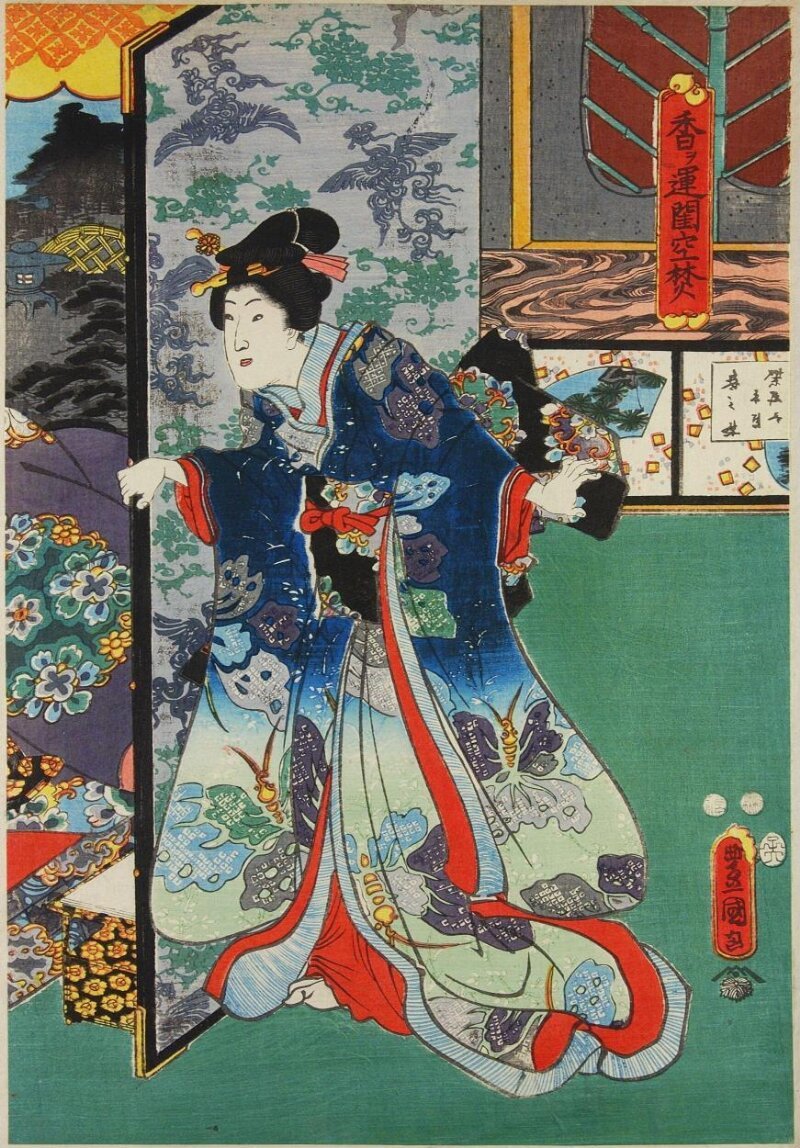
Utagawa Kunisada. Kō o hakobu neya karadaki.
A room made fragrant for someone who does not come.
© Victoria and Albert Museum, London · Victoria and Albert Museum (V&A)
A single sheet in an album
This sheet was printed in 1852 in Edo. It is the right hand sheet of a woodblock triptych in ōban format, printed in full colour as nishiki-e. The Victoria and Albert Museum in London keeps it in an album and records that the triptych is incomplete. The other two sheets are not with it.
The museum bought the album from the dealer S. M. Franck & Co. and registered it in 1886. Its description is brief: a figure standing beside a folding screen in an indoor setting.
The sheet is signed Toyokuni ga, drawn by Toyokuni. That was the name Utagawa Kunisada used in his later years, after taking on his teacher's title. The work's title sits in a red cartouche. Beside it are censors' seals, marks of the Edo publishing controls, showing that the print was cleared for sale.
Reading the title word by word
The Japanese title is Kō o hakobu neya karadaki. The museum translates it as heating incense in the bedroom in vain.
Taken apart, it tells a small story. Kō is incense. Hakobu is to carry, to bring. Neya is the bedroom, the private inner room. Karadaki is written with the character 空, meaning empty or hollow, and the character for burning. Incense is carried into the private room, and burns into emptiness.
The title does not say who waits for whom. It does not say why the other person stays away. It only sets two things side by side: a careful preparation, and a result of nothing.
In Edo culture, burning incense in a private room before a visitor arrived was a familiar gesture. It belonged to getting ready for a meeting, along with clothing, hair and lamplight. When the title adds 空, the gesture changes meaning. It is no longer preparation. It is waiting.
Screen, room, and a standing figure
The folding screen is a common object in ukiyo-e interiors. It divides space, hides part, reveals part. A figure beside a screen stands on a border between the seen and the hidden.
Scent does not respect that border. A screen can block the eye, not the smoke. Incense lit in one corner travels through the room, through gaps and paper, out into the corridor. Perhaps that is why incense suits waiting so well: it goes out to look for someone while the one who waits must stay still.
Penta does not guess at what the sheet does not say. No face of the awaited one, no reason, no ending. There is one figure, one screen, one room, and the title above them. The scent says the rest.
Why the sheet stays with us
Images of scent usually show the moment it is received. This sheet does the opposite. It shows a scent no one receives.
It suggests that scent in Edo carried an emotional language clear enough for a short title to tell a whole situation. A buyer in 1852 read the word karadaki and understood at once what was happening.
Today the sheet is still waiting, in another sense. It waits for the other two sheets of its triptych. A figure beside a screen, in a scene that was never complete.
Olfactory Art