
Essays · Olfactory Art
Japan, Edo period. Ten-round incense game set.
A bride brings a game for the nose.
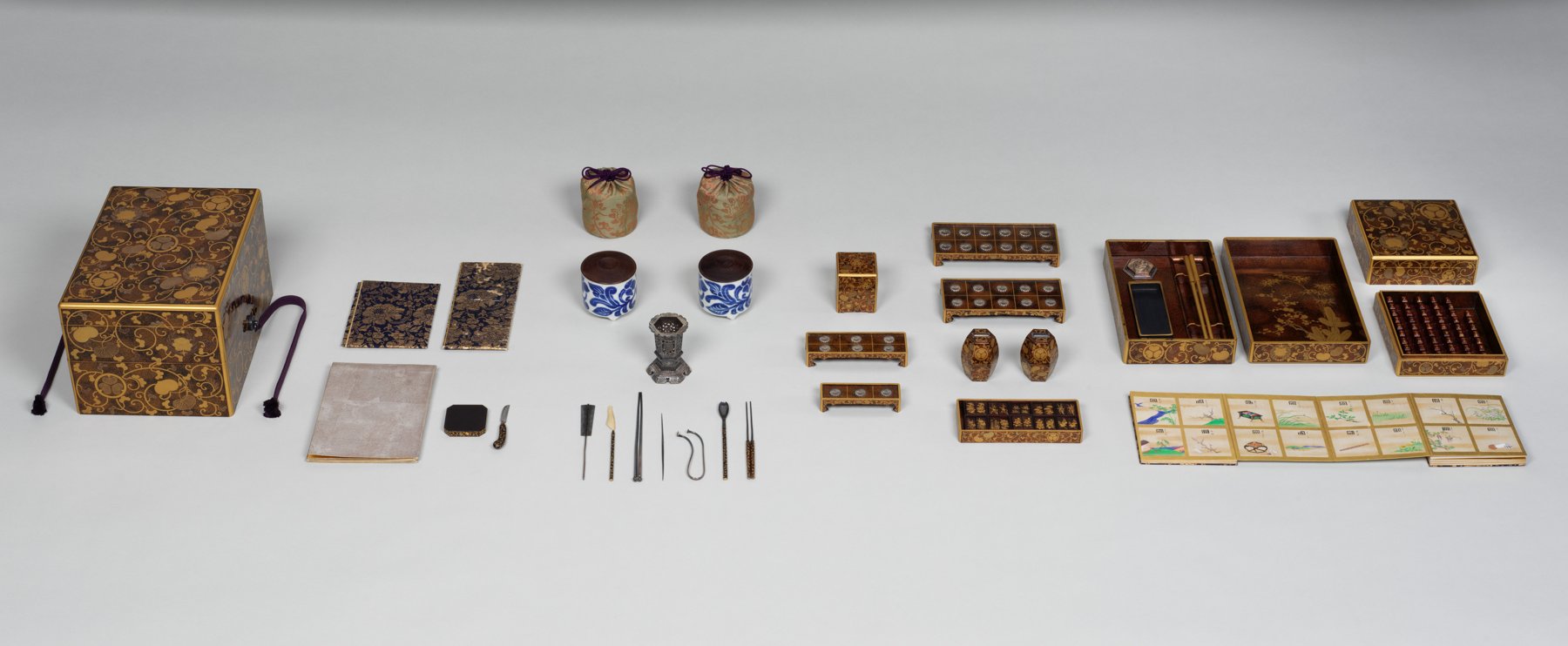
The Metropolitan Museum of Art, Purchase, Bequests of Mary Clark Thompson and John D. Rockefeller Jr., by exchange, 2021 (Open Access, public domain) · The Metropolitan Museum of Art
A box in a dowry
In 2021 The Metropolitan Museum of Art in New York acquired a Japanese incense game set made in 1856. The museum's title is long: a ten-round incense game set with arabesque foliage and family crests. The storage box is about 17.6 cm high, 21.4 cm wide and 26.7 cm deep.
The material is lacquered wood. On a nashiji ground, lacquer scattered with fine gold flecks that the Japanese liken to pear skin, the design is worked in hiramaki-e: gold and silver powder sprinkled onto wet lacquer to make flat, bright, smooth images.
Inside is everything needed to play. According to the museum the set is complete, down to a folding album for Genji-kō, another guessing game named after the chapters of The Tale of Genji.
What makes this set special is not only its craft. It is its owner. It belonged to Atsu-hime, and the year it was made is the year she entered Edo Castle.
Atsu-hime and a political marriage
Atsu-hime was born in 1836 and first named Okatsu. She was a daughter of Shimazu Tadatake, of the Shimazu house that ruled Satsuma in the far south of Kyushu. As the museum's account records, she soon moved to Kyoto, and in 1855 to the Shimazu mansion in Edo.
In the eleventh month of 1856 she entered Edo Castle as wife of the thirteenth Tokugawa shogun, Iesada. Iesada died in 1858, less than two years later. Atsu-hime lived until 1883.
For The Met, the game set is a symbol of a very important political alliance between the Tokugawa and the Shimazu. One held the shogunate in Edo. The other ruled one of the most powerful domains in the south.
In a marriage like this, dowry objects were not just things to use. They were statements. Gold and silver lacquer, crests on the lid, a set complete to the last piece: all told the shogun's court that the bride came from a house of standing.
A game of ten rounds
Jisshukō means ten incenses, or ten rounds of incense. The Met calls it one of the earliest incense games. It uses four different fragrant woods. Three are introduced first and passed around in a trial round so that everyone can learn them. The fourth is kept back.
After the trial, the real rounds begin. Players cannot look, only smell. Each round they must decide which of the three known scents it is, or whether it is the stranger never introduced.
In the Japanese way of incense this is not called smelling but listening. The player lifts a small burner close, falls still, and lets the scent speak. A sliver of wood is warmed over hot ash, not burned into smoke, so the scent rises slowly and cleanly.
The game asks for two things: a fine nose and a good memory. No formula, nothing to look at. Only scent, and the short time between one breath and the next.
Why a game box matters
Today it may seem odd that a guessing game for the nose belonged in the dowry of a marriage of state. But among Edo period aristocrats and samurai, incense stood beside tea and poetry. To know incense was to know manners, literature and stillness.
A woman entering the shogun's inner palace with this set brought a whole cultural capital with her. An incense gathering was a place to meet, to show refinement, to belong.
The box is now in New York, far from Satsuma and from Edo. The fragrant wood inside was probably used up long ago, or lost its scent. What remains are tools, crests, and a date: 1856, the year a young woman entered the castle.
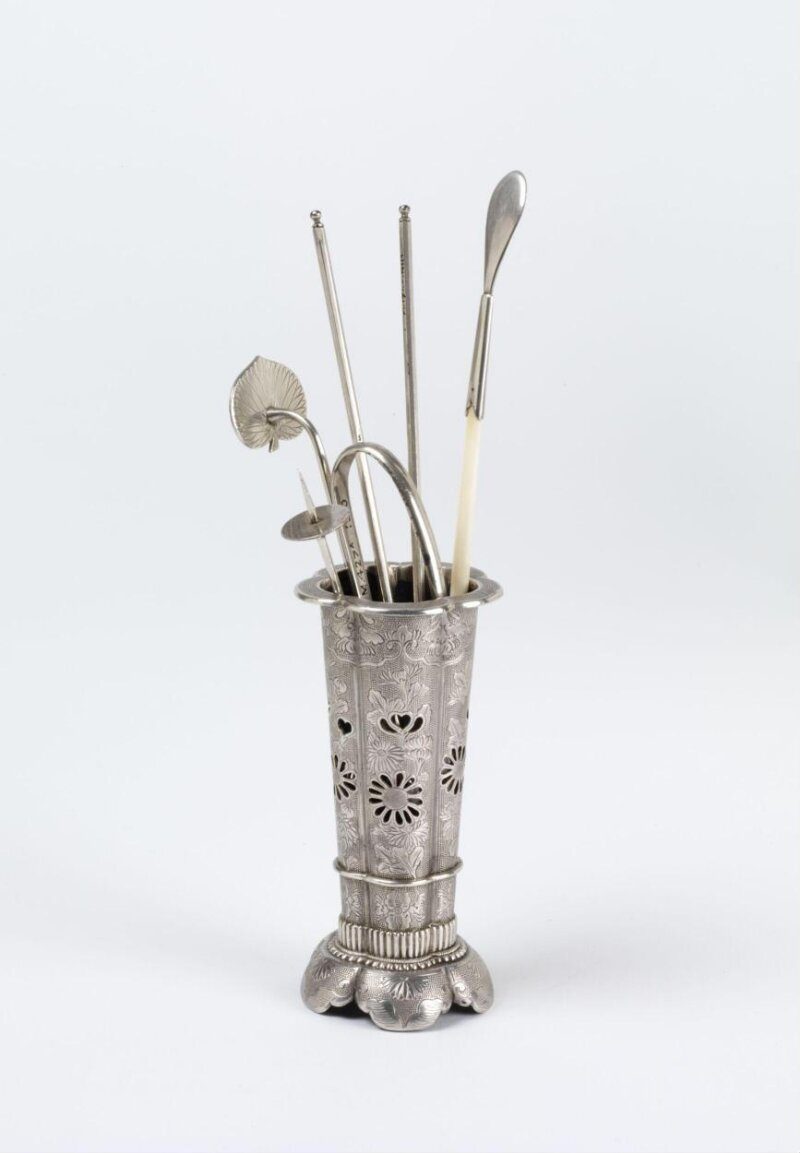
In London, another Edo period incense game set sits at the V&A, complete down to its ivory counters. Seen side by side, the two show how much this game was loved.
Olfactory Art