
Essays · Olfactory Art
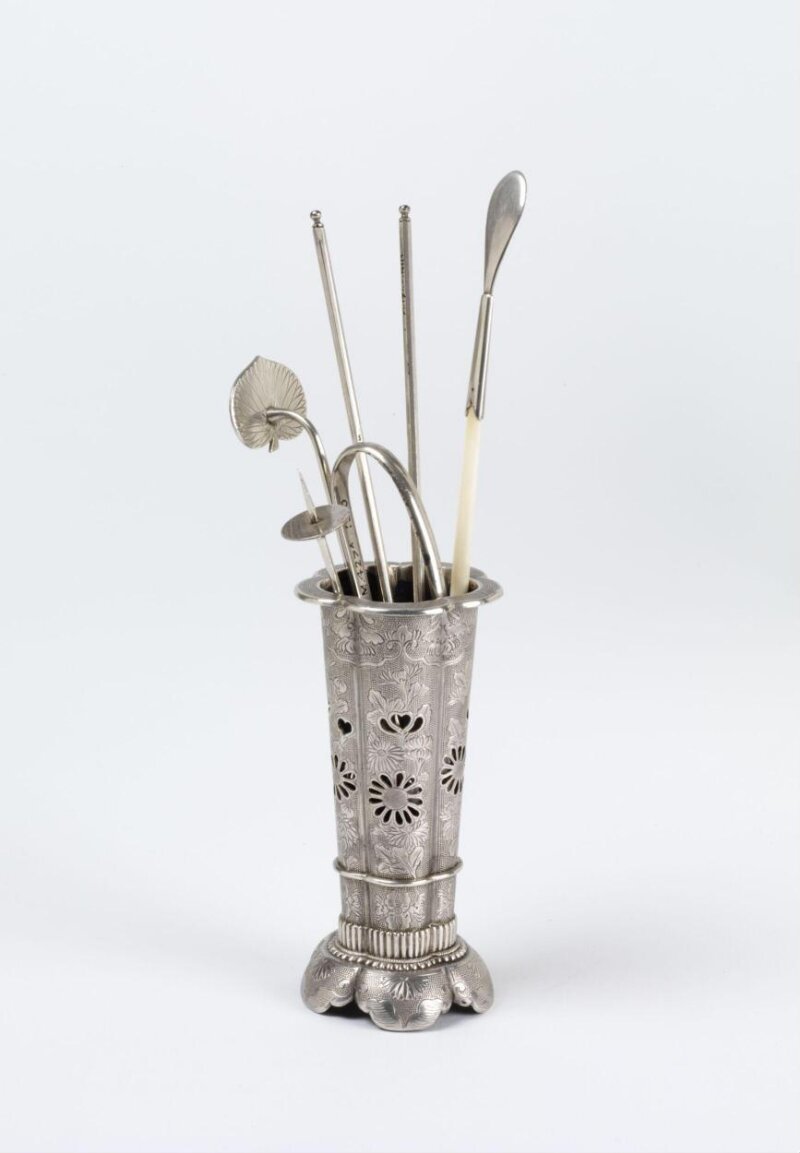
Tomoharu. Set of incense utensils.
Each utensil is a gesture kept in metal.
© Victoria and Albert Museum, London · Victoria and Albert Museum (V&A)
Seven pieces in a silver holder
The set belongs to the Victoria and Albert Museum in London, museum number M.427-1910. The record gives the maker as Tomoharu, the place as Japan, and the date as roughly 1700 to 1850. The material is silver, with ivory handles.
There are seven parts. Two incense chopsticks. An ash arranger. A spike. A spatula. A pair of tongs. And a holder for all of them. The holder is silver, pierced and engraved with flowers, 87 mm high and 43 mm across.
The whole set fits in one hand. It is smaller than a teacup. The pieces stand upright in the holder, ivory handles up, like a bundle of dry twigs.
The museum's description is brief: utensils for the incense game, tongs, spatula, ash arranger, incense chopsticks and a spike, held in a silver container with pierced and engraved flowers. Nothing about who used it, where, or how often.
Listening, not burning
To see why seven pieces are needed, it helps to know how incense is enjoyed in kōdō, the Japanese way of incense. There the wood is not burned into smoke. A small piece of charcoal is buried in the ash of an incense cup. The ash is heaped and shaped. On top sits a thin plate of mica, and on the mica a sliver of fragrant wood, often aloeswood.
Heat travels from ember, through ash, through mica, to wood. The wood warms slowly and gives off its smell without burning. Guests lift the cup toward the face one after another. And instead of saying they smell the incense, they say they listen to it.
In incense games, players listen to several pieces in turn and guess which ones match. Nobody sees the names of the woods. There is only smell, and the memory of the smell that just passed.
Every step asks for a precise gesture. The ash must be smoothed so the heat rises evenly. The mica must sit in the right place. A sliver of wood the size of a grain of rice must be lifted without falling. The set answers each of those demands. The V&A record lists the pieces by name but not when each is used. Still, the names show how they divide the work of the hand: pick up, scoop, smooth, pin.
Tomoharu, and what was not written down
Of the maker, the museum keeps only a name: Tomoharu. No dates, no workshop, no city. The date range given for the set spans a century and a half. That is how a museum honestly says it does not know.
The set's history also fits in one line. In 1910 the museum bought it from Mr Hogitaro Inada. This was checked again in a 2022 provenance research project based on the Asia Department registers. Today the set is on display in Room 45, the Toshiba Gallery, where the V&A shows Japanese art.
So here is an object whose maker is nearly anonymous, whose users are entirely anonymous, and whose smells vanished long ago. What remains intact is the shape of the gestures. The length of the chopsticks tells the distance between hand and heat. The flatness of the spatula tells how small the wood was. The pierced flowers on the holder say it was meant to be looked at even when idle.
The set is worth remembering because it says something rarely said: scent needs a way of being handled. Not every smell simply arrives. Some must be prepared with seven pieces of silver, with ash pressed smooth, with a hand that knows when to step back.
Olfactory Art