
Essays · Olfactory Art
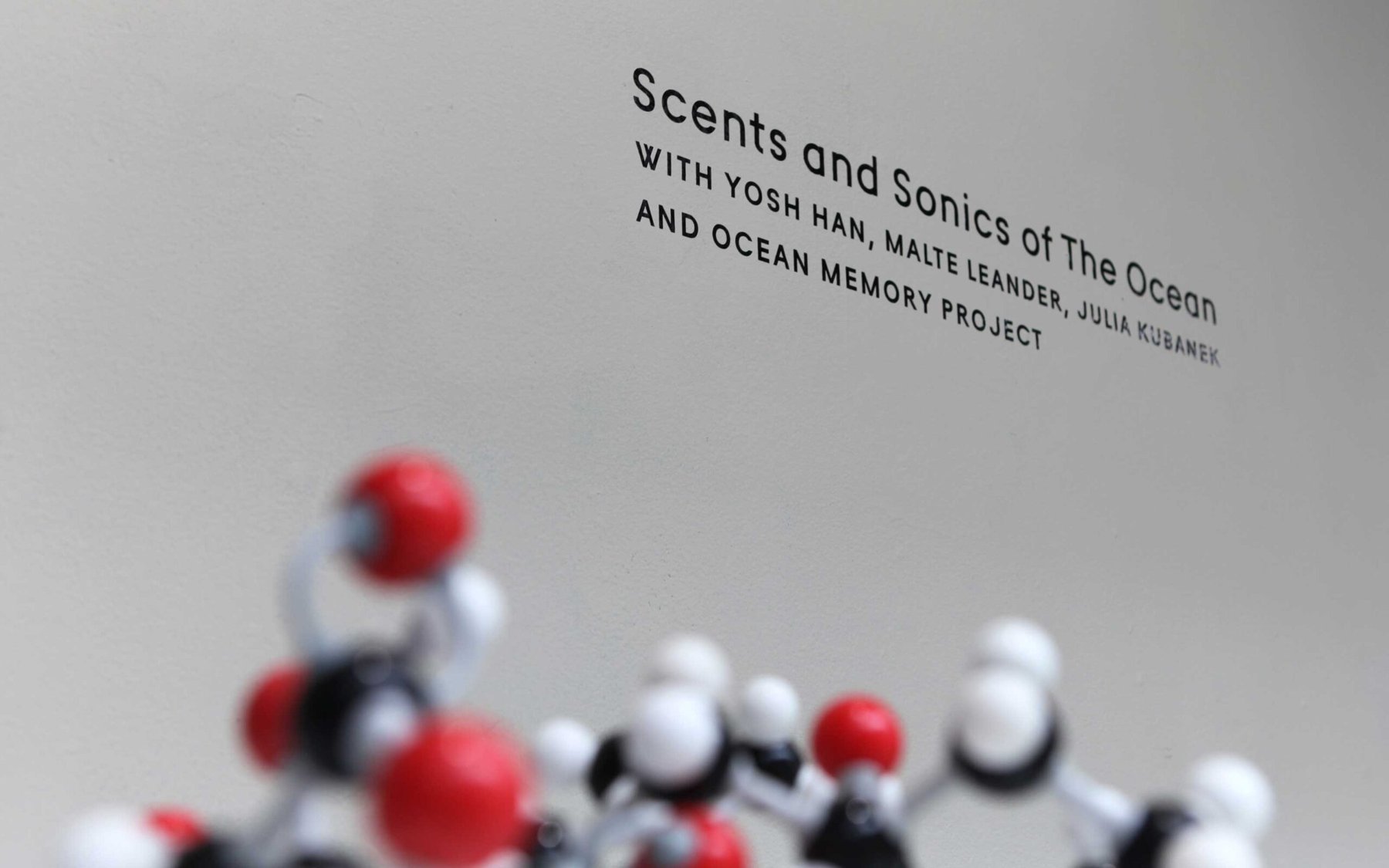
Scents and Sonics of The Ocean.
A scent molecule can also be heard.
Institute for Art and Olfaction · Institute for Art and Olfaction
Four parties, one island
Scents and Sonics of The Ocean opened at IAO Gallery, the space of the Institute for Art and Olfaction in Chinatown, Los Angeles, from 20 January to 2 February 2024. Its full title is longer: multisensorial traces of lost and recovered memories of Sapelo Island.
Sapelo is a barrier island off the coast of Georgia, on the American east coast. Four parties worked on it together.
Yosh Han is a perfumer, founder of the YOSH line, with close to three decades in the flavour and scent industry. She is also a licensed captain with the US Coast Guard. Malte Leander is a sound artist and composer based in Montréal, working with musique concrète and soundscape, often on ecological themes. Julia Kubanek is a professor at the Georgia Institute of Technology who studies how marine organisms use chemical signals to communicate, find habitat, find mates and avoid predators.
The fourth is the Ocean Memory Project, a network of more than a hundred researchers across oceanography, neuroscience, visual art, theatre, history and philosophy. The idea of ocean memory emerged in 2016 at a transdisciplinary conference of the US National Academies. The Los Angeles project was funded through the Academies' Keck Futures Initiative.
From molecule to sound
The method is a chain of translations. The smells of the island are traced to specific molecules. Each molecule has a spectroscopic signature: the way its chemical structure responds to light in a spectrometer. That signature is a band of data with peaks, troughs and rhythm.
Leander used those bands as material for soundscapes. Not waves recorded on the beach, not birdsong. Sound generated from the shape of the scent molecule itself.
In the room, smell and sound are present together. A visitor smells something and hears its translation at once. The two senses are not placed side by side to illustrate each other, but to point to a single source: an island most visitors in Los Angeles have never seen.
Within the same project, Yosh Han developed a smell walk, recorded as a podcast of about fourteen minutes. The format borrows from the soundwalk that composer R. Murray Schafer developed in the 1970s.
Memory lost and recovered
The word memory in the title is not only a metaphor. Sapelo shows traces of human life from more than four thousand years ago. In the early nineteenth century, enslaved Black people were brought to the island by force to farm sugar cane and other crops. After the Civil War, Black residents founded settlements around the island and helped shape the Gullah Geechee culture of the lowcountry.
Today very few people from that community still live on the island full time. Much has gone: houses, land, habits, the smells of a life that once was.
Set beside that history, the question of ocean memory becomes concrete. What does the sea keep? Salt marshes, tides, organisms that read one another through chemistry. Kubanek studies exactly this kind of memory: the chemical signals marine life leaves for itself, a language far older than ours.
The exhibition does not retell the history in words. It places visitors in a room of smell and sound, and lets them make the connection.
Why it stays
Many scent works deal with personal memory: a grandmother's house, one summer. Scents and Sonics deals with something larger and slower. The memory of a body of water, an island, a community shrinking over time.
What stays is how the group refused a shortcut. They did not record waves and spray a sea smell over them. They went through molecules, spectra, data. Science here proves nothing. It is a bridge between two senses that rarely speak to each other.
Others have moved in this direction, rebuilding a forest from data, as Refik Anadol did in Machine Dreams: Rainforest. But at Sapelo the data does not move toward images. It moves toward the nose and the ear.
Leaving the room, visitors do not carry an image. They carry a smell and a sound, two traces of the same place.
Olfactory Art