
Essays · Olfactory Art
Unknown maker, Italy. Pomander.
A silver apple. Scent inside, words around it.
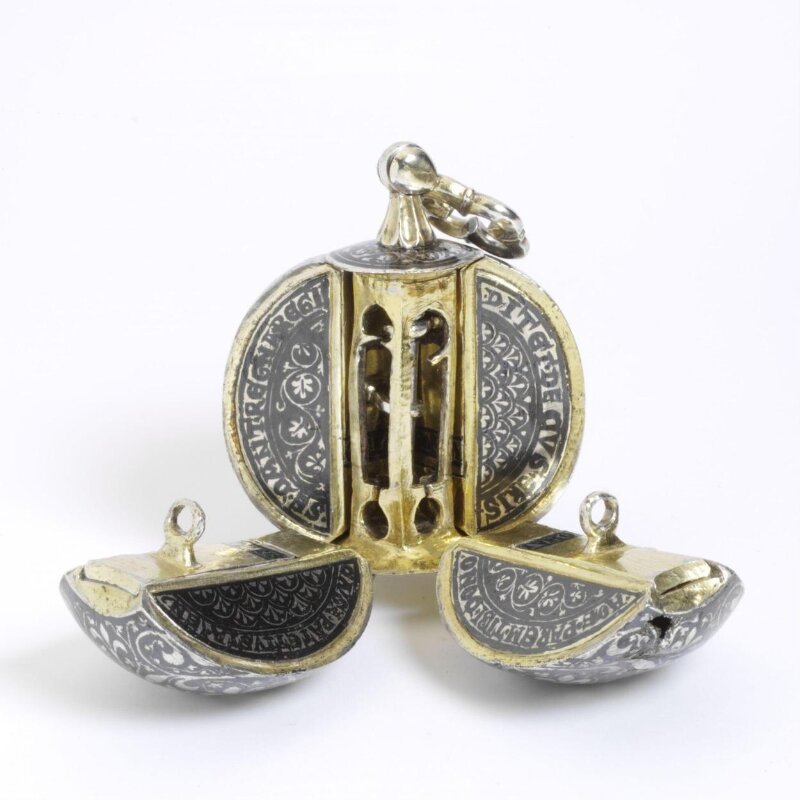
© Victoria and Albert Museum, London; Bequeathed by Francis Reubell Bryan · Victoria and Albert Museum (V&A)
An apple that opens
It is 6.5 cm tall and 4 cm wide. It fits in a palm. It is shaped like an apple, made of silver, partly gilded, and inlaid with niello, a black metallic compound filling the engraved lines so the pattern stands out against the silver.
The body divides into four segments, held by a pin with a screw at the top, fixed to an octagonal gadrooned head. On that head a quatrefoil handle is hinged. Unscrew the pin and the four segments open like the skin of a fruit.
According to the Victoria and Albert Museum, each segment originally held spices or perfumes. The pomander hung from a long belt or girdle circling the waist or hips. Inside and out, it is covered with scrolling foliage and geometric patterns.
Imagine it in use. The wearer unscrews the pin, opens a segment, puts in a pinch of dry spice or a little scented paste, and closes it. The smell probably escaped through the seams between the segments. It sits at hand height, close enough to lift to the nose, far enough that no one has to lean in. Small as it is, it has a hinge, a screw, a handle: it was made to be opened and closed many times.
The museum records it as made in Italy around 1350. The maker is unknown.
Four figures, one apple
What sets this pomander apart is its words. On the cover of each segment is a name: Juno, Venus, Pallas, Paris. Around each edge runs a line of Latin.
It is the Judgment of Paris. In the myth, the Trojan prince must give a golden apple to the most beautiful of three goddesses, and each offers him something. In the museum's translation, Juno promises a spouse, Venus promises delight, Pallas, that is Minerva, promises kingdoms. The last segment belongs to Paris, and its words choose Venus.
In the story, that choice sets the Trojan War in motion. On a scent case worn at the waist, it likely meant something else: a choice, a declaration. The apple of the myth and the silver apple in the hand become one.
The word pomander itself leads back to an apple. It comes from the Latin for an apple of ambergris. Here shape, story and name are all apples.
A girdle as a promise
The museum places the pomander in the context of medieval girdles. Romantic inscriptions and images on girdles show they were sometimes courtship or marriage gifts. Medieval Jewish weddings included a formal exchange of girdles between spouses, and Czech bridegrooms around 1500 are recorded giving girdles to their brides.
A scent case hanging from such a girdle may therefore also have been a gift of love. The museum says "may". There is no name of giver or receiver.
The object passed through several English collections. It was shown in Leeds in 1868, sold twice at Christie's, in 1884 and 1925, and bought by the V&A with funds from the Francis Reubell Bryan bequest. More recently it appeared in the catalogue of A Feast for the Senses at the Walters Art Museum in 2016, an exhibition on the senses in medieval art.
In another essay Penta reads a seventeenth century pomander with six chambers and a vinaigrette, where scent was treated as a shield. This Italian one is three centuries older and says something else. Scent here is close to the body in a more private way: it travels with a vow.
Olfactory Art