
Essays · Olfactory Art
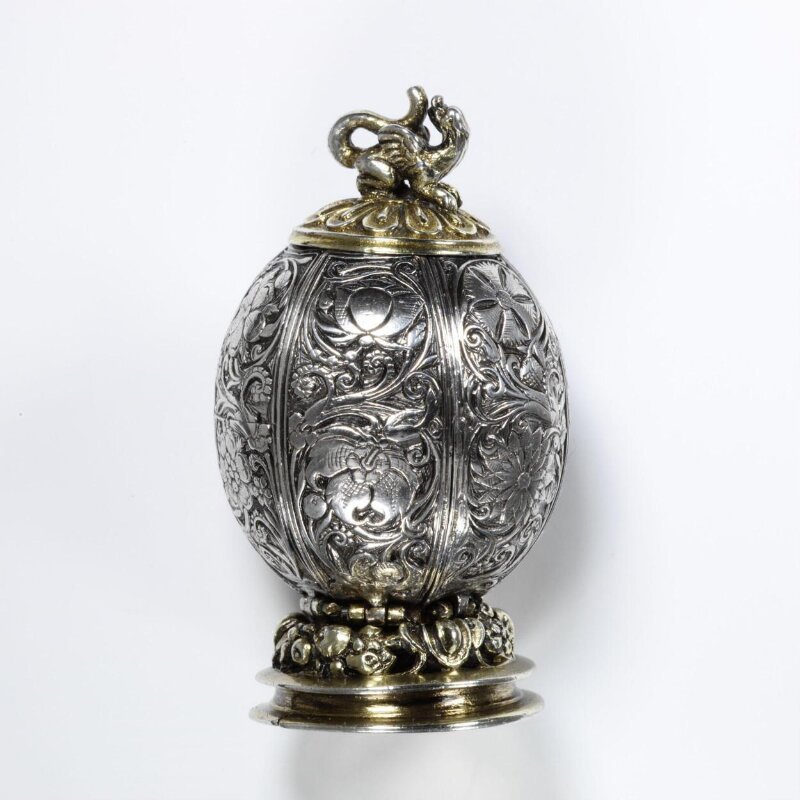
Unknown maker, Europe. Pomander and vinaigrette.
Six chambers, six scents. None allowed to touch another.
© Victoria and Albert Museum, London; Given by the Misses Dagmar and Gladys Farrant in memory of Arthur Maud Loscombe Wallis · Victoria and Albert Museum (V&A)
A sphere with six chambers
The object stands 6.7 cm from foot to finial. It is silver and gilt silver, engraved with flowers and arabesques, and topped by a suspension loop in the form of a dragon.
Turn a decorative knop and six segments hinge outwards around a central shaft, opening like petals. Each segment is a separate chamber, numbered 1 to 6 at the top near the loop. The shaft is numbered 1 to 6 to match, engraved with scrolling foliage and gilded.
Each chamber was originally sealed with a sliding lid. Two survive. They are numbered too, and each carries an engraved scroll, left blank, waiting for the name of the substance to be stored inside.
The Victoria and Albert Museum records it as made in western Europe between 1600 and 1650, maker unknown. It was given by the Misses Dagmar and Gladys Farrant in memory of Arthur Maud Loscombe Wallis.
The apple of ambergris
The English word pomander comes from the Latin pomum de ambre, apple of ambergris. According to the museum it was in use in England from the 1490s. A pomander was a mixture of fragrant substances kept in a case of gold, silver, ivory or wood, worn at the neck or the waist.
People then believed that carrying one protected them from disease. It was the belief of an age that thought illness travelled in foul air. Scent was not only pleasant; it was a thin wall between the body and the city. The habit was older still: the museum notes that the ancient Romans carried aromatic blends in small perforated boxes.
Each spice was assigned its own purpose, so they had to be kept apart. Hence six chambers. On pomanders of this kind, the museum notes, compartments were engraved with the names of their contents: rosemary, cinnamon, cloves, nutmeg, ambergris.
The engraved flowers and the dragon, in the museum's reading, evoke both the scent and the power attributed to the ingredients. A design with so many joints and chambers needed a highly skilled silversmith.
A base that held vinegar
The lower half is a different object. The base unscrews from the sphere and itself opens in two halves. Its underside is gilded and pierced. This is the vinaigrette.
The museum says it once held balsam, or a small sponge soaked in oils of mint, camphor, cloves and lavender mixed with vinegar. The sharp smell escaped through the holes. The name vinaigrette comes from that vinegar.
So a thing not seven centimetres tall holds two ways of keeping scent. Above, dry spices in numbered, lidded chambers. Below, something wet, sharp, quick to rise, for reviving oneself.
The pomander appeared in the catalogue of the Samuel Pepys exhibition at the National Maritime Museum, Greenwich, in 2015, alongside the story of plague in London. It is jewellery, and also a way of living with fear in the air.
In another essay Penta reads an apple shaped Italian pomander from around 1350, with only four segments and a love story engraved inside. Side by side, the two show how scent worn on the body changed meaning over three centuries: from a promise to a shield.
Olfactory Art