
Essays · Olfactory Art
Chelsea Porcelain Manufactory. Perfume vase.
A vase that holds no water, only the scent of dried flowers.
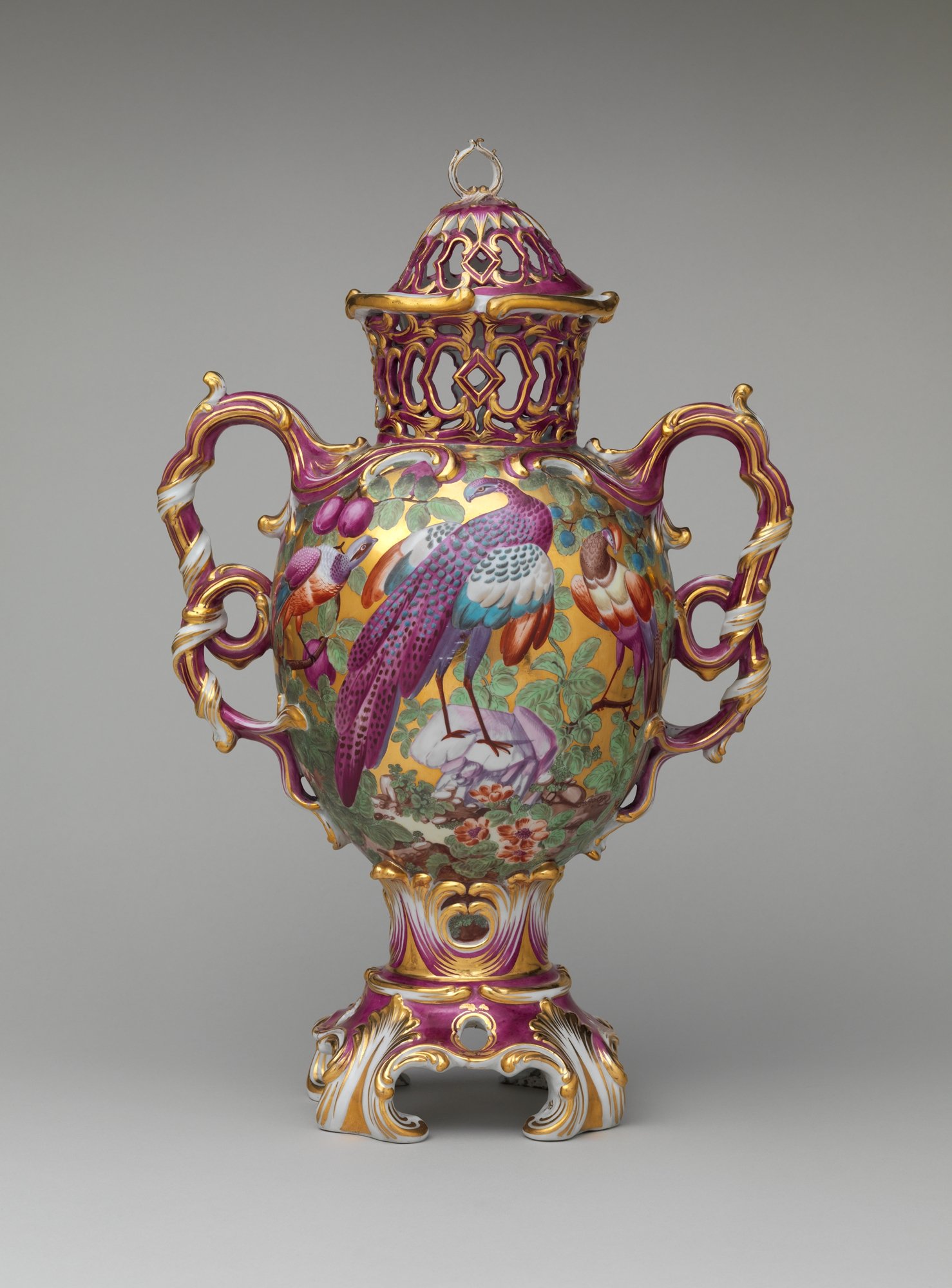
The Metropolitan Museum of Art, Gift of Irwin Untermyer, 1964 (Open Access, public domain) · The Metropolitan Museum of Art
A vase on the chimneypiece
The vase was made at the Chelsea porcelain manufactory in London around 1761. According to The Metropolitan Museum of Art in New York, where it is kept, it is soft paste porcelain, 43.2 cm high, 29.2 cm wide, 17.8 cm deep, weighing nearly 2.9 kg. It has two parts, body and cover, numbered separately in the museum's records.
The museum calls it a perfume vase. Eighteenth century England also called such vessels essence pots or pot pourri vases. They were usually set on the chimneypiece and filled with a mixture of fragrant dried petals and leaves. The cover kept the scent in, or let it out slowly.
The museum tags the vase with the keyword birds. Birds, flowers and branches were familiar images on European porcelain of the time. On a vase for dried flowers, they read like a reminder of the garden the petals had left.
The vase was a gift from the collector Irwin Untermyer in 1964. It is on view in gallery 512 at the Met.
Soft paste and the Gold Anchor years
The Chelsea manufactory worked in London from 1745 to 1784. It was one of England's first porcelain factories, founded while Europe was still trying to make the hard porcelain it imported by sea from China and Japan.
The English did not yet have the hard paste recipe. They made soft paste, fired at lower temperatures from clay mixed with other materials, including bone ash in some periods. Soft paste was riskier in the kiln, but its surface was gentle and took enamel colours beautifully.
The vase belongs to what scholars call the Gold Anchor period, 1759 to 1769, named after the small anchor mark painted in gold that the factory used then. These were Chelsea's most elaborate years, with deep ground colours, polychrome enamels and gilding.
A Gold Anchor perfume vase was not an everyday object. It was for display, placed where guests would see it first.
Scent in the Georgian house
Pot pourri in French literally means rotten pot, or steeping pot. The name sounds odd, but it describes the method: petals, fragrant leaves, peel and spice were steeped and dried slowly, sometimes with salt, then placed in the vase. They kept their smell long after losing their colour.
An English house of the eighteenth century did not smell pleasant by default. There was coal smoke, candle smoke, the damp of stone and cloth. A pot pourri vase was a way to adjust the air of a room, quietly, without fire.
What stands out is that scent here was designed together with the furniture. The vase had to suit the fireplace, the mirror, the other porcelain on the mantel. Its beauty was for looking; its work was for smelling. Both belonged to the arrangement of a room.
Scent was not an afterthought. It was considered from the moment a house was furnished.
Why the vase matters
Today the vase is empty. No petals inside, no scent rising from the cover. Visitors at the Met see porcelain, enamel, gold, birds. But its name keeps its old function. It is a perfume vase, though it has long held no perfume.
It reminds us that the history of scent is not only in bottles worn on the body. It is also in objects standing still in a house, working all day, unnoticed. The smell of a room was chosen too, placed in objects, put on display.
In the same years in London, another factory made porcelain scent bottles far smaller, to hold in the hand and carry, such as Charles Gouyn's scent bottle. One is scent for a body, the other scent for a room. The Chelsea vase belongs to the second: tall, heavy, still, waiting for someone to walk in.
Olfactory Art