
Essays · Olfactory Art
Charles Gouyn. Scent Bottle.
A little scent, wrapped like a jewel.
© Victoria and Albert Museum, London · Victoria and Albert Museum (V&A)
A girl under 9 cm tall
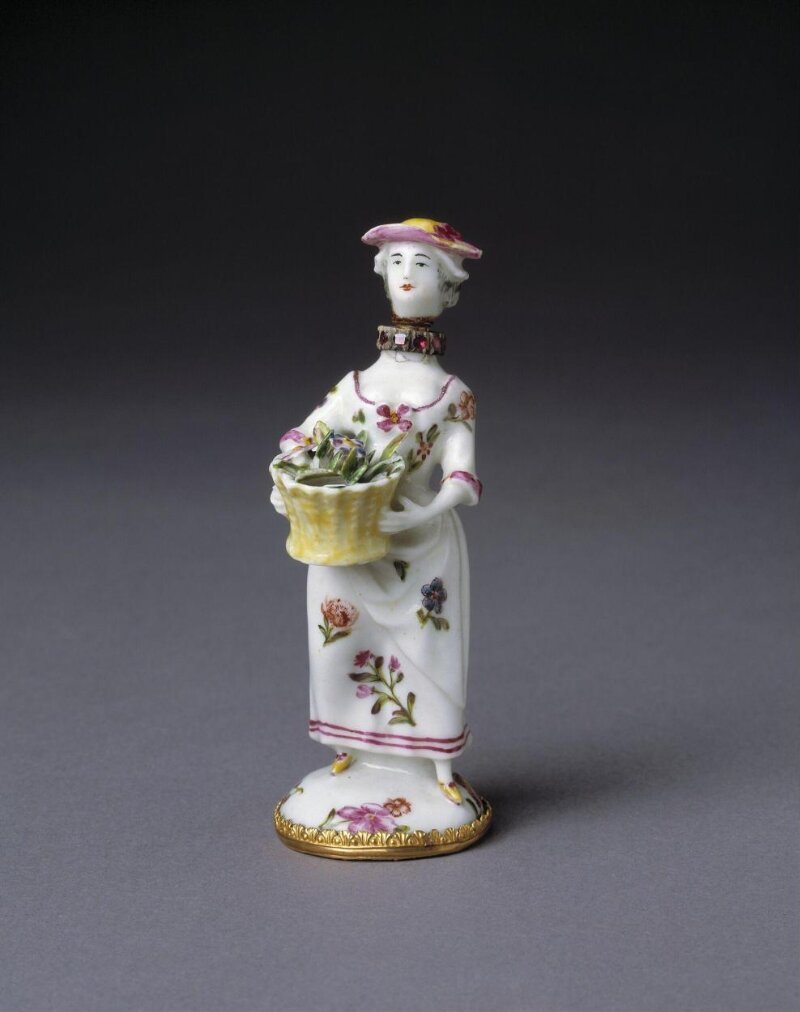
The bottle is in the British Galleries of the Victoria and Albert Museum in London. It is 8.57 cm tall and about 3 cm wide, made of soft paste porcelain, painted in enamels, with gilt metal mounts set with stones. The museum dates it to about 1749 to 1760, made in London.
It takes the form of a woman carrying a basket of flowers. Her body is the body of the bottle. The gilt metal holds the stopper and frames the edge, small stones catching the light. According to the V&A, it held scented liquid for one person's own use.
Its size tells us how it was used. This is not a large bottle left in one place. It is small enough to sit in the palm, to be carried, to be taken out in the middle of a gathering.
A jeweller who made porcelain
Charles Gouyn was a jeweller, second generation of a French Huguenot family living in London. According to the V&A, after his involvement with the Chelsea porcelain works he ran his own factory in St James's. This bottle was made there.
Collectors later came to call Gouyn's factory Girl in a Swing, after a small porcelain figure of a girl on a swing thought to share its origin. The name sounds like a story, but it is really a label standing in for what is still unclear.
The jeweller's trade explains much about the bottle. The gilt metal set with stones is the language of jewellery. The small size, the care in each detail, the way the object is made to be seen up close: all of it comes from someone used to making things worn on the body.
Making a thin porcelain body
The V&A describes the making in some detail. A model was first shaped in wax. From the wax, a lead model was cast. From the lead, plaster moulds were made. Three steps just to get a mould.
Then a mixture of clay and water was poured into the hollow mould. The plaster drew out the water, leaving a thin layer of porcelain on the inside. When it was thick enough, the rest was poured out. What remained was a hollow, thin walled body in the exact shape of the first model.
Thin walls were essential. A scent bottle must be hollow to hold, light to carry. The body was then fired, painted, fired again, and only then fitted with metal. Every step was a chance to fail. So small an object passed through many hands.
Why these toys stay with us
According to the V&A, small decorative objects like this were called toys in the 18th century. They were exported in large numbers to continental Europe and formed a real part of the luxury trade.
The word toy is worth pausing on. It does not mean a child's plaything. It means small, lovely, unnecessary things, made to please the eye and to be shown. Scent sat right in that group. It was packaged like a snuffbox, a seal, a little pocket case.
This shows that 18th century scent was not only a matter for the nose. It was a matter for the hand, the eye, one's place in society. Elsewhere in the world, scent was also placed in precious vessels to offer guests, like the gold Indian attardan. Two very different objects, one idea: scent deserves a beautiful shell.
Olfactory Art