
Essays · Olfactory Art
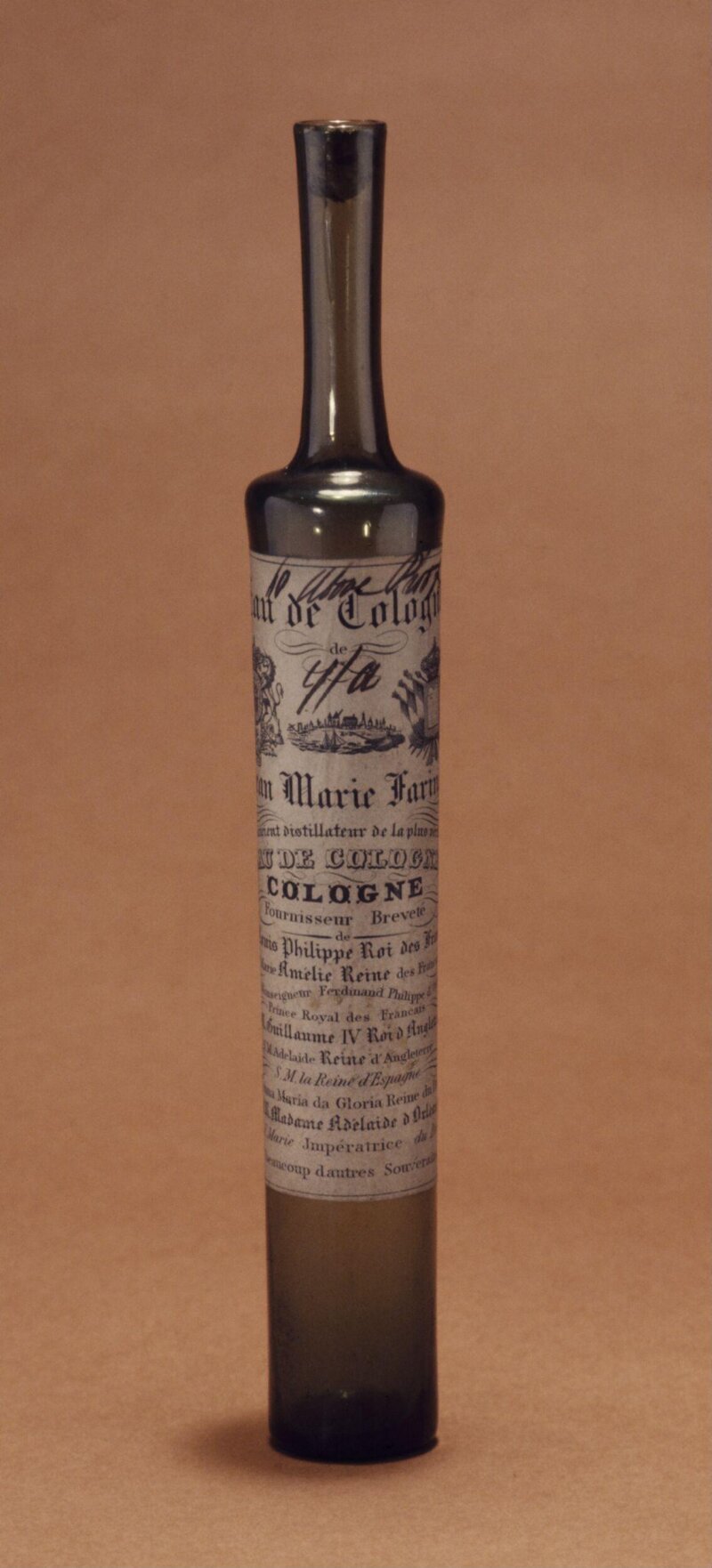
Jean Marie Farina. Eau de Cologne Bottle.
The scent has gone. The promise on the label remains.
© Victoria and Albert Museum, London · Victoria and Albert Museum (V&A)
A glass bottle and a scrap of paper
The bottle belongs to the Ceramics Collection of the Victoria and Albert Museum in London. It is 24.5 cm tall, made of glass, and still carries its original printed paper label. The museum dates it to about 1825 to 1850, made in Germany or France.
Its shape is plain. Tall, straight, undecorated. What makes it worth keeping is the label. Most old perfume bottles have lost theirs, since paper absorbs moisture, glue fails, and edges tear over the years. This one did not.
The V&A lists Jean Marie Farina as the retailer. The name on the label, then, does not tell us who blew the glass. It tells us who stood behind the liquid inside, and who answered for it to the buyer.
A visitor at the case therefore looks at the words more than at the glass. The bottle is only the ground. The paper is what tells the story.
The oldest distiller
The label is printed in French. Its main line names the product as the Eau de Cologne of Jean Marie Farina, and calls its maker the oldest distiller of the truest Eau de Cologne. Further lines mention royal patrons.
It is a claim, not a description. It says nothing of how the scent smells. It speaks of age, of authenticity, of the eminent people who chose it. The buyer is invited to trust the name before opening the bottle.
Such wording says something about the market of the time. When someone must declare themselves the truest and the oldest, it is usually because others are saying the same. Eau de Cologne, literally water of Cologne, is tied to the Farina family, of Italian origin, working in the city of Cologne from the early 18th century. By the 19th century the Farina name appeared on a great many labels, each wanting to be believed as the original.
One of the first scent brands
Before the word brand, there were names used as brands. Farina is an early European example. A family name became a guarantee for a scent. A city became the name of a whole kind of perfume.
Eau de Cologne is a light, fresh water, led by citrus and herbs. It was widely used, not only by the elite. Because it was common, it was easy to copy. Because it was easy to copy, the paper label mattered.
The label on the V&A bottle is a tool of trust. Print, a proper name, a list of eminent users. It does the work that logos, packaging and certificates do together today, only folded onto one small piece of paper.
Why this small bottle stays with us
The history of scent is usually told through beautiful bottles. The Farina bottle is not beautiful in that sense. It matters because it kept the most perishable part: the seller's words.
Looking at it, we see that scent has always needed words. A scent cannot prove its own origin. The nose alone cannot tell the real from the copy, especially when the two are close. So the name must carry that burden.
Decades later, some bottles carried the scent's name and the perfume house's name moulded into the glass itself, like the Cyclamen bottle Lalique made for Coty in 1909. The words were no longer glued on the outside but held in the material. The need was the same, though, and its beginning may lie in scraps like this one, glued to a plain glass bottle, surviving nearly two hundred years.
Olfactory Art