
Essays · Olfactory Art
René Lalique for Coty. Cyclamen.
Two names on one skin of glass.
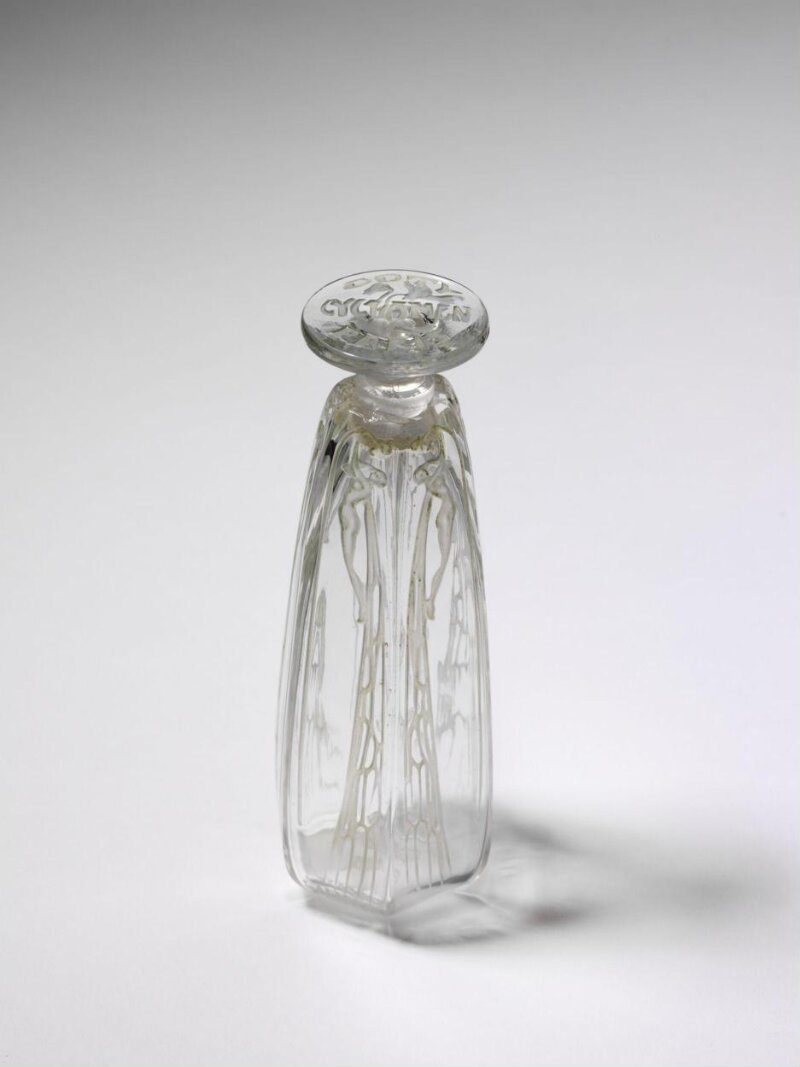
© Victoria and Albert Museum, London; Sir Claude Phillips Bequest · Victoria and Albert Museum (V&A)
A bottle 14 cm tall
Cyclamen is a scent bottle designed by René Lalique in 1909 for the perfume house Coty. It stands 14 cm tall, made of press moulded and mould blown glass, its surface patinated so that the relief reads clearly in the light.
The bottle in the Victoria and Albert Museum in London was made at the Combs la Ville glassworks in Seine et Marne, France. It entered the museum in 1924 through the bequest of Sir Claude Phillips and is shown in the museum's Glass gallery.
The museum records three lines moulded into the glass: Coty Paris, Lalique Deposé, and Cyclamen Coty Paris. The name of the scent, the name of the perfume house, the name of the designer. All three on one surface.
Cyclamen is the name of a flower. But on the bottle it is first of all a word. Standing before the case, one reads the scent's name before knowing anything of how it smelled.
The scent maker meets the bottle maker
According to the V&A, the cosmetics maker and perfumer François Coty first commissioned perfume bottle designs from Lalique in 1908. Cyclamen was the first design to come out of that collaboration. The first bottles were produced at Baccarat, one of France's long established glassworks.
By then Lalique was already famous for Art Nouveau jewellery. He was used to small objects held in the hand and looked at very closely. A perfume bottle asks for exactly that kind of attention: an object on a table, picked up, turned, opened every day.
The collaboration succeeded so well that Lalique changed the course of his work. In autumn 1908 he leased the Combs la Ville glassworks of the Compagnie Générale d'Électricité. In 1913 he bought it. A jeweller became a glass manufacturer, and the perfume bottle was the door into the new trade.
Moulds and multiples
Press moulded and mould blown glass has one defining trait: one mould yields many identical bottles. This is not a jewel made once for one person. It is a design multiplied, so that everyone who bought Cyclamen held the same bottle.
This is why Cyclamen is often named among the first steps of a new kind of partnership, between glass designer and perfume house. The bottle was no longer a generic flask bought ready made. It was designed for one scent, carried that scent's name on its body, and was produced in quantity.
The patina is the detail to watch. It darkens the hollows and lets the raised parts catch light. A bottle made in series still holds the depth of a carefully worked object. Up close, the eye lingers on the surface before thinking of what is inside.
Why Cyclamen stays with us
No one can smell Coty's Cyclamen of 1909 as it was on the first day. Perfume evaporates, changes, runs dry. But the bottle remains in a glass case in London, the scent's name moulded on its side.
That is what separates Cyclamen from an ordinary flask. It shows that a vessel for scent can be read as a work in its own right, with an author, a date, a place of making. People remember the scent through the bottle, and the bottle through the name.
Twenty years later Lalique was still making bottles for perfume houses, but by then the bottle had begun to do more than hold. Read on with the Calendal atomiser for Molinard, where the vessel not only keeps the scent but sends it into the air.
Olfactory Art