
Essays · Olfactory Art
René Lalique for Molinard. Calendal.
A bottle that sends scent into the air.
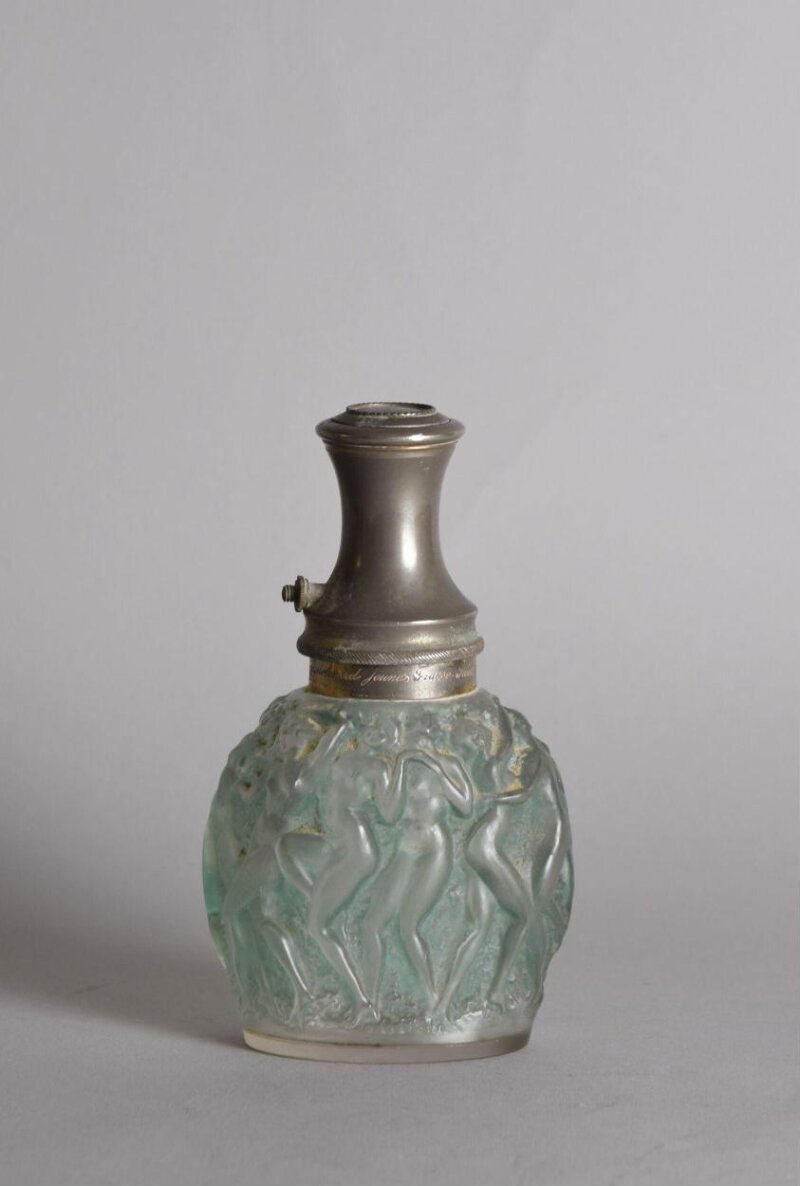
© Victoria and Albert Museum, London; Given by R.J.C. Hildyard · Victoria and Albert Museum (V&A)
An atomiser for Grasse
Calendal is a perfume atomiser designed by René Lalique in July 1929 and made around 1930. The example in the Victoria and Albert Museum in London is 10 cm high and 8 cm wide, with a glass body, enamel, and brass metal fittings.
According to the V&A, it was made exclusively for the perfume house Molinard, with branches in Grasse and Paris. On the base, Molinard Paris France is etched in acid. The metal rim carries a small engraved line repeating Molinard, Grasse and Paris, with further marks that are hard to read in full.
Molinard was founded in Grasse in 1849. Calendal was one of its scents, launched in 1929. According to the Musée Lalique, the name comes from the poetry of Frédéric Mistral, who wrote in Provençal, the language of Grasse's own region.
A band of dancers
The body is ovoid. Its raised moulding was machine blown in the mould, then patinated. Around it runs a frieze of dancing nude women, picked out in green enamel. On top sits a brass cap.
The figures join into a ring. No beginning, no end. Turn the bottle in the hand and the dance goes on. The green enamel lifts the figures off the glass, like shadows cast on frosted glass.
This is Lalique at the end of the 1920s. The lines are cleaner than in his Art Nouveau years, the rhythm more even, close to the spirit of Art Deco. But an old habit remains: he still places the human figure on the object, and still lets light do the final work.
From holding to releasing
An ordinary perfume bottle has a stopper. You open it, dab the scent on skin, close it again. An atomiser is different. It turns liquid into fine droplets that hang in the air. The scent does not go straight from bottle to skin. It crosses a small space first.
That mechanism changes how the bottle is seen. It is no longer only where scent is stored. It is a point of departure. The scent begins its real life once it has left the nozzle and met the air, the warmth of a body, the warmth of a room.
So the atomiser is an object of gesture. The hand squeezes, the air pushes, the scent flies. Each use is a small motion repeated every day, almost a ritual before leaving the house.
The dancers around the body match that gesture. They do not stand still like the women holding the burner in Renaissance engravings. They move. The bottle says in images what it does in function: it puts scent into motion.
Why Calendal stays with us
Calendal shows how far the perfume bottle travelled in twenty years. From the Cyclamen bottle for Coty in 1909, where the scent's name was moulded into glass, to an atomiser in 1929 whose form describes how scent leaves the bottle.
It also shows a particular relationship. This atomiser was made only for Molinard. Not a stock model sold to every house. A glass designer in Paris and a perfume house in Grasse built together an object named after a Provençal poem.
Today the atomiser sits in the V&A's store, brought out when someone asks to see it. It no longer sprays. But the green dancers still circle its body, standing in for the scent that has flown.
Olfactory Art