
Essays · Olfactory Art
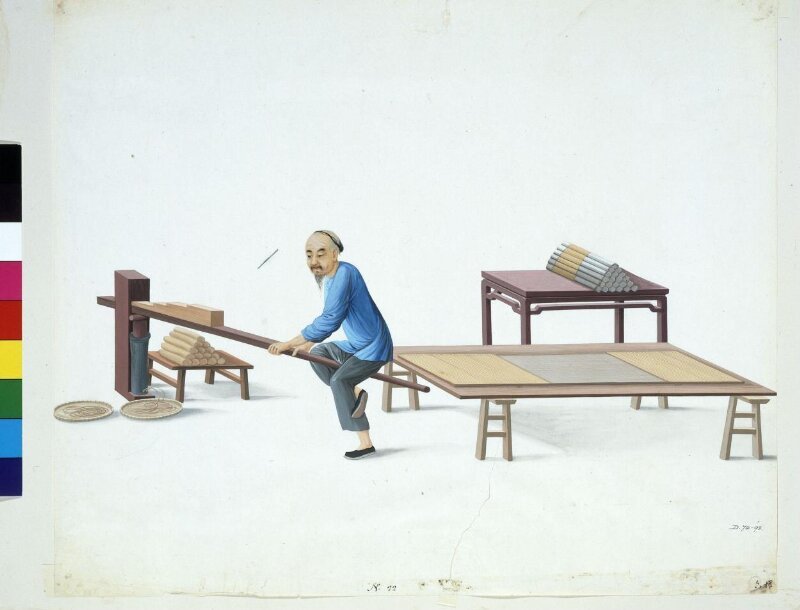
Puqua. Man Making Incense Sticks.
Before it becomes smoke, incense is the work of a pair of hands.
© Victoria and Albert Museum, London · Victoria and Albert Museum (V&A)
A man, a board, two tables of incense
The Victoria and Albert Museum in London holds a painting in watercolour and ink on paper, 36 by 46 cm, called Man Making Incense Sticks. The museum names the painter as Puqua, the place as Guangzhou, the date as about 1790.
The record describes the picture in a few lines. The central figure wears blue and sits at the end of a long brown board. Behind him, on two tables, are piles of incense sticks. No landscape, no story. Just the worker, the workplace, and the work.
The picture does not say exactly which stage of the process he is at. Penta will not guess. What can be seen is proportion: a long board, large piles, a small, still man. Making incense, as the picture shows it, is a work of repetition. One stick, then another, then hundreds, until the tables are full.
The museum bought the painting from Parsons & Sons and entered it in its registers in 1898. It was reproduced in Souvenir from Canton, a book on the V&A's Chinese export paintings, published in Shanghai in 2003.
A hundred trades in Canton
Man Making Incense Sticks does not stand alone. According to the V&A, it belongs to a set of 100 paintings, each showing a trade or occupation in Canton. The set includes a paper maker, a money changer, a fortune teller, a tailor, an arrow smith, an umbrella mender, a bird seller.
And there is one more about incense: Man Selling Incense Sticks. Again a man in blue, this time standing between two orange red boxes. The two share a size, a date, and the year they entered the museum, 1898. Side by side, they show two ends of one road: where incense is made and where it is sold.
The V&A explains why such paintings existed: they were made for Europeans eager to learn more about China and its people. In the late 18th century Canton was the main port where Western merchants were allowed to trade with China. They bought tea, silk, porcelain, and pictures too, as a way of carrying part of the city home.
Sets of trades were a kind of picture dictionary. One page, one trade. A viewer in London or Amsterdam turned the pages and saw a city they might never reach. They saw the incense maker. They could not smell the incense.
The man who makes the smoke
In the art history of scent, we mostly meet objects: burners, boxes, bottles, beautiful things kept because their materials were precious. The people who made the incense rarely appear. They signed nothing on a stick. The stick burns away, and its maker disappears with it.
Puqua's painting is a small exception. It was not painted to honour the worker but to explain him to foreigners. Yet because of that, it keeps a scene insiders may never have thought worth recording: an ordinary working day among piles of unlit incense.
In Japan, incense making has recently been recorded by camera, as in the incense workshops of Awaji. But Canton in 1790 had no cameras. Only watercolour, paper, and a painter called Puqua about whom almost nothing more is known today. The V&A records his name, and in one place spells it Paqua.
More than two centuries later, the man in blue still sits at the end of the board. The piles behind him are still unlit. They never will be. They are scent held in the state before it becomes scent.
Olfactory Art