
Essays · Olfactory Art
Unknown maker, London or East Anglia. The Ramsey Abbey Incense Boat.
A boat for incense, under water for at least three centuries.
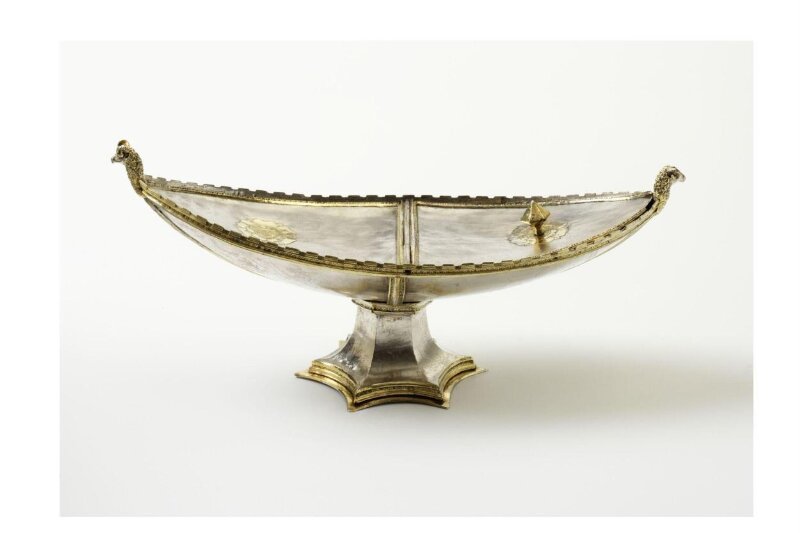
© Victoria and Albert Museum, London; Acquired with the aid of a generous donation from Mr C. W. Dyson Perrins FSA · Victoria and Albert Museum (V&A)
A boat for incense
In the medieval church, incense was burned in a censer swung on chains. The dry incense needed somewhere else to wait. A small boat shaped vessel held it, and it was spooned from there into the censer during the service. According to the Victoria and Albert Museum, the boat was the standard form for such vessels across Europe, made in every metal.
The V&A boat is 29 cm long, 12.5 cm high, almost 10 cm deep, and weighs about 540 grams. It is silver and silver gilt, engraved. Its narrow rim is battlemented like a castle wall. The body is covered in punched, gilded strapwork. The foot is star shaped.
The top is engraved with two stylised double roses. Half of it is hinged to form a lid, with a pointed diamond knop. Lift it and you see the hollow where the incense lay.
The museum dates it to around 1350, made possibly in London, possibly in East Anglia, maker unknown. The record calls it the only English gothic incense boat in silver to survive.
Rams and roses
At each end rises a ram's head from the waves. One has lost a horn. The detail is a clue. The rams are almost certainly a rebus, a visual pun, on the name Ramsey.
The Benedictine abbey of Ramsey lay seven or eight miles from where the boat was found, and its arms bore three rams' heads. So the boat, with the censer found beside it, is thought to have belonged to that abbey. It came from a wealthy church or monastery: the workmanship is of the highest quality.
The double rose on the lid was once taken for a Tudor emblem. The museum rejects this. It is a symbol of the Virgin Mary, common in the Middle Ages. It appears on the Grandisson ivory diptych in the British Museum, around 1340, and on the crozier of Bishop William of Wykeham, around 1367.
So the boat carries two identities at once. The rams say where it belonged. The roses say whom it served.
On the bed of Whittlesea Mere
In 1850 Whittlesea Mere in Huntingdonshire was drained. On its bed lay the boat, a censer, and a group of pewter and pottery objects. The censer is now at the V&A too.
Why were they there? The museum offers two answers. They may have been hidden in the mere when England's monasteries were dissolved under Henry VIII. Yet Ramsey seems to have accepted dissolution calmly: in 1538 Richard Cromwell wrote to his uncle Thomas that abbot and monks were conformable, and the monks received comfortable pensions. Or the hoard was lost, probably in a boating accident, some time before.
There is no answer. Only a small boat for incense lying under a lake, very close to its abbey. If it went into the water before 1538, it lay there at least three hundred years. Exactly how long, no one knows.
Penta reads the boat beside a fifteenth century engraving by Martin Schongauer, The Censer, which shows a gothic censer in fine detail. The engraving gives the censer. The Ramsey boat is the other half of the ritual: where incense waited before becoming smoke.
The V&A acquired it with the help of the collector C. W. Dyson Perrins. It belonged to an abbey, then to a lake, and now to a museum.
Olfactory Art