
Essays · Olfactory Art
Martin Schongauer. The Censer.
An object made so smoke has a way out.
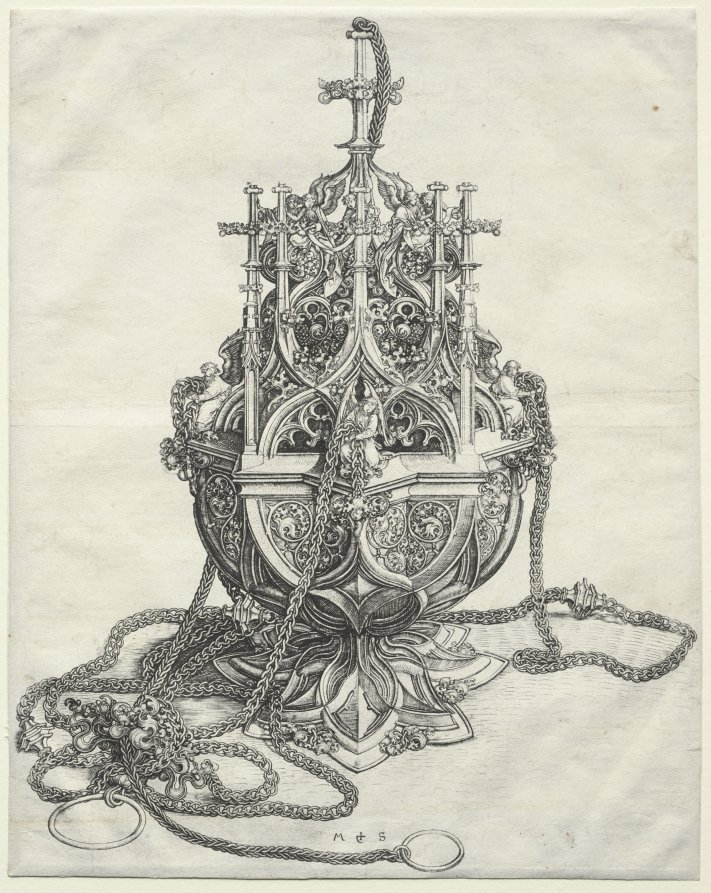
Martin Schongauer (German, c. 1450–1491), A Censer. The Cleveland Museum of Art, John L. Severance Fund · Public domain
A small building on a chain
The Censer is an engraving by Martin Schongauer, made around 1470 to 1474. The impression at The Art Institute of Chicago is printed on cream laid paper, the image about 26 by 21 cm. It was given to the museum by Mrs. Potter Palmer, Jr.
The sheet shows a censer, an object used in Catholic churches. Its form recalls a small Gothic building, with spires and arches. Its surface is covered with angels, a heavenly host standing around a building. Between the tiers are pierced openings to let the smoke out from inside.
Censers like this hung on long chains. During Mass they were swung back and forth, and each swing released a cloud of incense into the church.
A goldsmith with a burin
Schongauer is remembered today mainly for his engravings. But according to the Art Institute, he began as a goldsmith as well as a painter. The museum gives his birth as between 1430 and 1450, and his death as 1491.
That explains the precision of the print. Every vault, every ridge, every angel is described as if the engraver knew exactly how a silversmith would cast and join it. The museum suggests the print may be a design for a planned commission, or a close record of a censer that already existed.
Engraving itself is close to the goldsmith's trade. The maker cuts grooves into a copper plate with a burin, fills them with ink and presses paper onto them. The same hand could engrave ornament on a silver cup and a print on a copper plate. Schongauer was one of the most important engravers of the Upper Rhine in the fifteenth century. In 1492 the young Albrecht Dürer travelled to Colmar to meet him, but he had already died.
Incense in the church
Incense in ritual has a long history. Fragrant resins such as frankincense were placed on glowing coals, and the rising smoke stood for prayer ascending. The medieval church used censers in many rites, and the finest were goldsmiths' work.
So the censer in the print is not just a tool. It is a precious object, alongside the chalice and the reliquary. Censers often came with other objects, such as incense boats, like the Ramsey Abbey incense boat in England.
What is striking here is that a metal object, made to produce smoke, has been turned into a sheet of black and white. No metal, no fire, no smell. Only line.
Why it is worth another look
Schongauer's engraving shows how seriously the fifteenth century took the vessels of incense. People did not only burn it. They built smoke a building, with spires, doors and a guard of angels.
It also shows a way of seeing that Penta knows well: look closely at the container to understand what it holds. Where the openings are, how many, how large, decides how the smoke leaves. The shape of the censer is the shape of scent in space.
More than five hundred years later the paper remains and the smoke does not. The viewer looks at a censer that was never lit, and still understands it was made to breathe.
Olfactory Art