
Essays · Olfactory Art
In Search of Chinese Art of Scent.
The smoke is gone. The censer remains.
Hong Kong Museum of Art · Hong Kong Museum of Art
Two museums, one hundred and sixty sets
From 28 June to 16 October 2024, the Hong Kong Museum of Art held an exhibition on Chinese scent culture, titled in English In Search of Chinese Art of Scent. It filled the Special Gallery on the second floor as part of The Hong Kong Jockey Club Series.
It was a collaboration with the Shanghai Museum. Of the hundred and sixty sets on view, a hundred and nine came from Shanghai and fifty one from the Hong Kong museum's own collection. Ceramics, bronzes, paintings, bamboo carvings, lacquer, textiles.
The span of time is long, from the Neolithic period to the Qing dynasty. It shows something simple: people in this land burned, kept and carried scent very early, and never stopped.
The exhibition was part of the Chinese Culture Festival and Shanghai Culture Week in Hong Kong. Alongside it ran incense making demonstrations and meditation sessions with incense from different regions.
Objects that hold smell
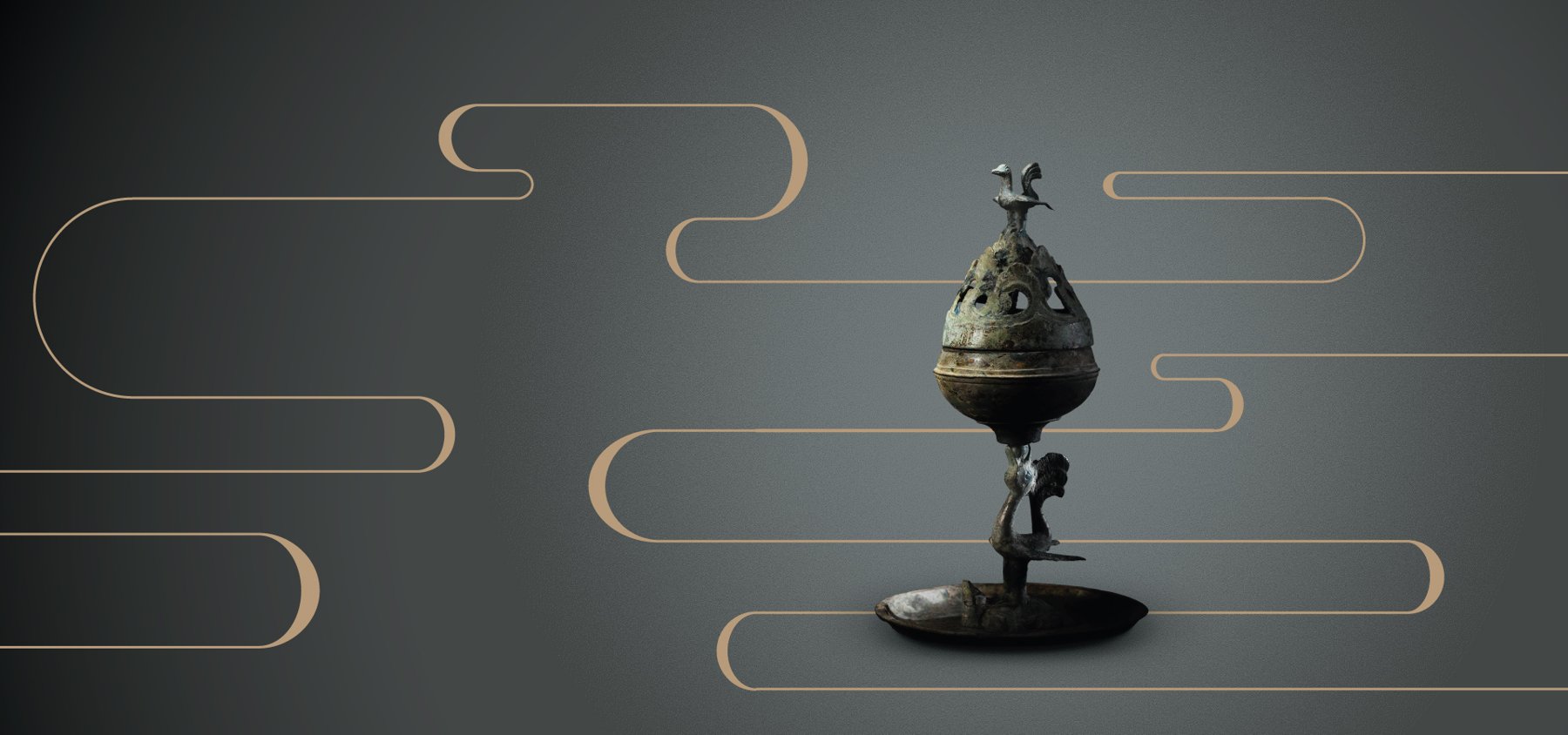
One highlight was a Han dynasty bronze hill censer on a stand shaped as a phoenix and a turtle. Censers of this type have lids cast as layered mountain peaks with small openings between them. When incense burned inside, smoke rose through the gaps, and the bronze mountain seemed wrapped in cloud.
There was a Buddhist stone sculpture from the Southern Liang, dated 546. In religious life incense is what is placed before the image: an invitation, a way of marking sacred space.
There were Ming paintings by Chen Hongshou and Qiu Ying, where incense appears in the life of the scholar class: a small censer on the desk, a thread of smoke beside a reader. And there were carved red lacquer incense boxes from the Qing, and embroidered scented pouches worn on the body.
Placed together, these objects tell the story of scent in three directions. Scent for the gods. Scent for the room. Scent for the body. Each needs its own vessel, and each vessel is a way of thinking about smell.
Three artists, three ways of making scent now
Beside the old objects, the museum invited three Hong Kong artists, Cheuk Ka-wai, Cheng Chi-kin and So Wing-po, to make new installations that reinterpret scent culture from today's point of view.
Cheng Chi-kin, also known as Max, made A Story of Time Through Scents. He gathered nearly fifty common herbs and aromatic materials, displayed them, and used them to create three scents for three times of day: dawn, noon, dusk. The scents were released through wave shaped diffusers.
Cheuk Ka-wai painted a very large floral handscroll in the gongbi manner, its title a gathering of ten scents, showing ten aromatic plants that grow in Hong Kong. It is a way of speaking about smell without smell: only fine brushwork, like the flower paintings of the past.
Dividing the day by scent has a distant precedent in Asian incense culture, where incense was once used to measure time. Cheng Chi-kin may not have had this in mind, but his work asks the same question: can a smell tell us what time it is?
In Japan the craft of incense has been kept to a similar rhythm, as on the island of Awaji. The Hong Kong exhibition showed the source of that stream. Incense is not only a smell. It is a set of objects, a set of gestures, and a way of ordering the hours of a day.
Olfactory Art