
Essays · Olfactory Art
Odilon Redon. Puis l'ange prit l'encensoir.
Incense smoke is a prayer that can be seen.
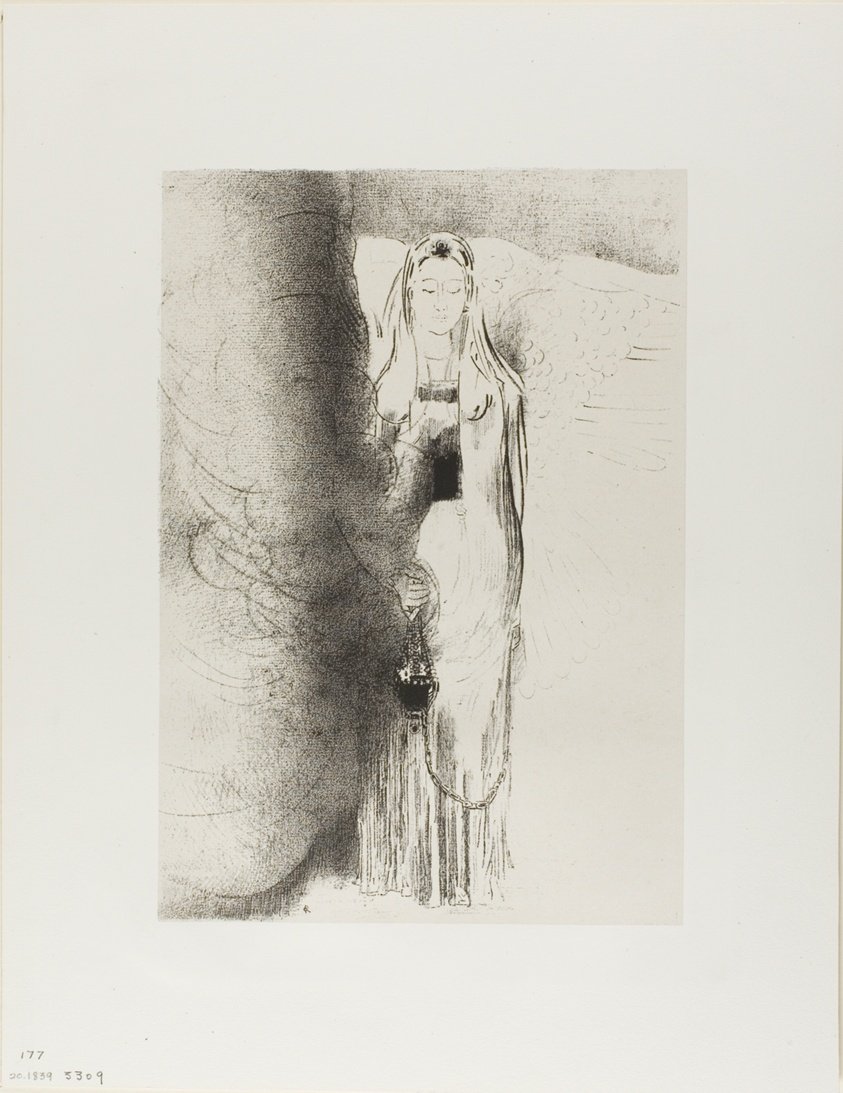
Odilon Redon, And the Angel Took the Censer, plate 4 of 12. The Art Institute of Chicago, The Stickney Collection · Public domain
The fourth plate of the Apocalypse
Puis l'ange prit l'encensoir, And the Angel Took the Censer, is the fourth plate of Apocalypse de Saint-Jean, the lithograph series Odilon Redon made in 1899 after the Book of Revelation.
In the image, a winged figure holds a censer in one hand. Smoke rises from it. The wings appear only as faint outlines around the body, as if the angel were dissolving into the dark ground, or emerging from it.
According to the Art Institute of Chicago, it is a lithograph in black on cream China paper laid down on ivory wove paper. The image is about 31 by 25 cm. That thin laid paper gives the black a soft depth and the light areas a warm glow.
The series has a cover and twelve lithographs, published by Ambroise Vollard in Paris in 1899, about a hundred sets printed by Blanchard. It was Redon's last lithographic album.
Redon and the blacks
Odilon Redon was born in Bordeaux in 1840 and died in 1916. For about twenty years from the late 1870s he worked almost entirely in black: charcoal drawings and lithographs. He called them les noirs, the blacks.
Their world is the world of dreams: an eye floating like a balloon, faces rising from water, hybrid creatures found in no natural history. Redon became one of the central figures of Symbolism, a movement that wanted to paint what cannot be seen: thought, premonition, fear.
By the late 1890s he was turning to colour, to pastel and oil. Apocalypse de Saint-Jean therefore stands at the end of a stage. It is his farewell to black.
The Apocalypse has a long history in printmaking. Albrecht Dürer's woodcut series of the late fifteenth century is the best known landmark. By choosing the subject, Redon placed himself in that line, but he did not picture the end of the world with crowds and detail. He drew little, and let the dark do the rest.
From prayer to fire
Chapter 8 of Revelation tells a short scene. An angel stands at the altar holding a golden censer. He is given much incense to offer with the prayers of the saints. The smoke rises with those prayers from the angel's hand before God.
Then the angel takes the same censer, fills it with fire from the altar, and casts it to the earth. There are voices, thunder, lightning, an earthquake. The seven trumpets begin.
In one object, incense and fire trade places. The censer was a tool of prayer, of sweet smell, of offering. Within a sentence it becomes a tool of wrath. Redon's title begins with Puis, Then. A joining word. It tells us something is about to come.
In Christian ritual, and in many other cultures, the censer is a familiar object. Its smoke links those below with what is above. Redon keeps that meaning and sets it on the edge of an event. The smoke in the print is soft and beautiful, but anyone who knows the story reads it as an omen.
The print is worth remembering because it gives scent a rare place in painting: not decoration, not a sign of luxury, but the centre of a moment of change. The smoke is the only thing moving in the picture. Everything else is waiting.
Olfactory Art