
Essays · Olfactory Art
Honoré Daumier. L'Odorat.
A flowerpot is the whole garden of a city dweller.
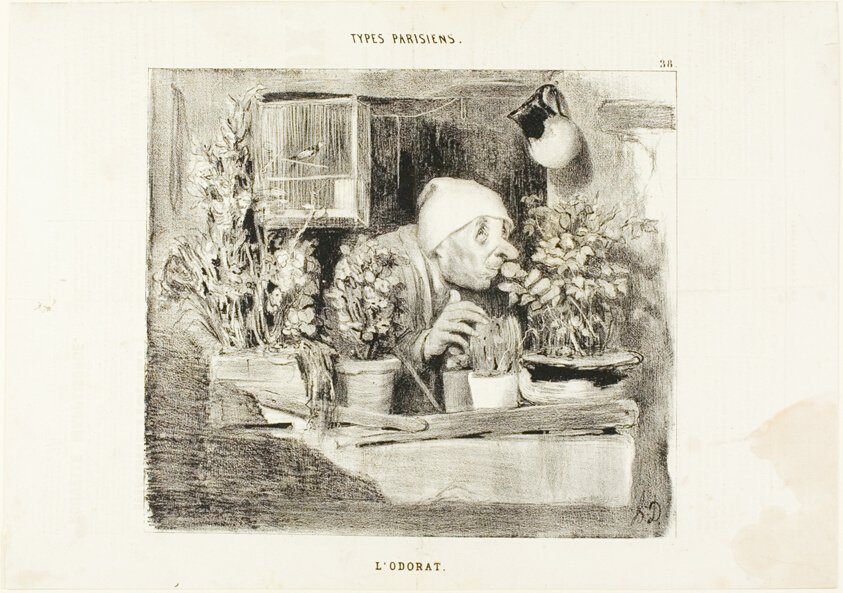
The Art Institute of Chicago, Mr. and Mrs. Carter H. Harrison Collection · The Art Institute of Chicago
One man, one sill, five pots
The print is called L'Odorat, Smell. It is plate 38 of Types Parisiens, Honoré Daumier's lithograph series on the types of people found in Paris.
The scene is spare. A man in a cap stands at a window, bending to smell a flower in a pot. Five pots sit on the sill. On the left a birdcage hangs in the air. On the right a jug hangs from a hook. No one else is there. No street, no crowd.
According to the Art Institute of Chicago, it is a lithograph in black on white wove paper with letterpress on the back. The image is about 20 by 23 cm. The printed text on the reverse tells us this sheet was once a newspaper page: nineteenth century Parisians held it together with news, advertisements and gossip.
The date varies by source. The Art Institute gives 1839. The Metropolitan Museum of Art records L'Odorat as published in Le Charivari on 18 January 1843. Both fall within the years Types Parisiens appeared, 1839 to 1843.
Daumier and the types of Paris
Honoré Daumier was born in Marseille in 1808 and died in 1879. He worked in lithography almost all his life, and most of his images were published in newspapers. Le Charivari was a satirical daily in Paris, each issue carrying a full page lithograph.
In the early 1830s Daumier drew political caricature and was jailed for a drawing that mocked King Louis Philippe. After the censorship laws of 1835 tightened control over political images, the satirical press turned to everyday life, and Daumier turned with it. He drew lawyers, doctors, bathers, tenants, newspaper readers.
Types Parisiens is one of those series, around fifty sheets. Each shows a type of person or a city habit. Some take the five senses as their subject, among them L'Odorat and Le Goût.
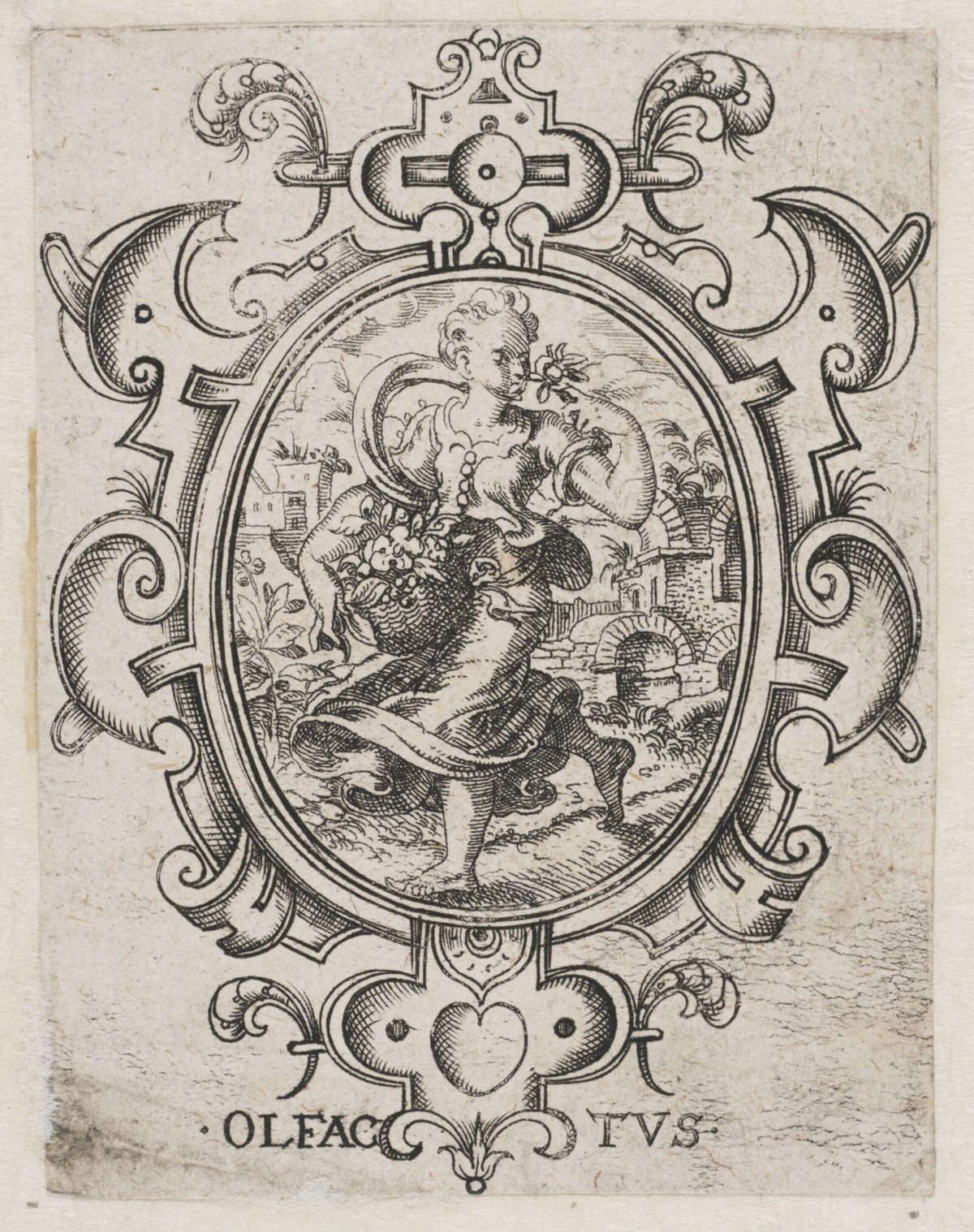
The five senses were an old theme of European prints. From the sixteenth century, Flemish engravers made sets personifying smell with stately figures, flowers and scent flasks. Daumier kept the theme and dropped the ceremony. His sense of smell is an ordinary man beside a flowerpot.
Smell for a city dweller
What Daumier records is not the smell of a flower but its scarcity. Paris in the 1830s and 1840s was crowded, damp, full of unpleasant smells. A windowsill with five pots was the nearest thing to a garden many people had.
So the bent figure is both funny and touching. Funny because the man is so absorbed in something so small. Touching because of that absorption. Daumier caricatures, but without contempt. He looks at the city dweller with some affection.
The objects around the man tell their own story. The birdcage is another piece of nature shut indoors. The jug on its hook is a daily tool. The room is not rich, but someone looks after it. Everything in it has a smell, though the print is only black ink.
The print is worth remembering because it takes smell out of allegory and puts it into life. No goddess, no emblem. Only a man, a windowsill, a flowerpot, and the idea that smelling is also a way of living in a city. A reader turning the page that year saw himself in it, and perhaps smiled.
Olfactory Art