
Essays · Olfactory Art
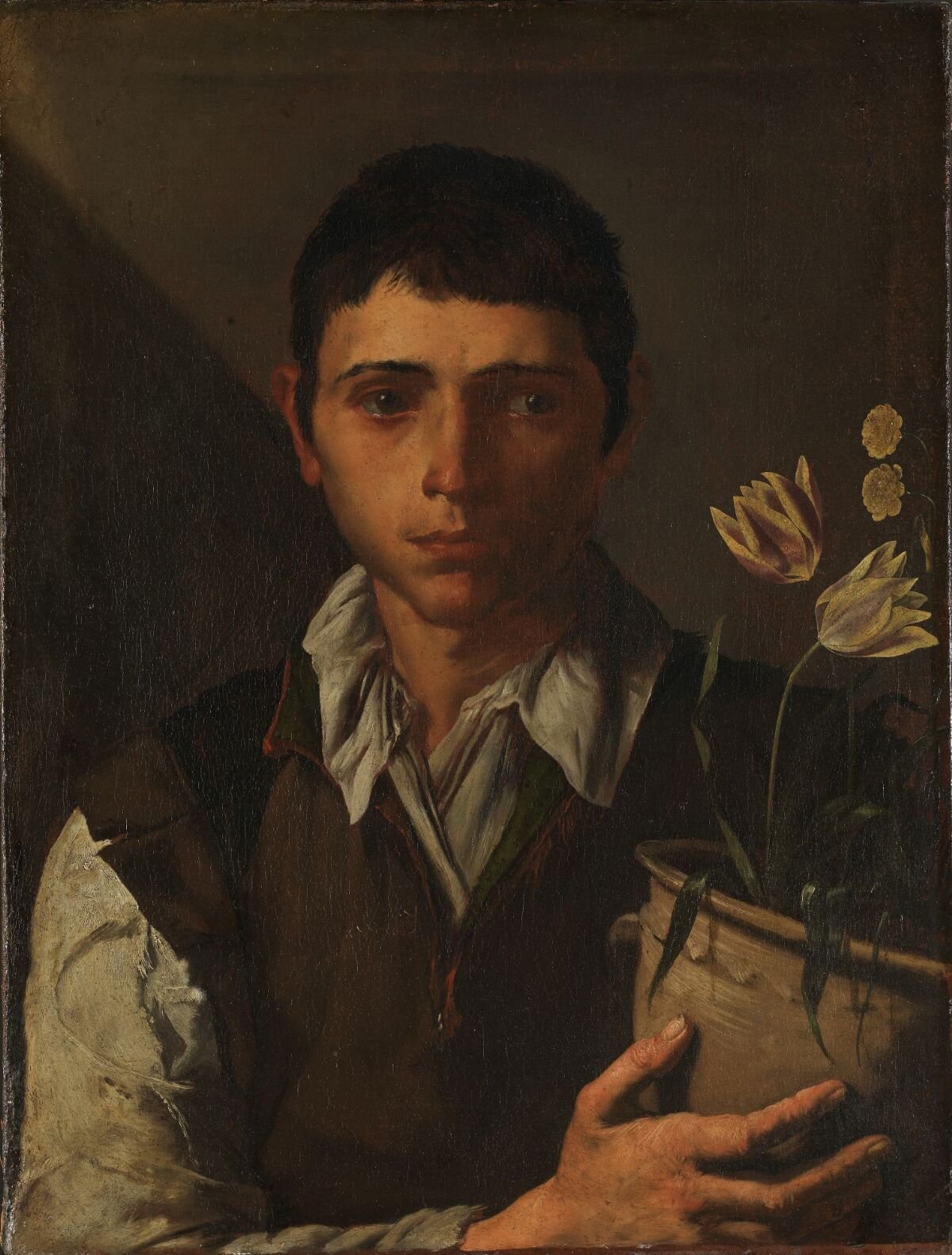
Jusepe de Ribera. Boy with a Pot of Flowers. The Sense of Smell.
The one who holds a scent need not smell it. Only stand there.
Nasjonalmuseet for kunst, arkitektur og design · Nasjonalmuseet (Na Uy)
A boy, a clay pot
The background is almost black. Out of the dark a boy appears, chest high. Short dark hair. An open, crumpled white collar. Over it a brown waistcoat, and one sleeve worn through to the lining.
He holds a cream clay pot with thick walls and a lug. In it grow a few tulips, white with streaks, and some small yellow flowers above. One hand supports the pot: thin fingers, knuckles showing.
Light comes from the left and falls on the face, the sleeve, the rim of the pot. The rest sinks into shadow. No room, no furniture, no story around him. One person and one object.
Oil on canvas, 60 cm high and just over 45 cm wide, painted around 1637. It belongs to the Nasjonalmuseet in Oslo as Boy with a Pot of Flowers. The Sense of Smell, in Norwegian Ung gutt med blomsterkrukke. Luktesansen.
Who painted it
The museum lists Jusepe de Ribera, the Spanish born painter who spent most of his life in Naples. But the record goes further. It adds a hypothetical attribution to an anonymous painter known as the Master of the Adoration of the Shepherds, and mentions Aniello Falcone, a name attached to the painting by tradition, noting that this tradition was mistaken.
Three names for one canvas. That is common in seventeenth century Neapolitan painting, when many younger artists around Ribera worked in his manner: dark grounds, hard light, models taken from the street. The museum keeps all three possibilities on the record.
The painting came to Norway through a collector. Christian Langaard bequeathed his collection to the museum, and the picture entered it in 1923. Today it hangs in a room devoted to the Langaard collection.
For Penta, the question of the hand does not diminish the work. The boy is still there. The pot is still there. The name on the label may change; what is in the picture does not.
Smell in a torn sleeve
The five senses were a familiar subject in European painting of the sixteenth and seventeenth centuries. Usually each sense was an allegorical figure: a beautiful young woman, a god, rich clothing, symbolic objects.
Ribera went another way. Around 1615, in Rome, he painted a series of the senses as ordinary half length figures from the city crowd. His Smell from that series is a poor man holding an onion, eyes watering, with garlic and a flower before him. Scent there is not pretty. It is sharp, real, it brings tears.
The Oslo painting continues that spirit, more gently. Smell is no longer a goddess. It is a boy in a worn sleeve, perhaps a flower seller, perhaps a model hired from the street. The beauty is in the pot. The truth is in the sleeve and the thin hand.
The flower is curious. Tulips are loved more for colour and shape than for scent. In those same years, in Holland, tulip bulbs were changing hands at astonishing prices. Yet here the tulip stands for smell. Perhaps the painter was not thinking of the flower alone but of the whole pot: damp soil, leaves, petals, clay, and the warmth of the one holding it.
Flemish painters of the time also painted smell, often as an entire garden in bloom, as in the Brueghel and Rubens picture that the Prado once recreated with real scents. The Oslo painting goes the other way. No garden, no gods, only a pot small enough for a child to carry.
Olfactory Art