
Essays · Olfactory Art
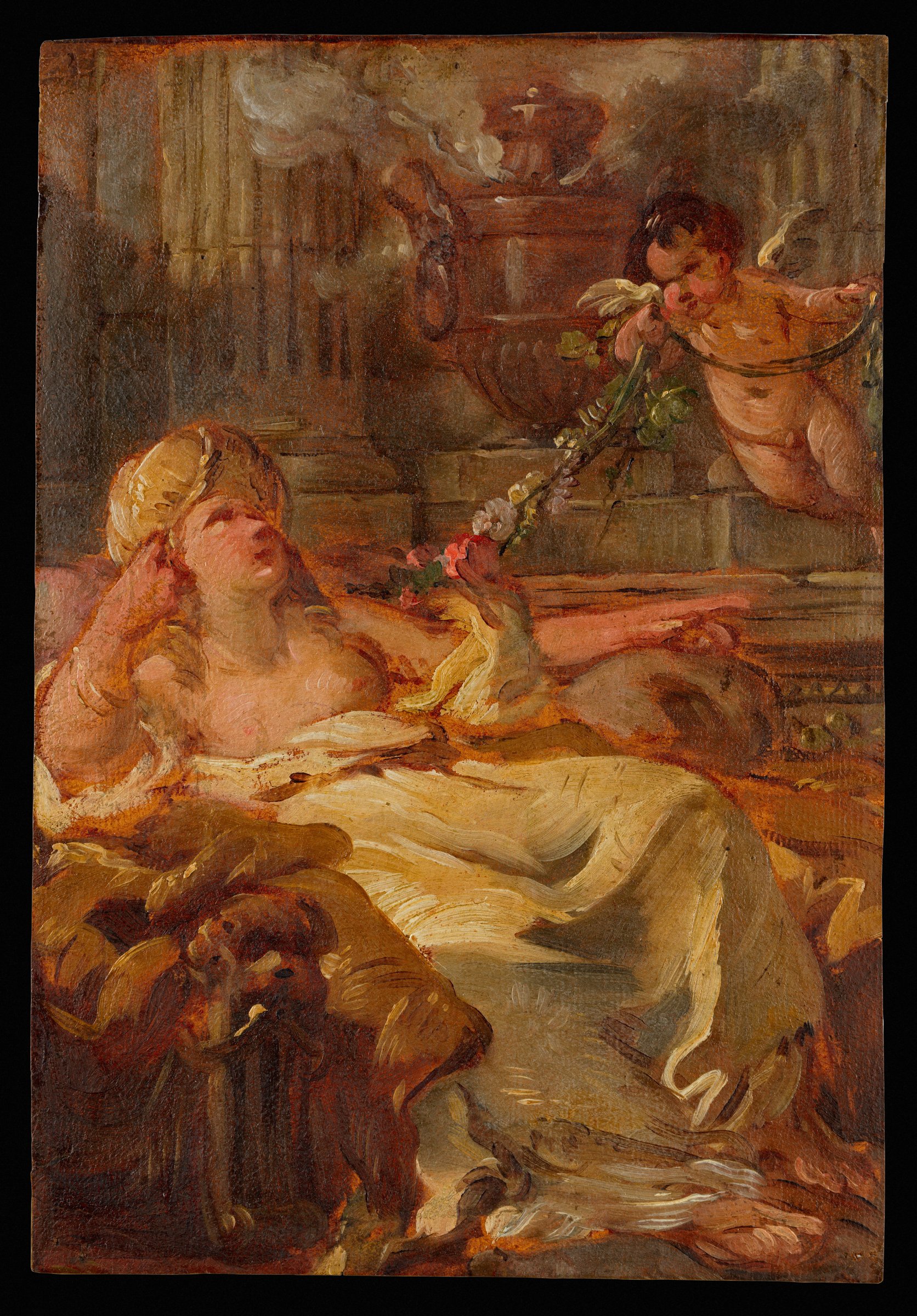
Joseph-Marie Vien. Allegory of Smell.
Every scent has travelled some distance.
The Metropolitan Museum of Art, Gift of J. Pierpont Morgan, 1906 (Open Access, public domain) · The Metropolitan Museum of Art
A quick sketch
The sheet is small, under 32 cm high and just over 22 cm wide. On it is oil paint, laid on fast, brushstrokes left visible. No careful outlines, no fine detail. This is a sketch, not a finished picture.
A woman reclines on cushions, ivory drapery falling away, shoulders bare. Her head is wrapped in a golden turban. One hand goes to her brow, her eyes turn upward, as if something has just stopped her. The other hand falls forward.
From the right a winged putto swoops down, holding out a garland of roses and leaves. Behind, on a stone pedestal, a large burner sends up smoke that curls between faint columns.
Everything is painted in warm tones: gold, red brown, ivory. The air seems thick with smoke.
Vien in Rome
Joseph-Marie Vien was born in Montpellier in 1716 and died in Paris in 1809. He lived through almost the whole eighteenth century and into the nineteenth, through the French Revolution. Art history usually names him a forerunner of Neoclassicism and the teacher of Jacques-Louis David.
The sketch is inscribed Vien ft. Romae, Vien made it, in Rome. The Latin itself is a classical gesture. It dates from 1775 to 1781, when Vien was director of the French Academy in Rome, where France's prize winning young painters trained.
According to the Metropolitan Museum, the sketch does not relate directly to any known finished painting. It is a preparatory study, an idea tried out on paper, perhaps for a decorative scheme, perhaps just a painter's exercise on the five senses. No one knows.
The sheet later belonged to the large decorative arts collection of Georges Hoentschel, a Paris decorator and dealer. J. Pierpont Morgan acquired that collection and gave it to the Metropolitan in 1906.
Three objects pointing to one region
To paint a sense, an allegorist needs objects the viewer can read at once. Vien chose three: the incense burner, the garland, the turban.
Burner and garland are the familiar ways of speaking about scent. One is the scent people burn, the smoke of resins and woods. The other is the scent plants give off on their own. Between them they cover nearly every pleasant smell an eighteenth century European knew.
The turban is different. It gives off no scent. It points the way. As the Metropolitan reads it, the turban stands for Asia, the source of incense and other aromatic goods. The woman is at once Smell and the East, two ideas folded into one figure.
That way of seeing belongs to its time. Eighteenth century Europe saw the East through merchandise, through what the ships brought back, and often imagined more than it knew. But it also records a historical fact: many of the most prized scents in Europe then had travelled very far to reach the room where they were smelled.
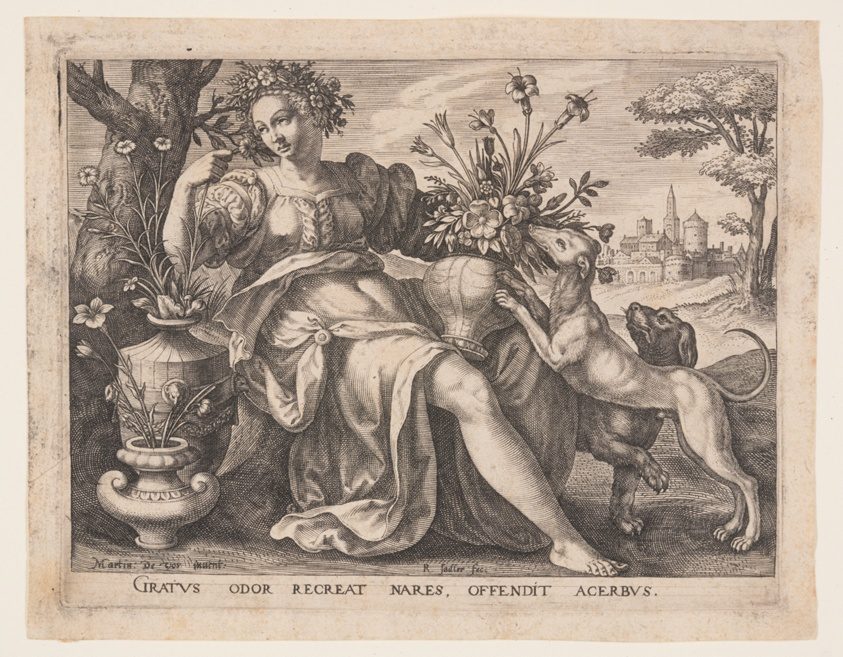
Set beside images of smell by earlier French painters such as François Boucher, Vien's sketch shows scent still alive as a subject of academic painting in the late eighteenth century. Only the brush is quicker, and the story reaches further: not just a flower in a garden, but a whole trade route.
Olfactory Art