
Essays · Olfactory Art
François Boucher. Smell.
A scent from far away, drawn as smoke.
The Metropolitan Museum of Art, Harris Brisbane Dick Fund, 1953 (Open Access, public domain) · The Metropolitan Museum of Art
A garden that never existed
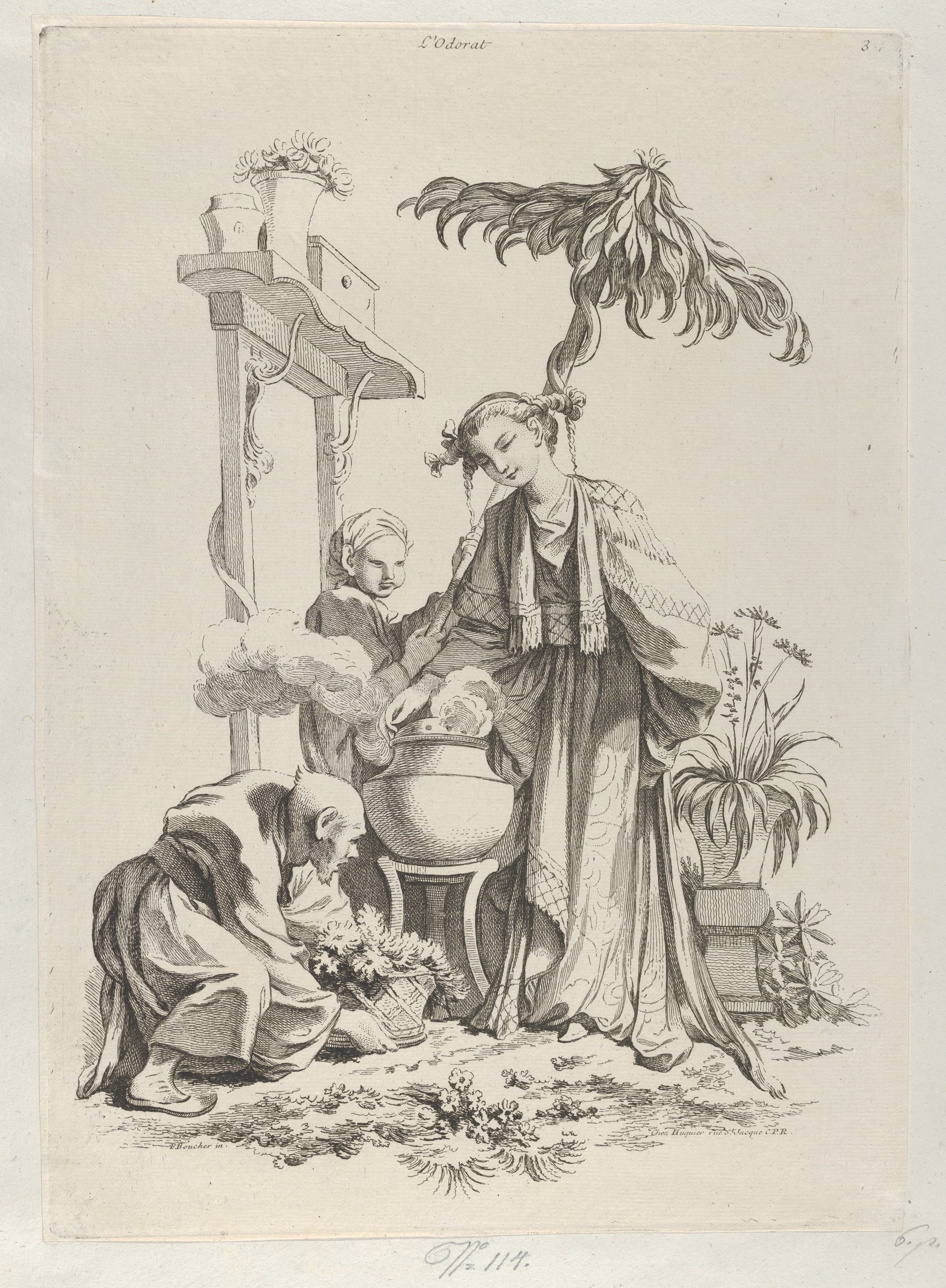
At the top of the sheet are the words L'Odorat, Smell. Below is a garden scene. A young woman in a long layered robe, a fringed shawl and a high chignon stands beside a large vessel on a stand. From its mouth, smoke or vapour rises in round billows. She bends her head towards it.
Behind her head a long, featherlike frond rises and curves out across the sky. On the left, a smaller figure in a headscarf stands behind the vessel, a hand reaching towards the smoke. In front, an old man kneels and offers up a basket of flowers. A wooden shelf on posts holds a few flowerpots. On the right, a plant with long leaves stands on a pedestal. Flowers grow scattered on the ground.
Everything in the print points to smell. Smoke, flowers in the basket, flowers in pots, flowers underfoot. Smell is not shown by a gesture of lifting something to the nose. It is shown by a scene full of things that smell.
Boucher's China
François Boucher was born in Paris in 1703 and died there in 1770. He was one of the defining painters of French Rococo, with his pastorals, mythologies and light scenes of love.
In the eighteenth century Europe was infatuated with goods from China: porcelain, silk, lacquer, wallpaper. From this came chinoiserie, a decorative style that borrowed Eastern imagery and rebuilt it through European imagination. Boucher was one of its best known designers. He never went to China.
So the costumes in L'Odorat are both familiar and strange. The fringes, the chignon, the long falling folds read as Eastern. But the pose, the face and the staging belong to a Parisian Rococo picture. This is a China assembled from imported objects and hearsay, not from looking.
The print belongs to a set, Les Cinq Sens, The Five Senses. The theme was long familiar in Paris. About a century earlier, Abraham Bosse had engraved his own Les Cinq Sens. What Boucher adds is distance: the sense is placed somewhere very far away, somewhere that exists only in the imagination.
A print made to be copied
The Met classes the sheet as an ornament print. It is etched and engraved, the plate about 36 cm tall. At the bottom is the address where it was sold: Huquier, rue Saint Jacques, Paris. Gabriel Huquier was an engraver and print dealer who published many of Boucher's designs.
Ornament prints of the period were not only for looking at. Porcelain painters, weavers, fan makers and decorators used them as models. A chinoiserie figure on paper could travel on to a plate, a tapestry, a cabinet door.
The Met gives a wide date range, 1720 to 1770, nearly the whole of Boucher's working life. The museum acquired this impression in 1953.
That gives L'Odorat another layer. The smoke in the picture is an imagined smell. The print itself is an image made to spread, to be copied, to settle on other objects. Like a scent, it does not stay in one place.
Drawing smell as smoke
In many European allegories of smell, flowers are the default. Boucher uses flowers too, plenty of them. But the centre of the print is the vessel giving off its cloud.
Burning something for its scent is an old practice, found in many cultures. Here it is tied to an imagined East, as if smell in a faraway place had to be stronger, thicker, dense enough to see.
The billows are the softest part of the plate. They have no corners and no clear shadows. Among the crisp lines of robes, shelf and leaves, the smoke is the only thing that seems to move. Boucher draws something invisible by giving it a temporary shape.
Olfactory Art