
Essays · Olfactory Art
Raphael Sadeler I theo Maarten de Vos. Smell.
An image that passed through two hands before reaching the eye.
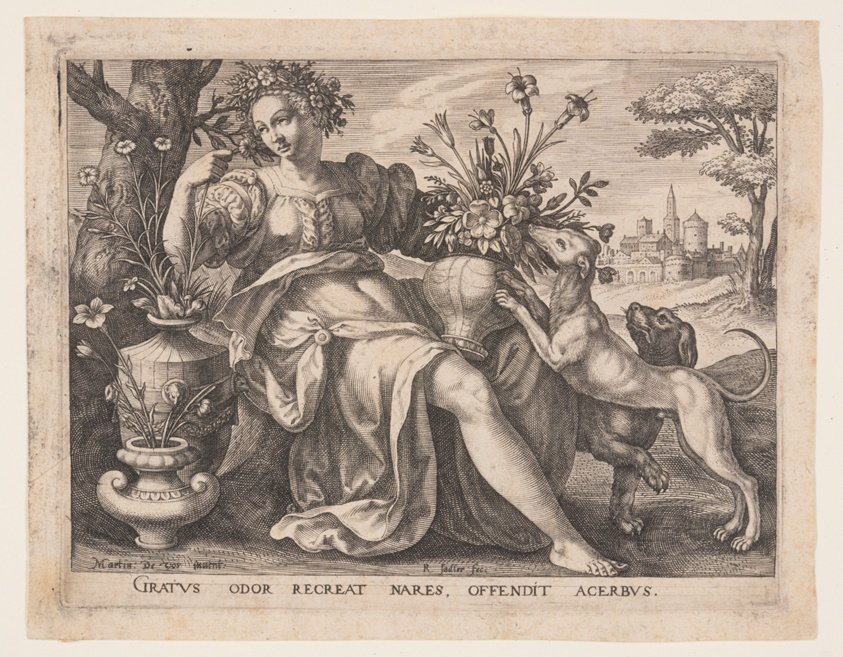
The Art Institute of Chicago, Charles Hack and the Hearn Family Trust Collection, purchased with funds provided by the Harry B. and Bessie K. Braude Memorial, Amanda S. Johnson and Marion J. Livingston, anonymous, and Suzanne Searle Dixon endowment funds · The Art Institute of Chicago
The woman under the tree
The engraving is very small, about 10 by 13 cm, the size of a palm.
According to the Rijksmuseum, which also holds an impression, the woman who personifies smell sits on the ground beneath a tree, arranging flowers in a vase. Two dogs play at her feet. In the distance lies a city.
It is a quiet scene. No flower lifted to the nose, no rapture. The woman is doing ordinary work with her hands. Yet everything around her has a smell: flowers, leaves, earth, and two dogs, animals that live by their noses.
The dog is smell's familiar companion in European allegory. Here the dogs are not scenting. They are playing. As if smell, in this garden, has been let off the leash.
Beneath the image runs a Latin verse. It opens with Gratus odor, a pleasant smell, and ends with acerbus, harsh or bitter. Those two ends alone suggest something: smell is not only what is sweet.
Invent, fec: two names on a copper plate
At lower left the plate reads Martin. de Vos invent., meaning Maarten de Vos devised the image. At centre, R. sadler fec., meaning R. Sadeler made the engraving. This was the standard credit line of prints at the time: one line for the designer, one for the engraver.
Maarten de Vos was born in 1532 and died in 1603. He was a leading Antwerp painter of the later sixteenth century, painting altarpieces and portraits and producing a great many designs for engravers.
Raphael Sadeler I was born around 1560 or 1561 into a Flemish family of engravers. In 1581, when he cut this Five Senses set, he was about twenty.
The Rijksmuseum names a third figure: Frans Floris, an Antwerp painter of the previous generation, credited as the design's inspiration. So one small sheet holds three layers: the idea of a predecessor, the image of the designer, the burin of the engraver.
A set of five, printed many times
The Five Senses comprises five engravings: sight, hearing, smell, taste and touch. According to the Rijksmuseum, all five are signed in the plate and one is dated.
Prints were how images travelled in sixteenth century Europe. One copper plate could yield many sheets. They were small, light and cheaper than paintings, carried by dealers and collectors. A design by de Vos in Antwerp could be in someone's hands in another city months later.
In the same period, in Nuremberg, Jost Amman also engraved smell in a Five Senses series. The subject was taken up again and again, by many hands, in many places. Each time a small variation on one idea.
The Art Institute of Chicago's sheet belongs to the Charles Hack and Hearn Family Trust Collection. The Rijksmuseum's is another impression from the same plate. Two sheets on two continents, one image, the same two names.
Why it stays with us
Seen from today, Smell is not dramatic. It is small, monochrome, and follows a well worn allegorical convention. But that ordinariness shows how smell was thought about in 1581.
Smell is not pictured as intoxication. It is pictured as work: choosing flowers, arranging them, setting them in a vase. Scent is something people arrange in a garden, with a city in the distance.
And the sheet is itself an arrangement by many people. One devised it, one engraved it, one printed it, one sold it, one kept it. More than four hundred years later it is still here, having passed through all those hands.
Olfactory Art