
Essays · Olfactory Art
Jost Amman. The Sense of Smell.
A scent, and the frame larger than it.
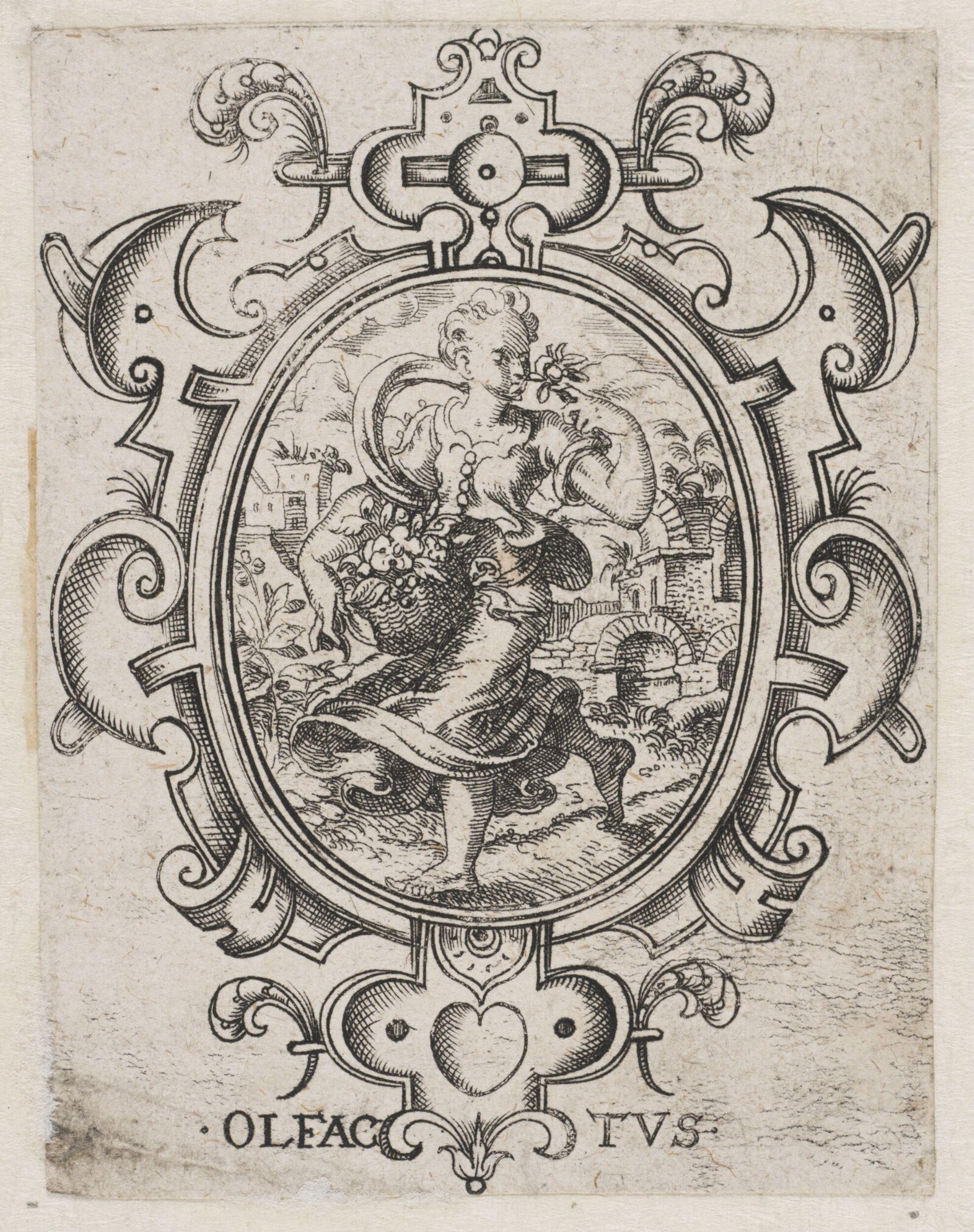
© Victoria and Albert Museum, London · Victoria and Albert Museum (V&A)
A sheet smaller than a hand
The Sense of Smell at the Victoria and Albert Museum is about 8 cm tall and 6 cm wide. The sheet was trimmed close before it reached the museum. It came to the V&A from the Rosenheim collection and was registered in 1923.
It is one sheet from The Five Senses, made in Germany in the late sixteenth century. The V&A holds the whole series. Each sense is a woman in an oval, each oval has its own ornamental frame, each frame a Latin word beneath. Sight holds a mirror. Hearing holds a lute. Taste lifts fruit to her mouth. Smell holds flowers.
In the oval for smell, the woman strides quickly across open country. Her skirt flies back. One hand raises a small sprig to her nose; the other arm carries a basket full of flowers. Beside her a small animal leaps, shaped like a dog. Behind her are city walls, a dome, broken stone arches. All of it is cut in fine, dense lines, on an area hardly larger than a postage stamp.
Two makers, two techniques
The museum records two names. Jost Amman made the etching, the figure and the landscape. Stefan Herman engraved the frame. The two techniques give two kinds of line. Etching gives a soft stroke, close to a pen. Engraving gives crisp, even curves, suited to symmetrical ornament.
Jost Amman was born in Zürich in 1539 and died in Nuremberg in 1591. He moved to Nuremberg around 1560 and worked for Virgil Solis, then one of the leading book illustrators. Amman himself became one of the most prolific illustrators in Germany. About 1,500 prints are attributed to him. A pupil once claimed that in four years he drew more than a hay wagon could carry.
His best remembered work is the Ständebuch, printed in Frankfurt in 1568, a book of woodcuts of the trades of the day: printer, shoemaker, goldsmith, apothecary. Amman drew daily life. He was used to watching people hold tools, stand at counters, do one specific thing with their hands.
The five senses as a pattern
Showing the five senses as five figures was a common habit of northern prints in the sixteenth and seventeenth centuries. Small prints of the time were often bought in sets, pasted into albums, or used as models by makers of decorative objects. A small sheet like this one could travel far, be copied, be carried into other objects.
So each sense needed an object that was easy to read. For smell, that object was the flower, often with a dog, the animal that lives through its nose. These signs recur across many series by other artists, such as the smell plate by Adriaen Collaert after Maarten de Vos. Viewers of the time read them at once, like a symbol.
What sets Amman's version apart is scale. The frame fills almost the whole sheet. The scene is pushed to the centre and shrinks. At the foot of the frame sits a heart, with OLFAC and TVS on either side. It is a sheet about ornament as much as a sheet about a sense.
Why it is worth another look
Four hundred years on, the sheet shows something simple: people tried to picture smell very early, and the first method was always to picture a gesture. No one could draw the scent of a flower. They drew someone smelling.
The gesture is still familiar. Leaning over a bloom. Lifting a leaf to the nose. Closing the eyes a little. Amman holds it in a space smaller than a palm, inside a knotted frame of the northern Renaissance.
Today one can see it as ornament. Or as evidence that smell, the hardest sense to draw, had its place in the set of five, level with the eye and the ear.
Olfactory Art