
Essays · Olfactory Art
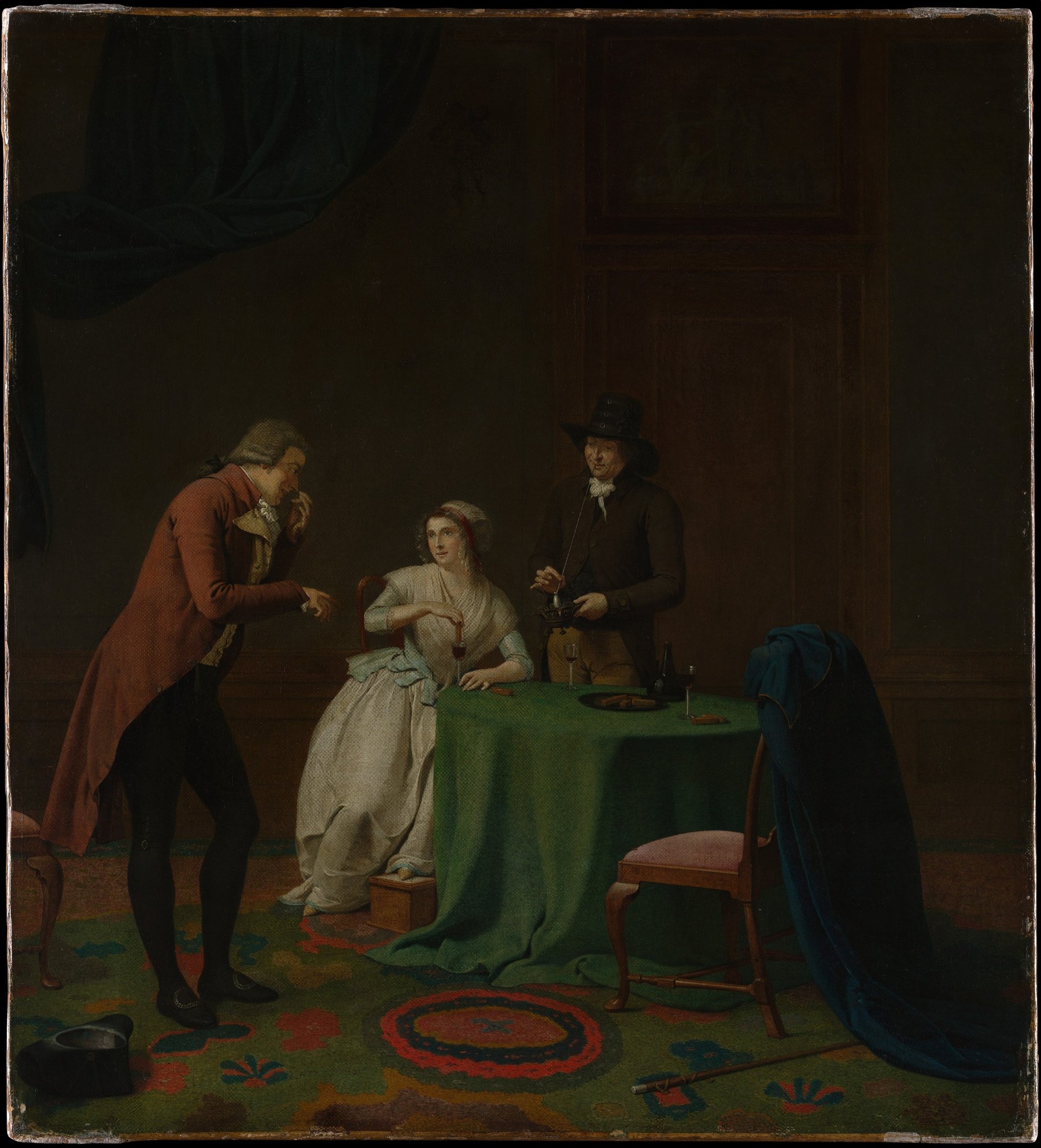
Jan Ekels the Younger. Conversation Piece (The Sense of Smell).
In a room, no one smells alone.
The Metropolitan Museum of Art, Gift of Mr. and Mrs. Bertram L. Podell, 1981 (Open Access, public domain) · The Metropolitan Museum of Art
Three people, one table
A dark room, panelled walls, a deep green curtain hanging at the upper left. Light gathers at the centre, on a table whose green cloth falls to the floor.
Three people are around it. At left a man in a long red brown coat, powdered hair tied back, leans forward. He brings his fingers up to his nose, his other hand held out as if mid sentence. In the middle a young woman sits in a white, finely striped dress and white cap, holding a glass of red wine and looking towards the man in red. Under her feet is a small wooden box to rest them on.
At right, behind the table, another man stands in a black hat and dark coat, holding a long pipe, as if lighting it or taking a draw. On the table: a bottle, a glass, a dish.
Other things lie scattered: a black hat on the floor at left, a cane on the floor at right, a blue cloak over the back of a chair. The carpet has round patterns. Everything looks as though it was just set down, halfway through an evening.
An Amsterdam painter who died young
Jan Ekels the Younger was born in Amsterdam in 1759 and died there in 1793, not yet thirty five. His father, Jan Ekels the Elder, was also a painter, hence the Younger.
He painted mostly genre scenes: interiors, people reading, writing, drawing, smoking. His manner looks back to the Dutch Golden Age of the seventeenth century, with quiet rooms, raking light, carefully painted objects. One of his best known works shows a man writing at his desk, painted in 1784.
According to the Metropolitan Museum, Conversation Piece was probably painted in 1791 and almost certainly belongs to a series of five canvases of the senses, four of which are now known. Oil on canvas, about 65.7 by 59.7 cm, it was given by Mr. and Mrs. Bertram L. Podell in 1981.
The words in brackets, The Sense of Smell, turn an ordinary conversation into an allegory. Without them we see three people and a table. With them, every detail starts to be read again.
The senses come home
Two centuries before Ekels, the five senses belonged to allegorical figures, beautiful women holding symbols. By the seventeenth century Dutch painters had moved the subject into taverns and homes, with peasants smoking pipes and soldiers drinking beer.
Ekels takes it one step further, into the parlour of the Amsterdam middle class at the end of the eighteenth century. The figures are well dressed; the room has a carpet, curtains, an upholstered chair. Smell is no longer a flower held up for the viewer. It is something hanging in the air of an evening with guests.
The scents here are everyday ones: tobacco smoke, wine in a glass, perhaps snuff if the man in red is lifting a pinch to his nose. Or perhaps he is shielding his nose from the smoke. The painting does not say, and that ambiguity keeps it alive. We can close our eyes to a scene, but we cannot stop breathing. Whoever shares a room with smoke smells the smoke, like it or not.
This is far from the stench of the seventeenth century Dutch city that the Fleeting exhibition at the Mauritshuis let visitors smell again. Here everything has been tidied indoors. But the air is still shared. And scent, as always, reaches every corner of the room.
Olfactory Art