
Essays · Olfactory Art
Fleeting. Scents in Colour.
The paintings are lovely. The city did not smell so.
A Grocer's Shop (1717), Willem van Mieris. Mauritshuis, The Hague · Apollo Magazine
A painting museum opens its nose
The Mauritshuis in The Hague holds some of the best known paintings of the Dutch Golden Age. In 2021 it opened Fleeting, Scents in Colour, an exhibition about smell in seventeenth century painting. It ran until 29 August 2021.
The curator was Ariane van Suchtelen of the Mauritshuis. The question was simple: how did Dutch painters of that time depict smell, and what did the Dutch of that time smell every day?
The exhibition had several parts. How smell appears in painting, through flowers, food, objects. The smells of the past. The role of smell in stories, and how the senses were understood then.
Among the paintings stood scent dispensers. Visitors pressed, and a puff of smell came out. They were designed to work without touch, because 2021 was a pandemic year.
From the grocer to the canal
One of the key paintings was A Grocer's Shop by Willem van Mieris, from 1717. A shop, goods piled up, seller and buyer. It is where spices from the trading ships reached the city's households.
Another was View of Haarlem with Bleaching Grounds by Jacob van Ruisdael, painted around the 1670s. In front, fields covered with white linen laid out to bleach; behind, the city. A wide, bright landscape, but also a workplace, where wet cloth lay out in the open day after day.
There was also a pomander made in the northern Netherlands around 1620, lent by Rijksmuseum Twenthe. People carried small objects like this, filled with aromatics, to raise to the nose when passing somewhere foul.
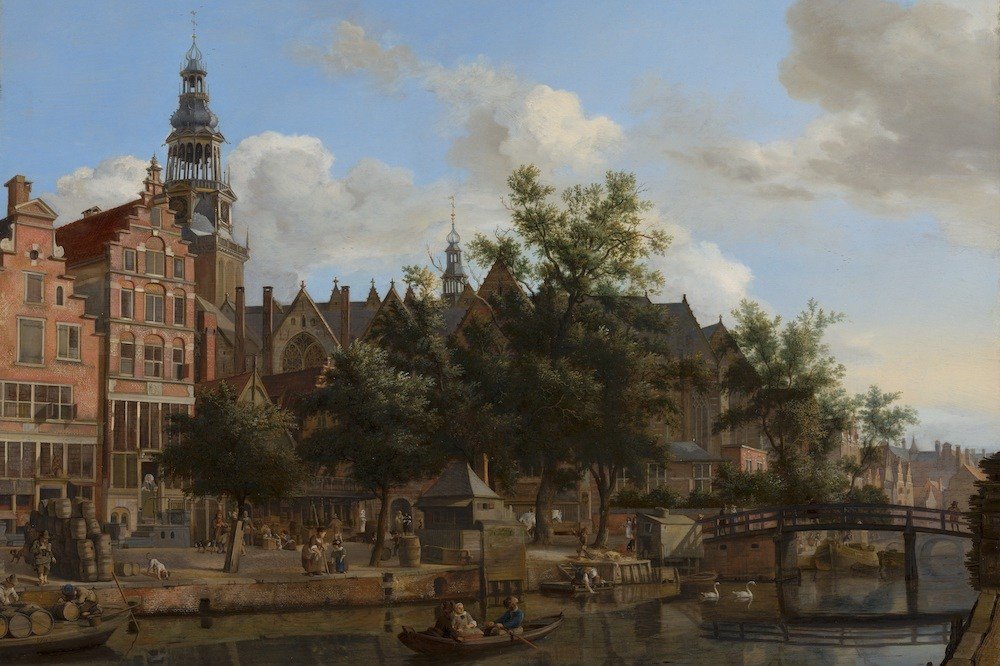
And there was the canal. In a city view by Jan van der Heyden, the Amsterdam canals look calm and clean. The Mauritshuis set beside it the smell of those same canals as researchers imagine it: standing water, refuse, waste. Visitors did not need to look long to understand.
A box of smells sent home
In 2021 Dutch museums were closed for months. The Mauritshuis looked for another way to reach its audience.
With its sponsor NN Group, the museum made a scent box and mailed it to people who signed up, together with a guided online tour. The Mauritshuis called it the world's first interactive look and smell tour. At home, people opened small vials as instructed while the screen showed the matching painting.
There is a paradox here. Smell is the hardest thing to send through a screen. Yet when the museum was shut, smell became the way a seventeenth century painting entered people's living rooms. The picture by screen, the smell by post.
Fleeting was not the first show to pair smell with old paintings, nor the last. A year later the Prado in Madrid recreated ten smells from a painting by Brueghel and Rubens. But Fleeting had something of its own. It did not only offer beautiful smells. It let visitors smell the dark side of an age called golden.
The title says as much. Fleeting means passing. The smells of the seventeenth century are long gone. What remains is colour, form, and a few small vials trying to call them back.
Olfactory Art