
Essays · Olfactory Art
The Essence of a Painting. An Olfactory Exhibition.
A painting of smell, smelled again.
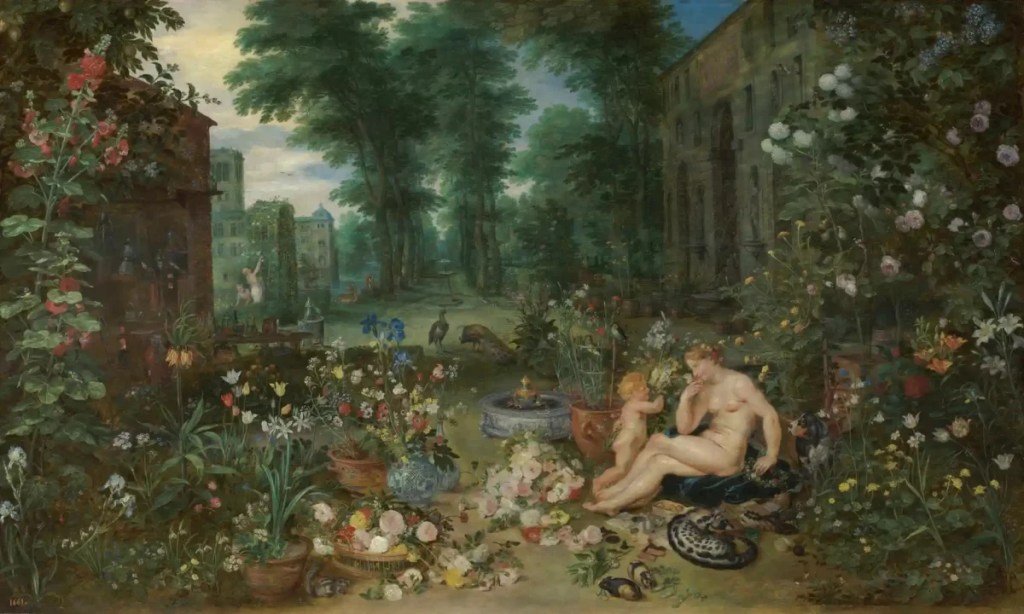
'The Sense of Smell', Jan Brueghel the Elder and Peter Paul Rubens. Courtesy Prado Museum · ARTnews
A painting about the nose
The Sense of Smell was painted around 1617 to 1618. It belongs to the Five Senses, a series of five paintings that Jan Brueghel the Elder made with his friend Peter Paul Rubens. Brueghel painted the setting and the objects. Rubens painted the allegorical figures.
A woman sits in a garden beside a small Cupid holding flowers. Around her are flowers, a great many of them, growing in beds, standing in vases, fallen on the ground. Behind are distilling apparatus, bottles, gloves. It is the smell world of a European court in the early seventeenth century.
The series is more than allegory. It is a portrait of a taste. What that court liked to smell, hear and taste is laid out across the canvas like an open cabinet of collections.
The Museo del Prado in Madrid holds the whole series. In 2022 it chose The Sense of Smell as the subject of a small, unusual exhibition: La esencia de un cuadro, The Essence of a Painting.
Ten smells, one perfumer
The exhibition was curated by the Prado's Alejandro Vergara. The smells were made by the perfumer Gregorio Sola, who works for Puig. His task was to read the painting with his nose and choose the smells it suggests.
The result was ten smells. Some come from the flowers in the picture: orange blossom, jasmine, rose, narcissus, tuberose, and a flower the Spanish list calls lirio. One is the fig tree. One is perfumed gloves, a fashionable item at the courts of the time. One is civet, the animal musk long used in older perfumery. And one carries the name of the painting's mode: Alegoría.
Visitors did not pick up bottles. The smells were released through four diffusers beside the painting, using AirParfum, a system developed by Puig that, according to press reports, lets people smell many scents in turn without tiring the nose.
These are not the real smells of 1617. No one knows for certain how a rose smelled then, or what the gloves were soaked in. They are ten readings of the painting, written in another language.
When painting needs another sense
A picture gallery belongs to the eye. People stand back from the wall, look, and move on. The other senses are set aside. No touching, no tasting, and usually no smell beyond wooden floors and crowds.
The Prado tried to reverse that in one room. The painting stayed as it was. But beside it was another layer of information, one that could not be seen. A visitor smells orange blossom, then turns back to find the orange flower on the canvas. The eye follows the nose.
There is a nice parallel. Brueghel painted flowers from different seasons blooming together in one garden, which could never happen in life. The ten smells are the same: they never shared a real space. Both the painting and the scents are assembled collections, not copies of reality.
Pairing smell with art is not a new idea. But for a museum like the Prado, placing scent beside a seventeenth century masterpiece was a real step. It admitted that a painting about smell will always lack the very thing it describes.
The Five Senses also reminds us that the senses were once a major subject of European painting. Other painters showed smell with one figure and a pot of flowers, like Ribera's boy with his flowers. Brueghel painted a whole garden. Four centuries later, the Prado let that garden breathe.
Olfactory Art