
Essays · Olfactory Art
Ancient Splendor: Roman Art in the Time of Trajan.
The marble remains. The smell must be rebuilt.
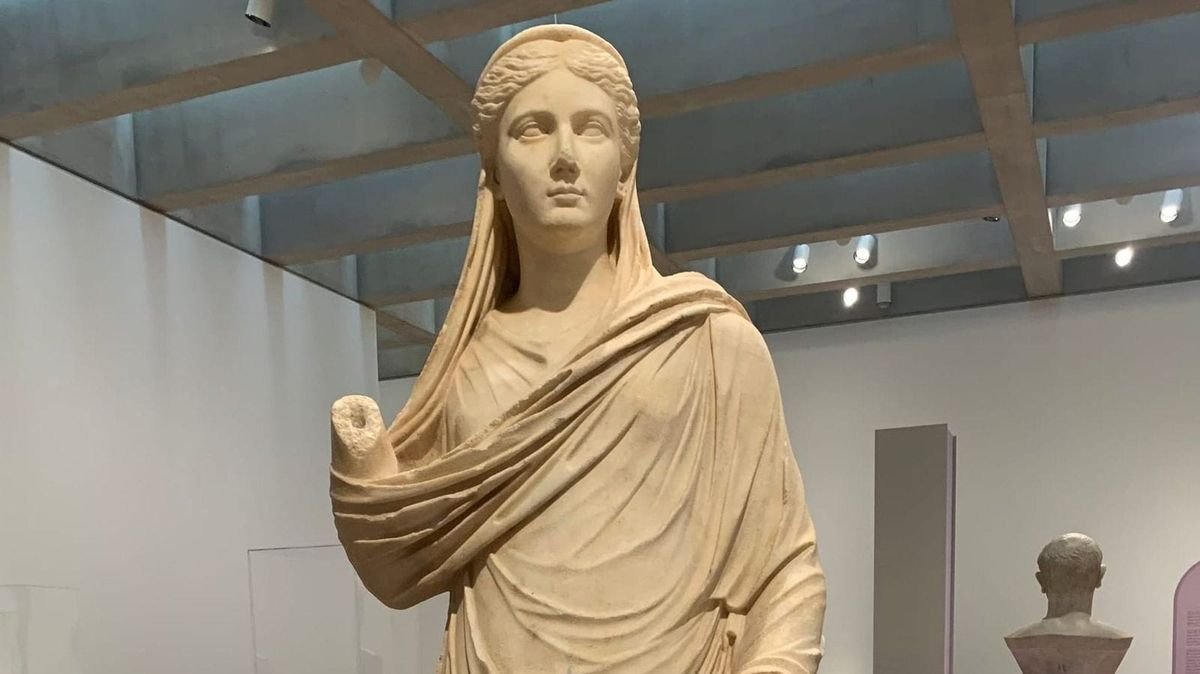
Image courtesy the Saint Louis Art Museum · Hyperallergic
An emperor and those around him
Trajan ruled Rome from 98 to 117. He was the second of those later called the Five Good Emperors, a period in which the empire expanded, built a great deal and was fairly stable compared with what came before and after.
Ancient Splendor: Roman Art in the Time of Trajan is on view at the Saint Louis Art Museum, Missouri, until 16 August 2026. It was organised by Lucrezia Ungaro, archaeological curator of the city of Rome, with Hannah Segrave as the curator in charge at the museum.
The objects come from across Italy: the Vatican, the archaeological site of Ostia Antica, the National Roman Museum, the National Archaeological Museum of Naples. There is a marble statue of Trajan himself, carved around the turn of the first and second centuries. There is a colossal bust of Plotina, his wife, dated to around 112 to 114. There is Sabina as the goddess Ceres, a nude Apollo, jewellery in gold, glass and emerald, and a fresco of the judgment of Paris.
From that list one might expect a show about power. But the emphasis lies elsewhere: not on war and conquest, but on the sensory life of Trajan's time. What Romans wore, ate, and rubbed onto their skin.
The scent boxes
Between the rooms of statues there are scent stations. Visitors open a box and lean in. The smells were reconstructed by Alexy Karenowska, director of technology at the Institute for Digital Archaeology, an organisation that uses technology to recreate heritage.
One box holds a perfumed oil made with rose and honey. Scented oil was a familiar part of Roman life, applied to skin and hair after bathing. Honey and rose were materials the Mediterranean world of the time had to hand.
Another box holds garum. This is fermented fish sauce, close to the nuoc mam Vietnamese people know well, and one of the most common seasonings in the Roman kitchen. Placing garum beside rose oil is a frank choice. Rome did not smell only of temples and baths. It smelled of fish, of salt, of jars fermenting in the sun.
None of these smells survived intact. Every reconstructed ancient smell has to rely on what remains: texts, vessels, knowledge of the materials. Each box is therefore a hypothesis. An informed guess about something lost. At Pompeii, Sissel Tolaas is also searching for the smell of a Roman city, by another route: from the soil and materials still on site.
White marble is a misunderstanding
We tend to think of Roman art as a white world. White statues, white columns, white floors. But that picture is mostly the work of time: paint flaked away, smells faded, only stone remained. Living Rome was full of colour, smell and noise.
The scent boxes in St. Louis do not correct the whole misunderstanding. They open a small gap. A visitor stands before the bust of Plotina, then smells an oil that might have been rubbed onto the skin of a woman of her time. The two thousand years do not vanish, but they gain another dimension.
What stays with you is the show's acceptance that the nose is also an archaeological tool. The eye gives us form. The nose gives us the life inside that form: a bath, a meal, a market street.
The statue of Trajan will stand long after the exhibition closes. The scent boxes will be packed away. Perhaps that is true of Rome itself: stone is what lasts, smell is what lived.
Olfactory Art