
Essays · Olfactory Art
Georges Rouault. Le juste, comme le bois de santal, parfume la hache qui le frappe.
What remains after the cut is a scent.
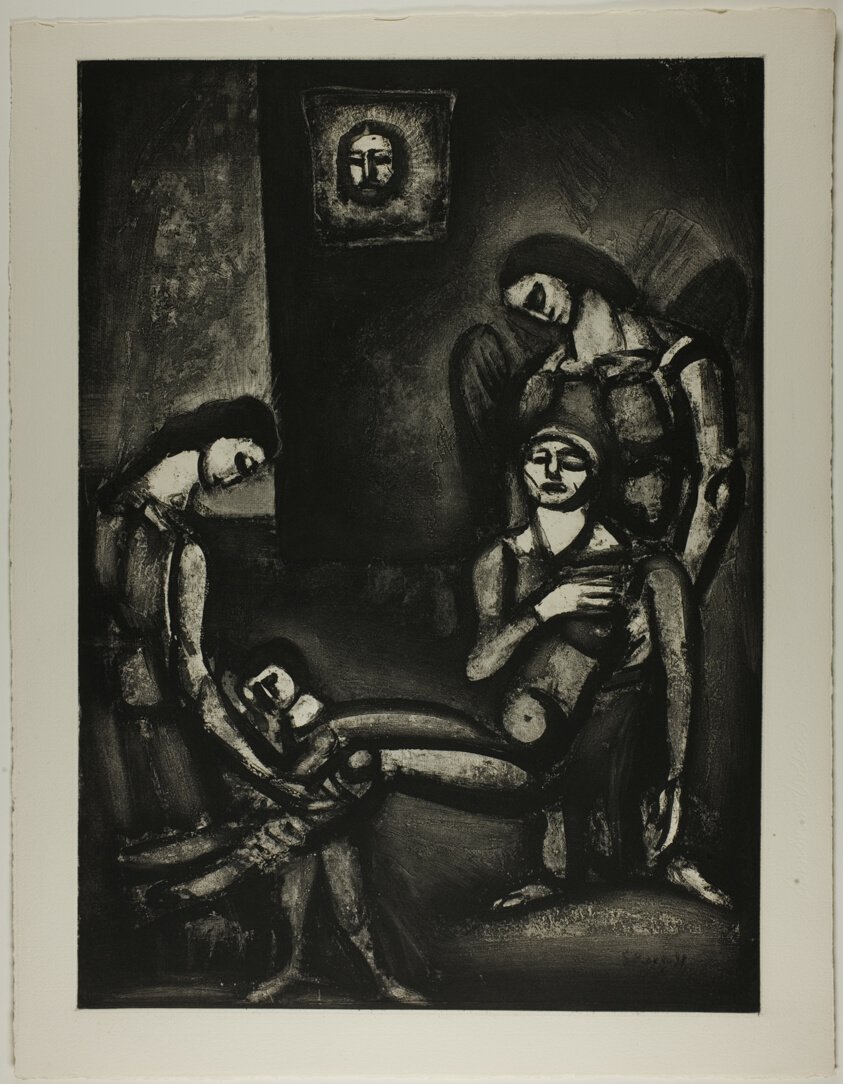
The Art Institute of Chicago, Gift of Frank B. Hubachek, Jr. and Mrs. Marjorie H. Watkins; © 2018 Artists Rights Society (ARS), New York / ADAGP, Paris · The Art Institute of Chicago
A sentence beneath a print
Plate 46 of Georges Rouault's Miserere carries a long French sentence: Le juste, comme le bois de santal, parfume la hache qui le frappe. The just man, like sandalwood, perfumes the axe that strikes him down.
The sentence is not a caption. It stands beside the image like a second voice. The image is silent, dark, heavy. The words bring in something paper and ink cannot hold: the smell of wood.
According to the Art Institute of Chicago, the print is an etching on paper, the image about 59 by 42 cm. That is closer to a painting on a wall than to a book illustration. Rouault was a painter before he was a printmaker, and the Miserere plates carry his hand: thick contours, broad blacks, scarce light.
The Art Institute dates its impression to 1945. Other museums give 1926. The gap is not simply a cataloguing slip. It shows how Rouault worked: he returned to his copper plates again and again, over years, before letting them be printed as a set.
Miserere, from war to mercy
The project began with Ambroise Vollard, the great Paris dealer of the early twentieth century. In 1916 he commissioned Rouault to make a book of prints, planned in two volumes of fifty plates each. Its first title was Miserere et Guerre: Mercy and War.
The First World War stands behind it. But Rouault also wrote that the series came after his father's death, and that he believed he had put the best of himself into it. Private grief and public grief travel together.
The plates were made mostly between 1922 and 1927. Then the project stalled. Vollard died in 1939, and Rouault had to win back the rights to the prints through the courts. Only in 1948 were 58 plates published in Paris under the title Miserere, more than thirty years after the commission.
The set holds Christ, soldiers, mothers, the poor, clowns. Each plate has its sentence. Some come from scripture, some sound like proverbs, some are Rouault's own. Moving through the 58 sheets is like moving through a litany made of images.
Scent as an answer
Sandalwood has been used for incense, boxes and fans in many cultures. Its scent lives in the heartwood and lasts a long time. Anyone who has held an old sandalwood fan knows this: years later, the ribs still smell.
Rouault's sentence turns that physical fact into a moral image. The just man does not answer violence with violence. What he leaves on the one who harms him is his own scent. The axe leaves the tree carrying part of the tree.
It is an image of forgiveness, but not a soft one. The axe still cuts. The tree still falls. Rouault does not promise that the good will be saved. He only says what remains once everything has happened.
In European painting, scent usually signals luxury, temptation, or the holiness of ritual, like the censer in the hands of Odilon Redon's angel. In plate 46 it is a human quality. A black and white print, without colour or smell, borrows the sense of smell to say what the image alone cannot.
Perhaps that is why this sentence is remembered longer than many other plates. The picture fades. The thought of wood scent clinging to an axe does not. It is concrete, it can be smelled in the imagination, and it asks the question Miserere asks across all 58 plates: faced with violence, what can a person keep?
Olfactory Art