
Essays · Olfactory Art
Marcantonio Raimondi, theo Raphael. The Incense Burner.
The smoke is gone. The shape remains.
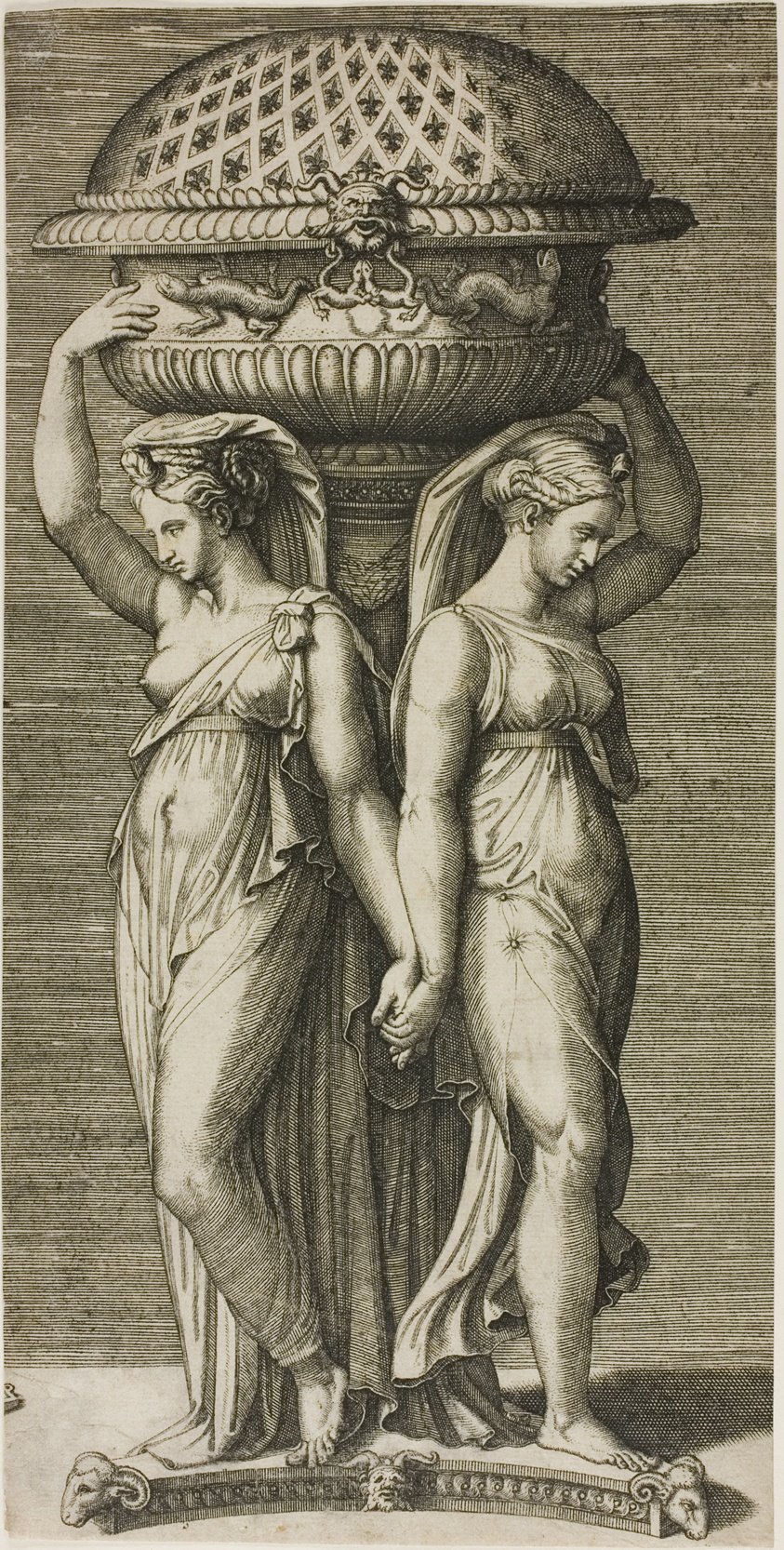
The Art Institute of Chicago, Clarence Buckingham Collection · The Art Institute of Chicago
A design on paper
The Incense Burner is an engraving by Marcantonio Raimondi, made around 1520. The sheet is about 30 cm high and 15 cm wide, printed in black on cream laid paper. It belongs to the Clarence Buckingham Collection at The Art Institute of Chicago, in the department of Prints and Drawings.
The image fills almost the whole upright sheet. At the centre stands a large incense burner, raised high. On either side, two women in draped classical garments hold it up. No room. No one offering incense. No altar. Only an object, and two figures serving as its support.
According to the museum, the design is based on a drawing by Raphael. Raimondi did not invent the shape of the burner. He moved it from pen line to engraved line on a copper plate, so that the image could be printed again and again.
The engraver and the painter
Marcantonio Raimondi was an Italian engraver, born around 1480 and dead around 1534. He is best known for engravings made after Raphael's drawings while both worked in Rome. Through him, Raphael's images left the walls and the workshop and entered sheets of paper that people could buy, carry and copy.
The Chicago museum places this print at the height of Raimondi's skill. It also points to a gift of Raphael's: simple but strong compositions. Two figures stand in symmetry. The burner sits on the central axis. The eye travels from base to top, in the direction the smoke would go.
At the time, ornament prints were often used as models by goldsmiths, bronze casters and carvers. A burner designed on paper could travel further than any burner made of metal. It passed through many hands and many cities without anyone burning a single grain of resin.
A burner for a king
The burner carries signs the museum reads as emblems of Francis I of France: the salamander and the fleur de lis. The design was therefore likely made in his honour. The word likely matters. The museum does not say whether such a burner was ever made in metal.
The salamander was Francis I's personal emblem. People then believed the animal could live in fire. Placing it on an object for burning incense is an exact choice: the fire inside the vessel, the creature that does not fear fire on the outside.
This is not a burner for an ordinary room. It is an object of display. Large size, two bearers, royal emblems: every detail says that scent travels with power. Resin was precious, and burning it in front of others was a way of stating where one stood.
Why an engraving of a burner stays with us
Renaissance scent left nothing for later noses. The resin burned away, the smoke dispersed five hundred years ago. What remains is the vessel, and images of the vessel.
The Incense Burner shows how much people of that time thought about scent through the eye. They invested in the form of the burner, in the figures that held it, in the emblems it bore. Scent was the centre of the ritual. But scent is invisible, so the vessel had to carry everything that could be seen.
The print also shows how an image travels. A drawing by Raphael, through Raimondi's burin, became a sheet that could be printed many times. That sheet now sits in Chicago, far from Rome. At the other end of the world, real burners also told the story of smoke through shape, like the Han dynasty mountain burner, where smoke rose through bronze ravines.

Olfactory Art