
Essays · Olfactory Art
Mountain-Shaped Incense Burner.
The mountain is bronze. The clouds are smoke.
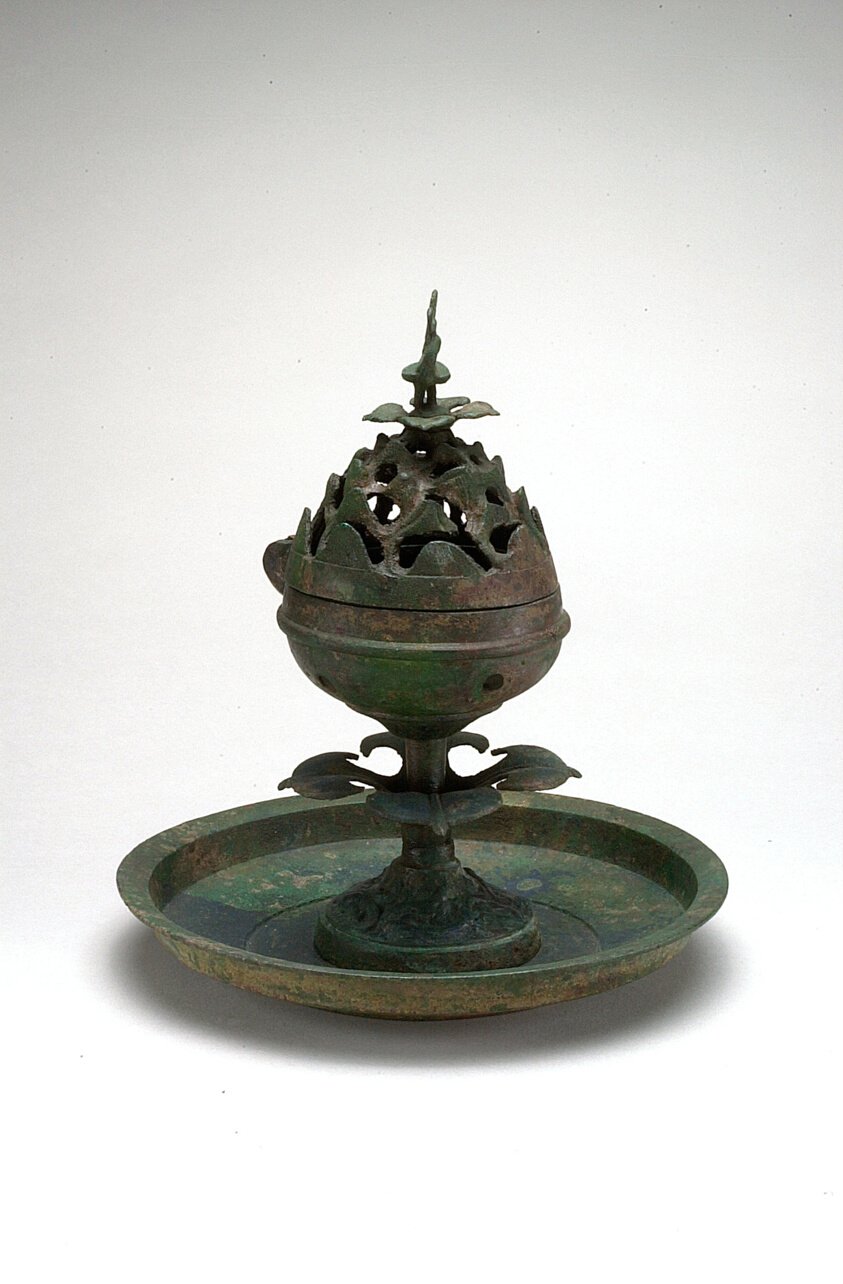
The Art Institute of Chicago, Lucy Maud Buckingham Collection · The Art Institute of Chicago
A mountain twenty one centimetres tall
The Art Institute of Chicago holds a bronze incense burner made in China during the Han dynasty, dated by the museum to roughly 100 BCE to 100 CE. It stands 21.3 cm high, 19.4 cm across. On a table it is about the size of a serving bowl.
The lower part is the bowl that holds the incense. The upper part is the lid, and the lid is the point. It is neither flat nor smooth. It rises into a cone of overlapping peaks, one behind another, with small openings between them. The museum records no inscription.
Later names for the type are boshanlu, the Boshan mountain censer, or in Western collecting, the hill censer. The name refers only to the lid. Nobody names it after its bowl, its foot or what burned inside. The name says people remembered it as a mountain.
The record traces it through the London dealer John Sparks to Kate Sturges Buckingham, who bought it on 13 December 1926 and gave it to the museum the same day. It belongs to the collection named for her sister, Lucy Maud Buckingham, who died in 1920; Kate, as executor, kept adding to it.
Isles of the immortals
According to the museum, Han beliefs about immortality and faraway lands inspired the earliest three dimensional landscapes in China. This lid, shaped like towering peaks, is associated with the mountainous Isles of the Blessed, described as the realm of the immortals.
Myth, superstition and magic about undying beings were widespread in the Han period. The islands belonged to stories, not to maps. No one saw them. People only heard about them.
The burner offered a way to see. It does not picture the islands; it builds a version that can stand on a table. And it leaves the most important part to the smoke, which drifts out through the openings and winds around the bronze peaks. The museum describes the effect as evoking a paradise wrapped in mist.
So this paradise is made of two materials. Bronze gives the form. Smoke gives the air. Without either, there is no scene.
A landscape born from scent
Chinese landscape usually brings to mind ink painting: peaks lifting out of cloud, white bands of mist across the rock. This burner is far older than those paintings. It shows that the wish to set mountain and cloud side by side was there early, and that at first it passed through the nose as much as the eye.
One thing is easy to miss. The clouds on this burner are never the same twice. They depend on the incense, the draught in the room, whether a door is open. The caster controlled the mountain. He could not control the cloud. He only prepared a place for it.
In 1973 the burner appeared in Unearthing China's Past by Jan Fontein and Tung Wu, published by the Museum of Fine Arts, Boston. On the page it is a photograph with no smoke and no smell. So it is today behind glass. The viewer looks at a bare mountain and has to add the clouds.
In Korea, the gilt bronze incense burner of Baekje carries the same idea much further, its peaks crowded with figures and animals. The Chicago burner is plainer. Because it is plain, the principle is clear: a pierced lid, a little smoke, and a world that appears for a few minutes.
Olfactory Art