
Essays · Olfactory Art
Baekje Kingdom. Gilt-bronze Incense Burner of Baekje.
A mountain made so that smoke has somewhere to go.
The Korea Times / Buyeo National Museum · The Korea Times
Found beneath a car park
In 1993, a car park was being built in Buyeo, South Chungcheong Province, Korea. The site had once been an old temple. During the work, the incense burner was found.
Buyeo was the last capital of Baekje, one of the three ancient kingdoms of the Korean peninsula. The burner was made around the sixth century, while Baekje ruled from there.
Three years after its discovery, in 1996, it was designated a National Treasure, number 287. Many now regard it as the defining object of Baekje art.
A world inside a burner
The burner is 62.3 cm tall, cast in bronze by the lost wax method and gilded with a mercury amalgam. The base is a dragon. The body is a lotus bud. The lid is a mass of layered mountains, crowned by a phoenix.
Lost wax casting means the maker first models the form in wax, encases it in clay, then heats it so the wax runs out and bronze is poured into the space. Each mould is used once. Details as small as a musician's fingers or a dragon's scales had to exist already in the wax. There is no second copy.
Across the slopes is a small world: waterfalls, lotus flowers, dragons, tigers, strange animals, immortals. Five musicians sit on the lid, each with an instrument: a double reed pipe, a vertical flute, a three string lute, a drum and a zither.
Hidden among the peaks are twelve small openings. They let incense smoke out and air in so the incense burns evenly. In use, smoke would rise from the ravines themselves, like mist around a real mountain.
Every detail, from the dragon at the bottom to the phoenix at the top, serves one purpose: to give a thread of smoke a shape, a path and a story.
A building for one object
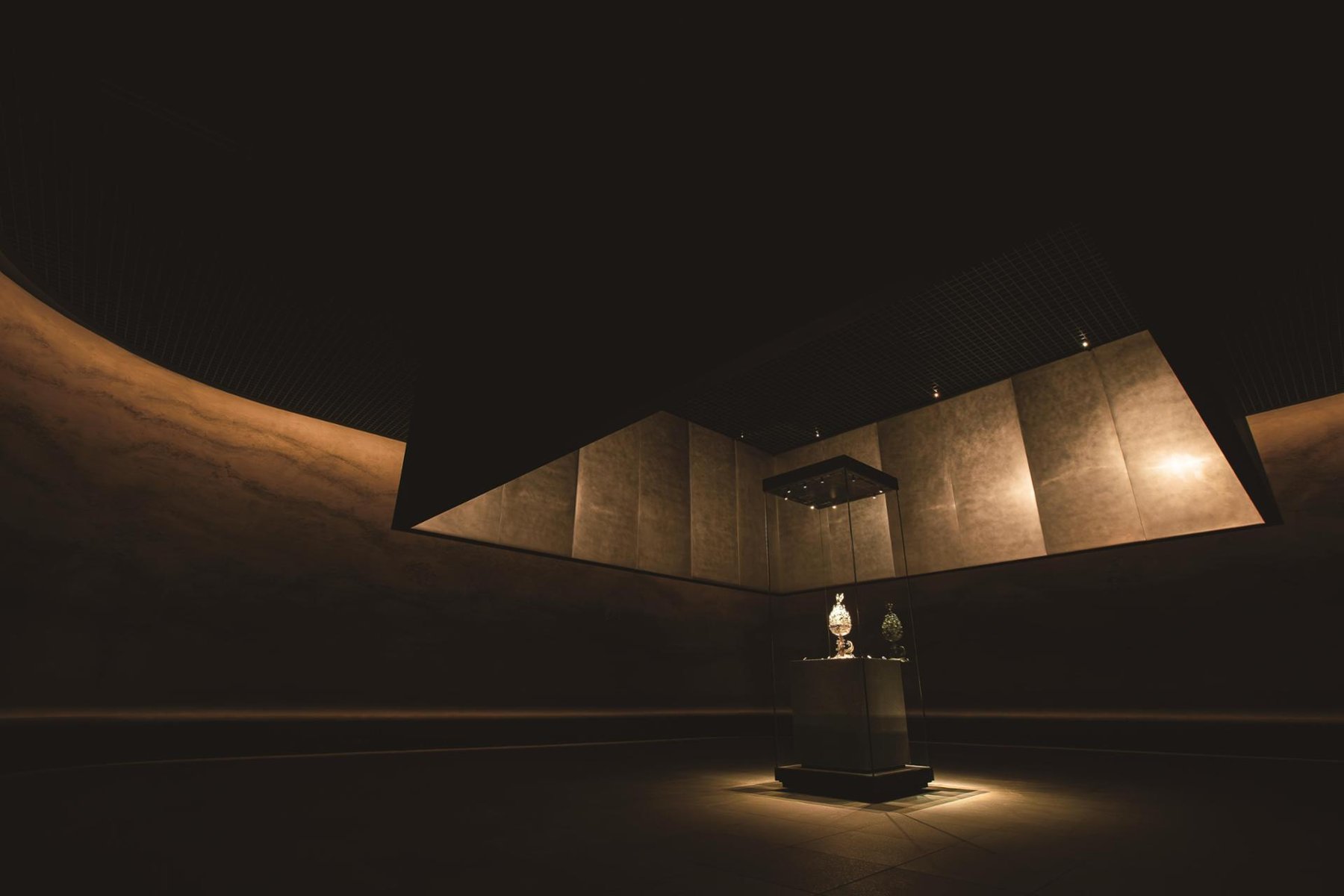
On 23 December 2025, the Buyeo National Museum opened the Baekje Great Incense Burner Hall. According to The Korea Times, it is Korea's first permanent building devoted to a single artefact. The three storey hall took three years to build.
Inside is a darkened room with compacted earth walls and reliefs of mythical creatures. The room carries a faint ambient scent and an original piece of music. There are high resolution films and metal replicas visitors can touch.
The museum's director, Shin Young-ho, described it as a space made for just one object.
What stands out is what the museum added. Not only light and glass. It added scent and music, the two things the burner once called up but can no longer hold.
Why the burner stays with us
Most incense burners in museums are beautiful utensils. The Baekje burner is a small cosmos. It does not only hold incense. It stages the way incense appears.
Its makers left no names. But they left a way of thinking: smoke is not an extra. Smoke is the last part of the work, the part that completes the mountain.
The burner is also a reminder that scent was once part of ritual, placed at the centre, made in the most precious material a kingdom had. The people of Baekje did not treat smoke as a small matter. They built it a mountain.
Today the burner stands alone in a dark room built for it. The smoke is gone. What visitors see is the shape of a place smoke once passed through.
Olfactory Art