
Essays · Olfactory Art
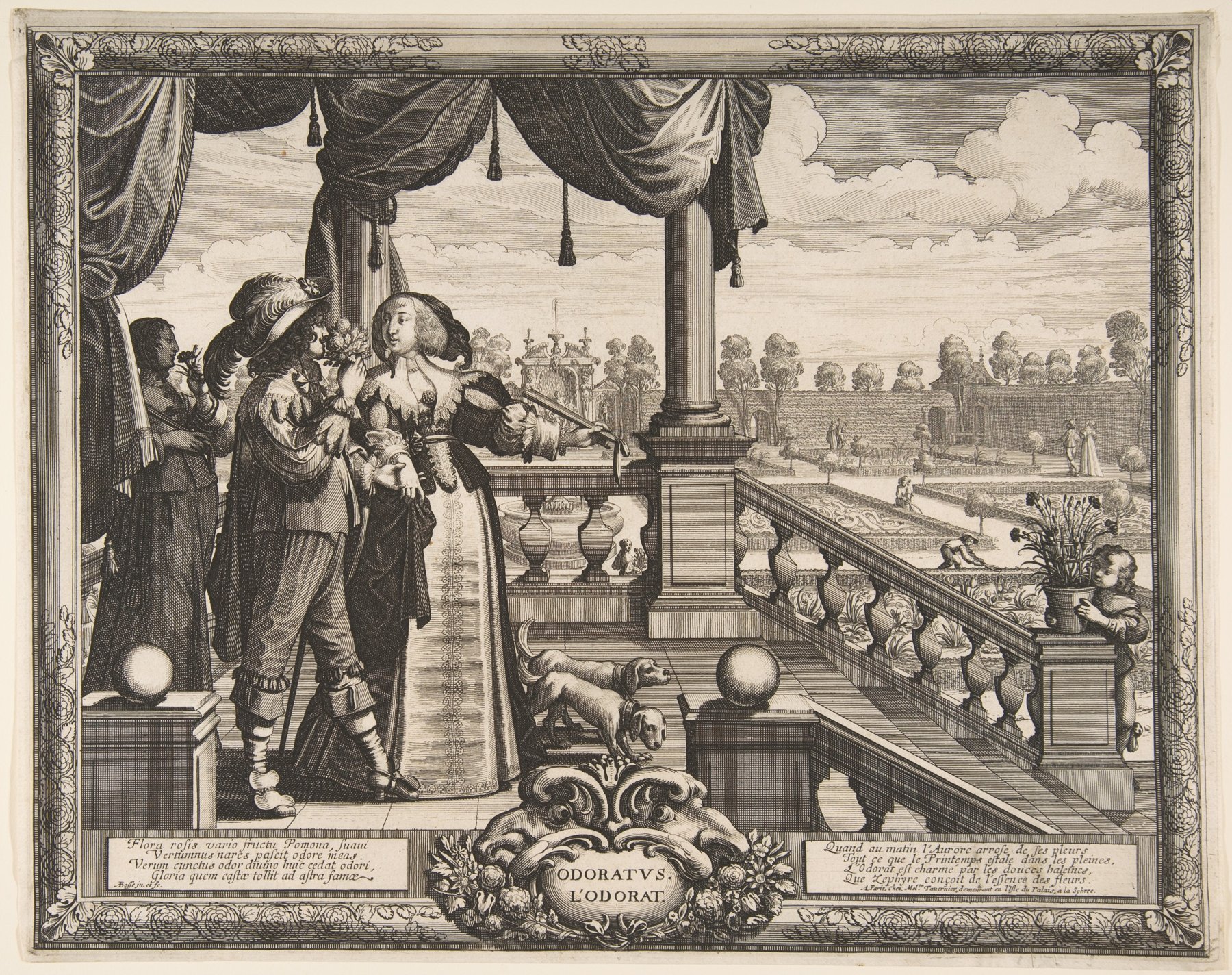
Abraham Bosse. L'Odorat.
People smell flowers, dogs smell each other. One sense.
The Metropolitan Museum of Art, Harris Brisbane Dick Fund, 1926 (Open Access, public domain) · The Metropolitan Museum of Art
An afternoon on the terrace
A heavy curtain is drawn back and tied with tassels. Below it is a paved terrace with a turned balustrade, stone spheres set on its posts. A tall column rises in the middle, dividing the image in two.
On the left a couple stands close together. The man wears a broad plumed hat, a doublet, full breeches and beribboned boots, and raises a flower towards his face. The woman wears a long gown with a wide lace collar and points something small towards the garden. Behind them another figure also lifts something to the nose.
At the couple's feet two small dogs are sniffing each other. At the right, on the steps, a child holds a pot of flowers.
Behind it all lies the garden. Patterned beds, straight paths, clipped trees, a few tiny figures strolling. A French garden, orderly and clean, stretching to the last row of trees.
Bosse and five scenes of daily life
Abraham Bosse was born in Tours around 1602 to 1604 and died in Paris in 1676. He was an etcher, one of the best known printmakers in France under Louis XIII, and in 1645 he published a manual on etching technique that was used for generations.
Les Cinq Sens, The Five Senses, was made around 1635 to 1638 and published in Paris by Melchior Tavernier. Five plates: hearing, sight, smell, taste, touch. Each carries the name of its sense in Latin and French in an ornamental cartouche at the bottom centre, flanked by two quatrains, one Latin, one French.
What sets the series apart is Bosse's choice of scene. Before him, smell was usually a goddess or an allegorical figure in antique dress. Bosse was among the first to show the five senses through five scenes of contemporary life. His figures wear what well off Parisians actually wore. The rooms, the garden, the furniture were things viewers recognised.
The series was a success from the start, and later painters copied it on canvas and in decoration. The impression at the Metropolitan Museum in New York has a plate of about 25.8 by 32.5 cm and was acquired in 1926.
Smell as a way of living
Look closely and L'Odorat is not only about the nose. It is about a way of life.
The Latin verse at left names Flora and roses, Pomona and fruit, the deities of the garden. The French verse at right speaks of morning and the essence of flowers. Myth survives, but only in the words. In the image there are only real people.
And what are they doing? They stand at the highest point of the garden, in their best clothes, smelling a flower as if it had been chosen for them. Scent here belongs to wealth: a garden big enough to need gardeners, flowers set in patterned beds, a child bringing a pot up to the adults.
Yet Bosse was a sharp observer. He places two dogs in the very foreground, at their owners' feet. In images of the five senses the dog often accompanies smell, since its nose is keener than ours. Here the dogs remind us of something simple: beneath the clothes and the manners, smelling is still a thing the body does.
Bosse's senses are often read as a record of seventeenth century Parisian dress, interiors and customs. L'Odorat adds one more thing: a picture of what people of that time wished to be seen smelling. Set beside sixteenth century series of the senses, such as Jost Amman's, it shows how smell left the world of symbols and stepped into daily life.
Olfactory Art