
Essays · Olfactory Art
Refik Anadol. Machine Dreams: Rainforest.
Images can be synthesised. A smell still has to come from something.
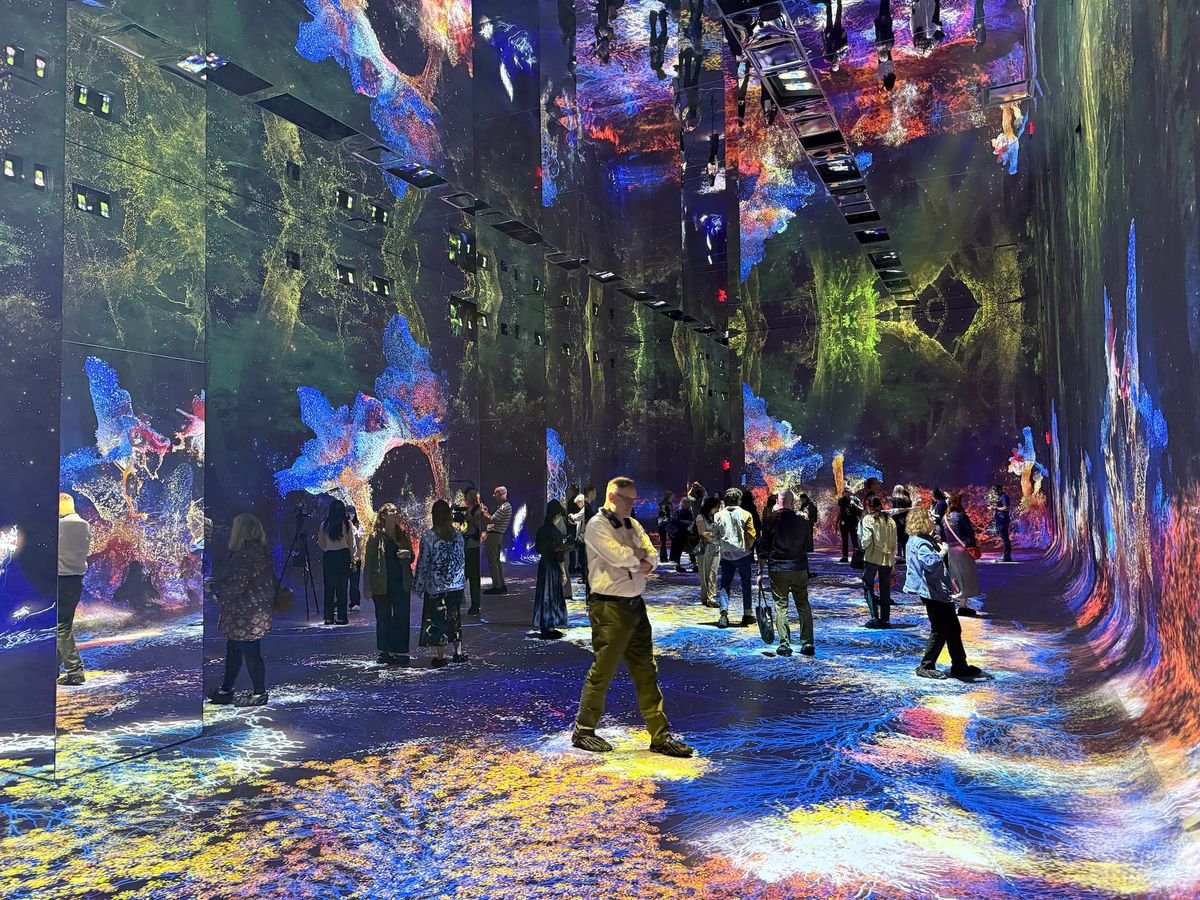
Photo Matt Stromberg/Hyperallergic · Hyperallergic
A museum for machine art
On 20 June 2026, Dataland opened in downtown Los Angeles. It calls itself the world's first museum of AI arts. It sits inside the Grand LA development on Grand Avenue, a high rise complex designed by Frank Gehry.
Its founders are the artist Refik Anadol and his longtime partner Efsun Erkılıç. Anadol is known for enormous screen walls where data turns into rivers of colour that never stop moving. Dataland is the first time he has a building of his own for that kind of work.
The opening exhibition is Machine Dreams: Rainforest. Visitors ride a long escalator down into a wide, mirrored space. On the walls, the floor and the ceiling, images keep moving: computer graphics slowly becoming networks of fungal threads, then flowers, then trees.
A forest made of data
According to Hyperallergic, the images are generated from around 1.2 billion data points gathered from 16 rainforests around the world. The data comes from partners including the Smithsonian, the Cornell Lab of Ornithology, the Getty Conservation Institute and the Natural History Museum in London.
From this, Anadol's team trained what they call a Large Nature Model, a machine learning model taught only on data about nature. The machine does not record any particular forest. It produces forms of trees, flowers and fungi that have never existed but look as if they could.
Sound travels with the images. At first, sparse ambient layers; then music that builds like a film score. In between, birdsong and the howls of monkeys. Visitors also wear a wristband that records heart rate, temperature and skin conductivity.
A smell worn at the neck
The most unusual part of Machine Dreams: Rainforest is the smell. Each visitor wears a small device around the neck, developed by L'Oréal Luxe. It releases a scent described as damp forest floor.
In many installations that use smell, the scent is diffused through the whole room. Everyone who enters breathes the same thing. Here, the smell travels with each person. It moves with the body through the mirrored space, closer to the nose than any image.
Set beside a billion data points, the device raises a simple question. A machine can generate pictures of a forest that never was. But to make visitors feel they are inside one, the museum still reaches for the smell of soil, the most material thing of all.
A damp forest floor, anywhere, calls up very material things: rotting leaves, roots, soil that has just taken in rain. The smell does not need to be beautiful. It only needs to recall what no projector can put on a wall.
When every sense arrives at once
Writing for Hyperallergic, the critic Matt Stromberg described his walk through the show in two registers at once. He was thrilled and absorbed by the images. He also felt queasy, his heart racing, as if his body could not keep up with the stimulation.
That account says a lot about the work. Image, sound and smell come together, all at high intensity. Visitors are left no room to look or smell on their own terms. Every sense is led along a script.
Anadol has fed museum data into his work before, as in Unsupervised at MoMA. At Dataland he adds smell. And the smell, the smallest thing in the room, is what reminds visitors that they still have a body, and still need ground to stand on.
Olfactory Art