
Essays · Contemporary Art
Refik Anadol. Unsupervised: Machine Hallucinations, MoMA.
When a museum remembers itself.
An archive enters the machine
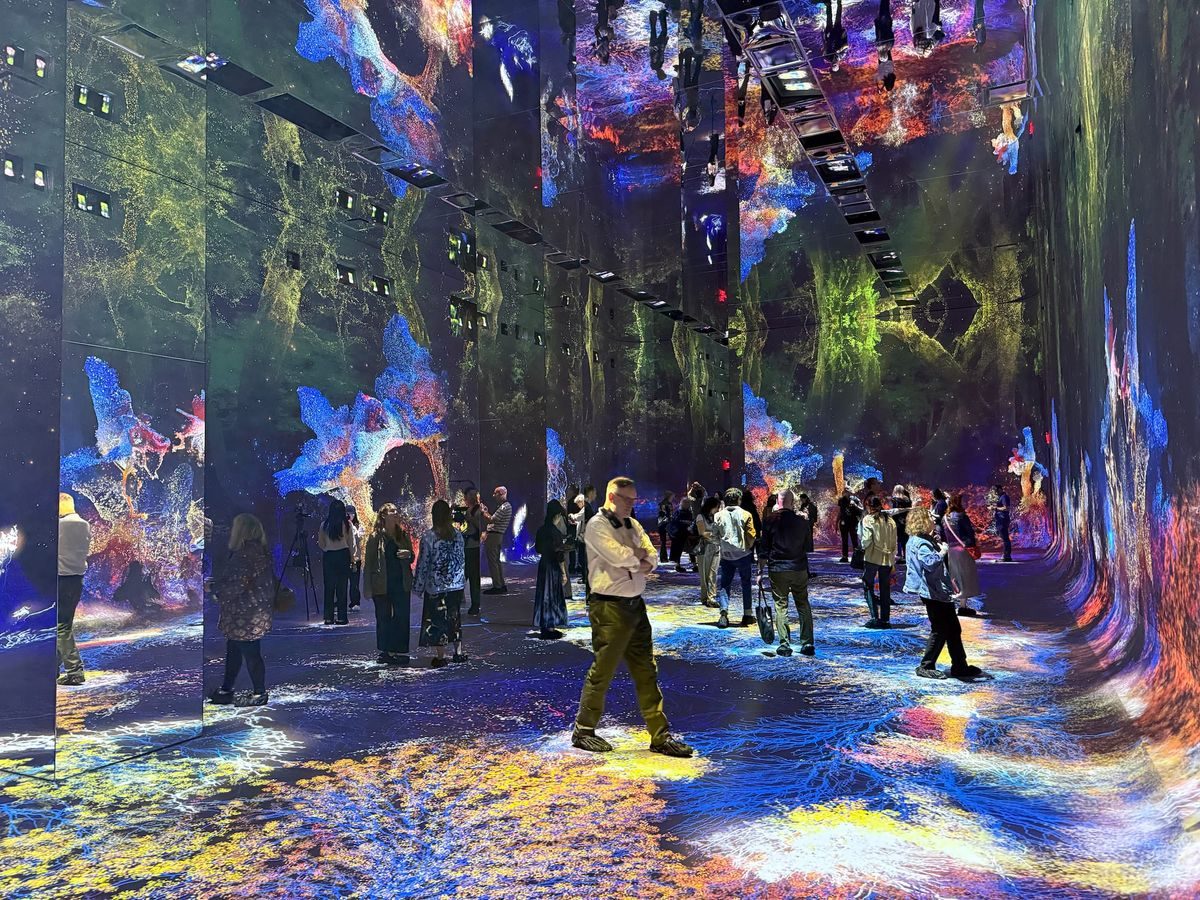
From 19 November 2022 to 29 October 2023, at MoMA in New York, a large screen never stood still. Masses of colour curled, dissolved, rose into shapes and collapsed. No painting could be identified. Yet viewers felt something familiar.
This was Unsupervised: Machine Hallucinations, MoMA, by Refik Anadol and his studio. According to the artist's own site, the team fed 138,151 images from MoMA's digital archive into a machine learning model. The model turned each image into a point in a mathematical space of 1,024 dimensions, where similar works sit close together and different ones far apart.
The project was made with two MoMA curators, Michelle Kuo and Paola Antonelli. Anadol calls his series machine hallucinations, and at MoMA the hallucination had the museum itself as its source.
No one teaching
Unsupervised is a machine learning term. It means training without anyone labelling the data. The machine is not told this is Cubism, that is a photograph, this is a chair design. It finds connections on its own, by its own logic.
Anadol used a network architecture called StyleGAN2, then let software wander through the mathematical space the model had built. Every step produces a new image. So the screen does not play a looping video. It shows a process in motion.
The results resemble no single work in the collection, yet are not strangers to them. At times a field of colour recalls abstract painting. At times a curve recalls a designed object. Viewers guess, each differently, according to what they have seen before.
Anadol describes his work as tracing the machine's unconscious decisions. Unconscious is a metaphor, of course. But it names the feeling in front of the screen: watching something think, without knowing what it thinks.
The museum dreams
A museum usually does the opposite. It classifies, labels, dates, lists materials, places each work in a box. Unsupervised removes all the labels. A Cubist painting and a chair, a photograph and a poster, all become the same thing: data about shape and colour.
Some find this troubling, since it erases context and the names of makers. Some find it beautiful, since it shows a collection as a living mass rather than a catalogue. The work takes no side. It puts the question before the viewer, in a space everyone has to pass through.
Anadol pursued this direction in other projects, such as Machine Dreams: Rainforest, where the machine learns from a rainforest instead of paintings. At MoMA the subject carries its own weight: one of the most important museums of modern art letting a machine look back over its whole memory.
In front of the screen, nothing new is learned about any single work. But something is learned about how memory works: it does not store, it transforms. And perhaps the paintings upstairs look a little different afterwards, like small pieces of a larger dream.
Contemporary Art