
Essays · Olfactory Art
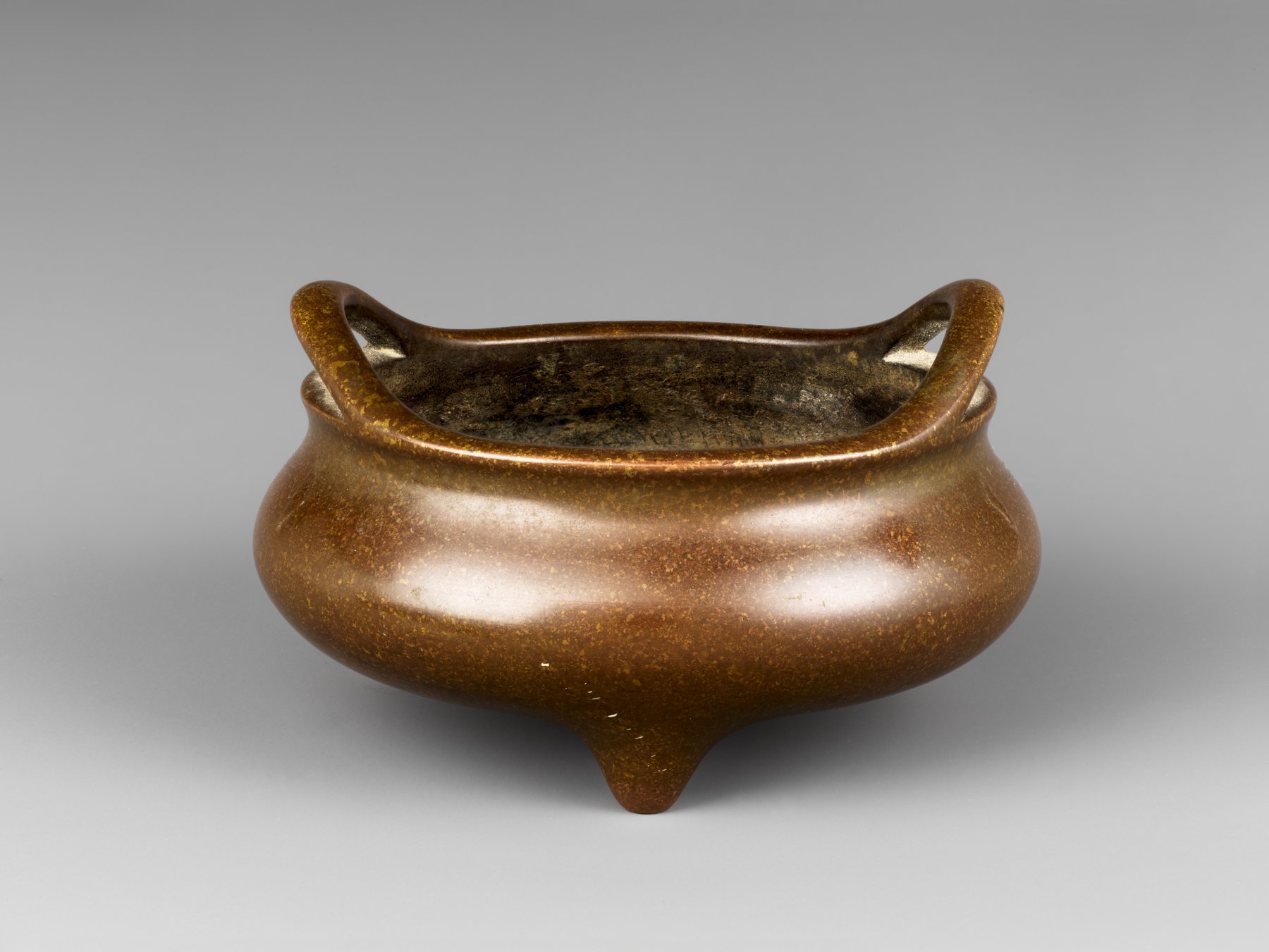
Unknown maker, China or Japan. Incense burner (kōro).
One burner, two possible homelands, three points in time.
The Metropolitan Museum of Art, Gift of Peggy and Richard M. Danziger, 2024 (Open Access, public domain) · The Metropolitan Museum of Art
A layered record
In 2024, Peggy and Richard M. Danziger gave the Metropolitan Museum in New York a copper alloy incense burner. It is small: 7.6 cm high, 11.4 cm across. It fits in a palm. The museum calls it Incense burner, with the Japanese kōro in brackets.
Read the record and things do not line up. Culture: China or Japan. Date: 15th century. Period: Qing dynasty, 18th century, with a Xuande mark, the Ming reign of 1426 to 1435.
Three points in time on one object. A 15th century reign mark, engraved. A 15th century date, recorded. An 18th century Qing period, noted alongside. The museum lets all three stand in the record without erasing any.
Penta will not try to untie this knot for the museum. The essay stays with what the record says, and looks at the uncertainty itself.
The name Xuande
Xuande was the reign name of the fifth Ming emperor. Under him, the imperial workshops made bronze burners that later generations held up as models. According to the Met, Xuande bronzes were so cherished that from the 17th century onward, later bronzes were often marked with the Xuande reign.
A mark, then, is not always an object's birth date. It can be homage, emulation, or a way of raising value. An 18th century burner with a 15th century mark is not simply a fake. It is an object placing itself in a lineage.
This helps explain why the burner's record has several dates. The name on the base speaks of one time. The material and form may speak of another. A scholar has to weigh the two voices.
China or Japan
The word kōro in the title points to Japan. Yet the record also lists China. The ambiguity has a history.
From the Muromachi period, the 14th to 16th centuries, Japanese warriors and Zen monks prized objects imported from the continent, known as karamono, Chinese things. Chinese bronze burners, vases and tea bowls crossed the sea, were displayed in reception rooms, catalogued, passed on as treasures. Japanese makers learned from them and made burners in the Chinese manner.
In the same centuries, the appreciation of incense in Japan slowly became a practice with rules, later called kōdō, the way of incense. A small metal burner that fits the hand is the kind of object that had a place at such gatherings. The record does not say where this one was used, so Penta only sets it beside that context, no further.
When an object moves from one country to another, is copied, marked, repaired, the trail back to its origin fades. The Met's burner carries that fading. It belongs to a current, not to one workshop.
Japanese ceramics followed the same path: the 17th century incense burner by Nonomura Ninsei shows how burners in Japan later found a look of their own, in clay, glaze and colour. This small metal burner stands earlier on that road, when the line was not yet clear.
Today it sits in gallery 228 at the Met. Less than eight centimetres of metal, no smoke, waiting for an answer.
Olfactory Art