
Essays · Olfactory Art
Suzuki Chōkichi. Incense Burner.
An incense burner made so a nation could be seen.
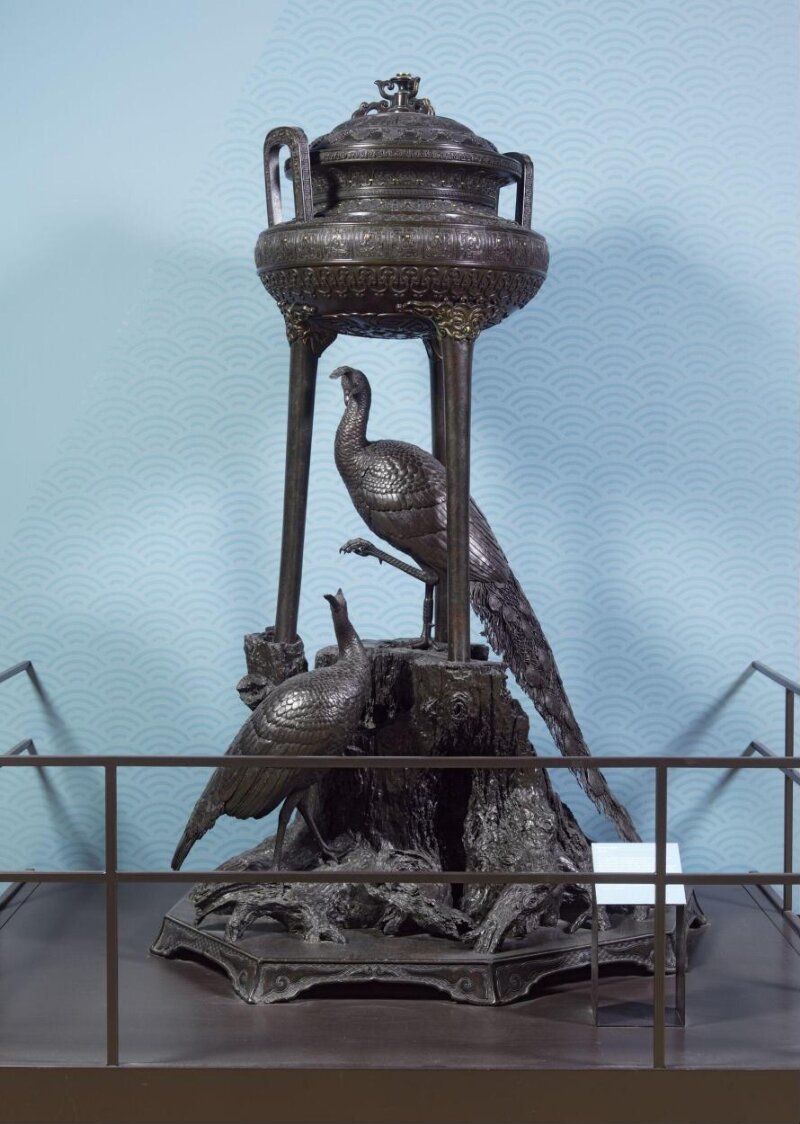
© Victoria and Albert Museum, London · Victoria and Albert Museum (V&A)
A stump and two birds
The burner belongs to the Victoria and Albert Museum in London, museum number 188:1 to 9-1883. The numbers one to nine show it is made of nine separately cast parts. The maker is Suzuki Chōkichi, signing with his art name Kakō. It dates to around 1877 to 1878.
It is cast and patinated bronze, 228.6 cm high and 128 cm wide. Standing beside it, most visitors have to look up. Nine bronze parts, each cast on its own, assembled into an object that stands above a person's head.
The form is a scene from nature. At the bottom, a tree stump with spreading roots. On the stump, a peacock and a peahen. In the middle of the scene, the burner itself: a bowl with handles, an upper section, a lid with a knob. Bowl, upper section, lid and base were each cast separately and then assembled.
Under the bowl is the inscription Dai Nihon Kakō sei, Great Japan, made by Kakō. A short line, but it makes clear whom the object stands for.
Cast from wood, learned from living birds
The V&A describes the birds' detailing as extremely realistic. The feathers, the stance, the reach of the necks are rendered so closely that the museum believes the maker studied live birds. For later works, Suzuki Chōkichi kept birds in his studio to capture their anatomy and posture exactly.
The stump has another story. According to the V&A, it may have been cast from actual wood, a technique used by nineteenth century Japanese metalworkers. Instead of modelling bark by hand, the maker took a mould directly from bark. Every crack is a real crack.
Both methods point the same way: not imagining, but recording. The birds are seen from living birds. The tree is taken from a real tree. The burner becomes a record in bronze of things that exist.
At the centre of that record is the one part that cannot be seen: the incense. When it burns, smoke rises around the birds, around the stump, and fades into the room. Something invisible placed among things made to be looked at closely.
From Paris to London
In 1878 the burner was shown at the Universal Exhibition in Paris. It was brought there by Kiryu Kosho Kaisha, a company sponsored by the Japanese government. These were the early Meiji years, when Japan had newly opened and wanted the world to see it through its crafts.
A burner more than two metres tall is not an everyday object. It was made to stand in a great exhibition hall, among crowds of European visitors, and make them stop. In that role it resembles an ambassador more than a utensil.
After the exhibition the dealer Siegfried Bing bought it. In 1883 he sold it to the V&A for £1,586 7s 2d. According to the museum's record, the purchase needed special permission from the Treasury. Today it stands in Room 45, the Toshiba Gallery.
The burner is worth remembering because it shows that incense can be used to say something larger than a room. Here the smell is only the occasion. What is said is skill, observation, a country introducing itself. Yet at the very centre there is still a small bowl, where a piece of incense could be placed to burn quietly.
Olfactory Art