
Essays · Olfactory Art
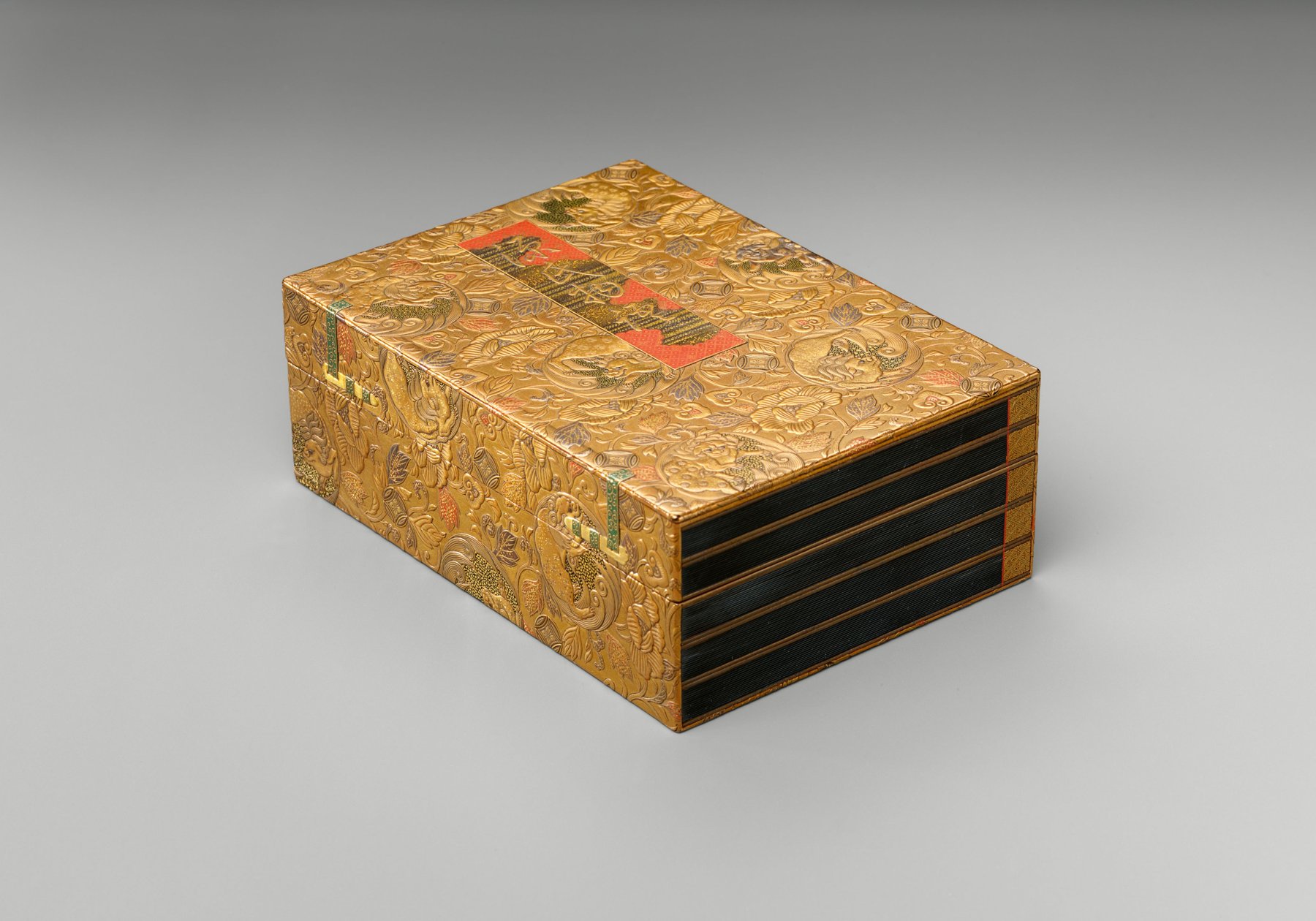
Japan. Incense Box in the Shape of Five Volumes of The Tale of Genji.
A book not for reading. For opening, and smelling.
The Metropolitan Museum of Art, Gift of Mrs. George A. Crocker (Elizabeth Masten), 1937 (Open Access, public domain) · The Metropolitan Museum of Art
Five books in lacquer
The Metropolitan Museum of Art in New York holds a small incense box, just over 11 cm long, about 8 cm wide and under 4 cm high. It was made in Japan in the late nineteenth century, the Meiji period, and entered the museum in 1938 as a gift of Mrs. George A. Crocker.
At first it does not look like a box. It looks like five books stacked and bound in a brocade cover, the kind once used to hold slim, thread bound volumes. The cover bears the title in Japanese: Genji monogatari, The Tale of Genji.
The brocade is not fabric. It is lacquer. According to the museum, its pattern shows medallions of Chinese lions, peonies, and scattered auspicious treasures.
To make this false brocade the craftsman used several techniques at once: takamaki-e for raised forms, hiramaki-e for flat ones, togidashimaki-e, in which the design is covered and then polished back to the surface, cut gold and silver foil, and red and green lacquer. A small surface carries a whole repertoire.
Inside: a blind and a flower ball
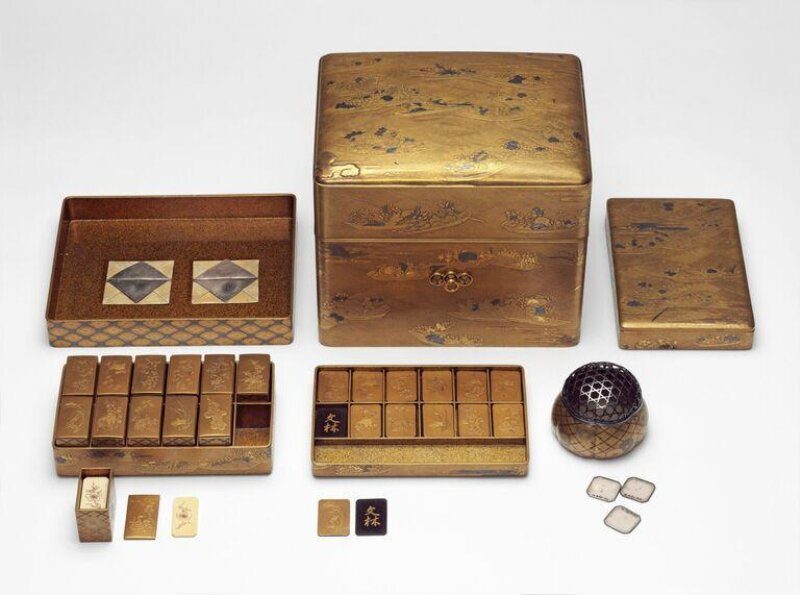
Inside the box is an incense tray. It too is decorated: a rolled up bamboo blind, with a kusudama hanging from it, the ball of flowers the Japanese hung as an amulet.
Neither detail is random. The bamboo blind belongs to the court world of the Heian period, where The Tale of Genji unfolds. A noblewoman sat behind the blind; visitors saw only a silhouette, heard only a voice, and often only smelled the incense in her robes. A blind rolled up is a moment of being seen.
The kusudama is tied to scent quite literally. Its name contains the word for medicine, and by tradition such balls held aromatics and herbs. Placing one in an incense tray places a fragrant thing inside a fragrant thing.
Whoever opens the box meets three layers: the book cover outside, a court scene inside, and finally the fragrant wood resting in the tray.
The Tale of Genji and Genji-kō
The Tale of Genji was written in the early eleventh century by a lady of the Heian court known to later readers as Murasaki Shikibu. It has fifty four chapters. Scent is everywhere in it: robes perfumed with incense, people recognised by smell, contests in blending incense.
Centuries later, incense players built a game on the tale, called Genji-kō. Five packets of incense are warmed in turn. Some are the same, some different. Players mark which packets match by joining vertical lines.
Five packets yield exactly fifty two ways of grouping. Each was assigned to a chapter, leaving out the first and the last. Every result thus has a literary name. To guess the combination of scents correctly is to name a chapter.
These Genji-kō symbols later left the game and appeared on textiles, ceramics and lacquer. They became a script of their own, belonging both to literature and to smell.
When a book becomes a shell for scent
Book shaped incense boxes are not rare in Japanese art. But this shape says more than novelty. It says that for incense players, The Tale of Genji and fragrant wood belonged to the same world.
In the Meiji period, when this box was made, Japan was opening and changing fast. Lacquer like this mostly looked back: to the Heian court, to the incense pastimes of earlier centuries. It held on to a culture while that culture was changing.
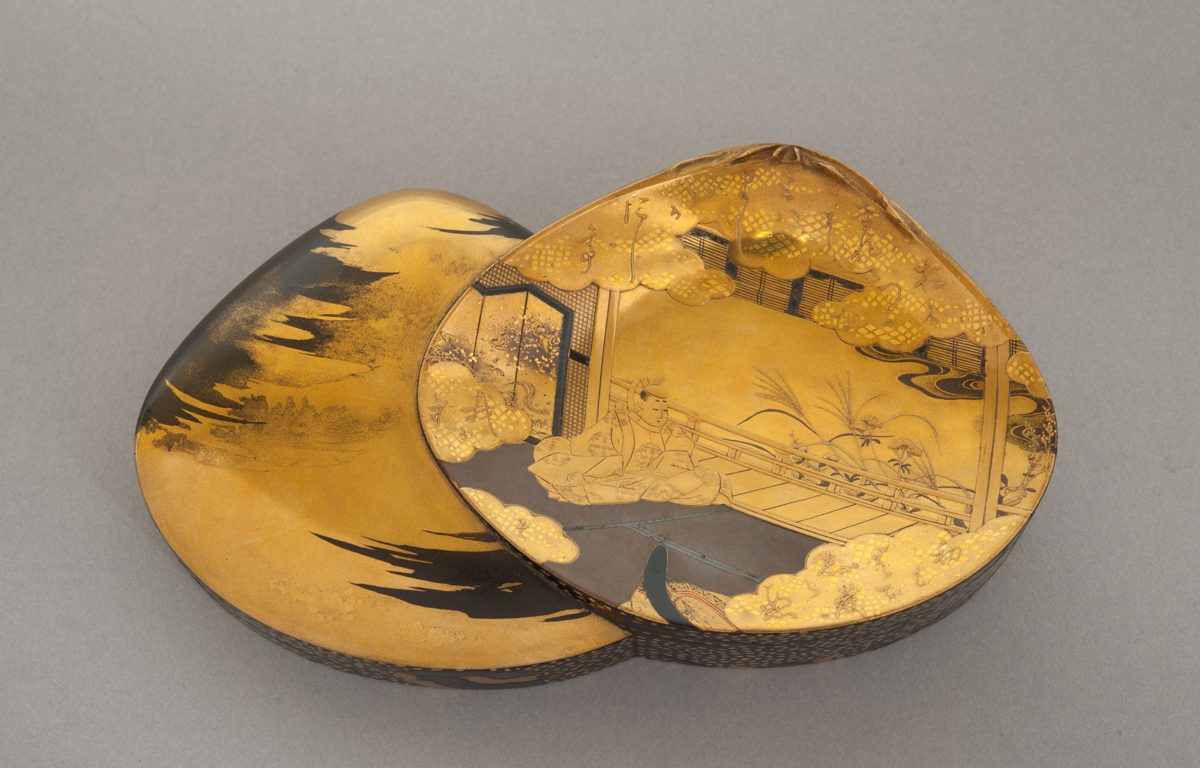
The Met's collection also holds an incense box shaped as two shells, also from Mrs. Crocker, painted with a scene from chapter forty two of the tale. One borrows the shape of the book; the other borrows a scene within it.
Olfactory Art