
Essays · Contemporary Art
Zoe Leonard. You see I am here after all.
One place, mailed thousands of times.
Courtesy of Dia Art Foundation · BOMB Magazine
One waterfall on four thousand cards
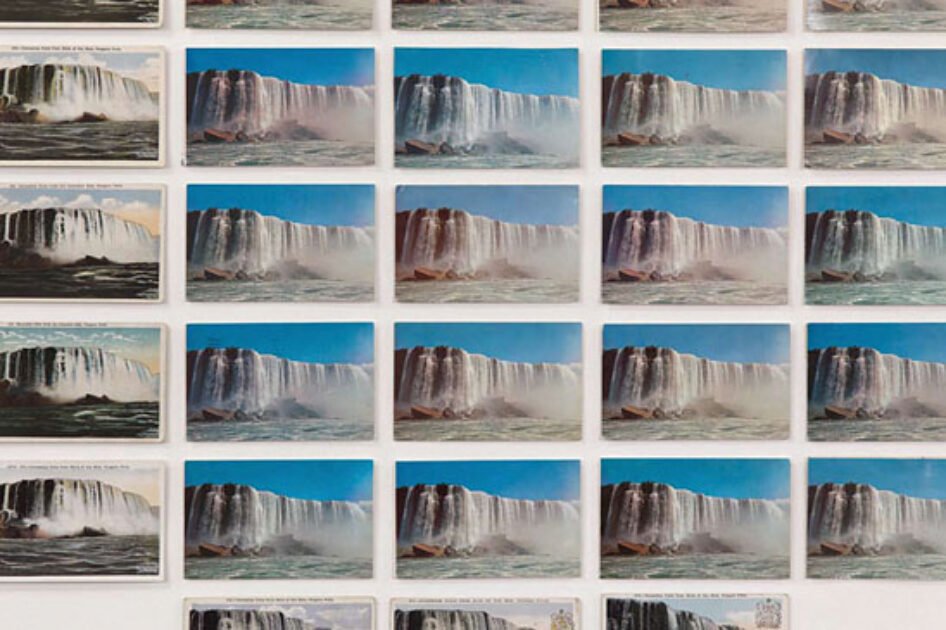
In 2008, at Dia:Beacon, a museum set in a former printing factory on the Hudson, Zoe Leonard showed nearly 4,000 vintage postcards. All of them picture one place: Niagara Falls, on the border of the United States and Canada.
The cards were hung in a band along the walls, on a horizon line at eye level. Leonard grouped them by vantage point: looking down from above the falls, up from below. Cards with the same view stand together in blocks, one after another, like a very long panorama.
The work stayed on view for about two and a half years. Anyone visiting could walk the wall and see the same falls repeated hundreds, then thousands of times.
Mass produced images
A postcard is an industrial image. One photograph printed in thousands of copies, sold at a souvenir stand for pennies, written on, mailed. The sender did not take the picture. They only chose it, as one chooses a ready made phrase.
Niagara is among the most printed places on postcards. So Leonard's wall reveals something odd: the falls barely change, but the printing, the ink, the borders, the lettering shift from era to era. The history of the falls becomes the history of how the falls were printed.
In BOMB, Marc Joseph Berg wrote about the rigor, repetition and pattern of the work, placing it beside other Dia artists who also work in series and systems. Leonard did not paint or photograph. She collected, sorted and arranged.
The book and forty texts
An artist's book accompanies the work. It photographs the postcard wall in very high resolution digital images, so an image made for mass reproduction is reproduced once more.
Alongside the pictures, the book gathers about forty historical texts on Niagara, from an account of 1683 to a film script of 1953. Each points to the same place from a different angle and a different time.
Pictures and words do the same job. They show that a place is not a fixed point but a stack of descriptions laid on top of one another.
Many people's memory
The title, You see I am here after all, sounds like a line from a sender. It keeps the private voice of each person who stood before the falls, while the pictures are nearly identical.
That is the subtlety of the work. Each card was once a private moment: a trip, a recipient, a greeting. Placed together, those moments merge into a collective memory of one place.
Standing at the wall, the viewer does exactly what the senders did: sees Niagara through a ready made image. The difference is that now they can see what they are looking through. Thousands of near identical frames force the eye onto small differences: a sky printed bluer, a slipped line of ink, a small detail in a corner. The particular emerges from the repeated.
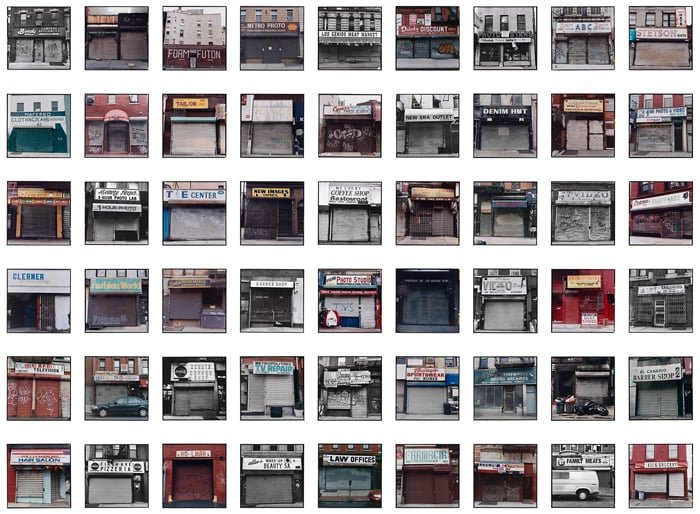
Earlier, Leonard made Analogue, photographing old shops and goods disappearing from New York and elsewhere; Zoe Leonard. Analogue. reads it as a record. With Niagara she turned around: she stopped photographing and gathered what others had printed and sent.

Contemporary Art