
Essays · Contemporary Art
Zhang Huan. 12 Square Meters.
Every room leaves a trace on those who live in it.
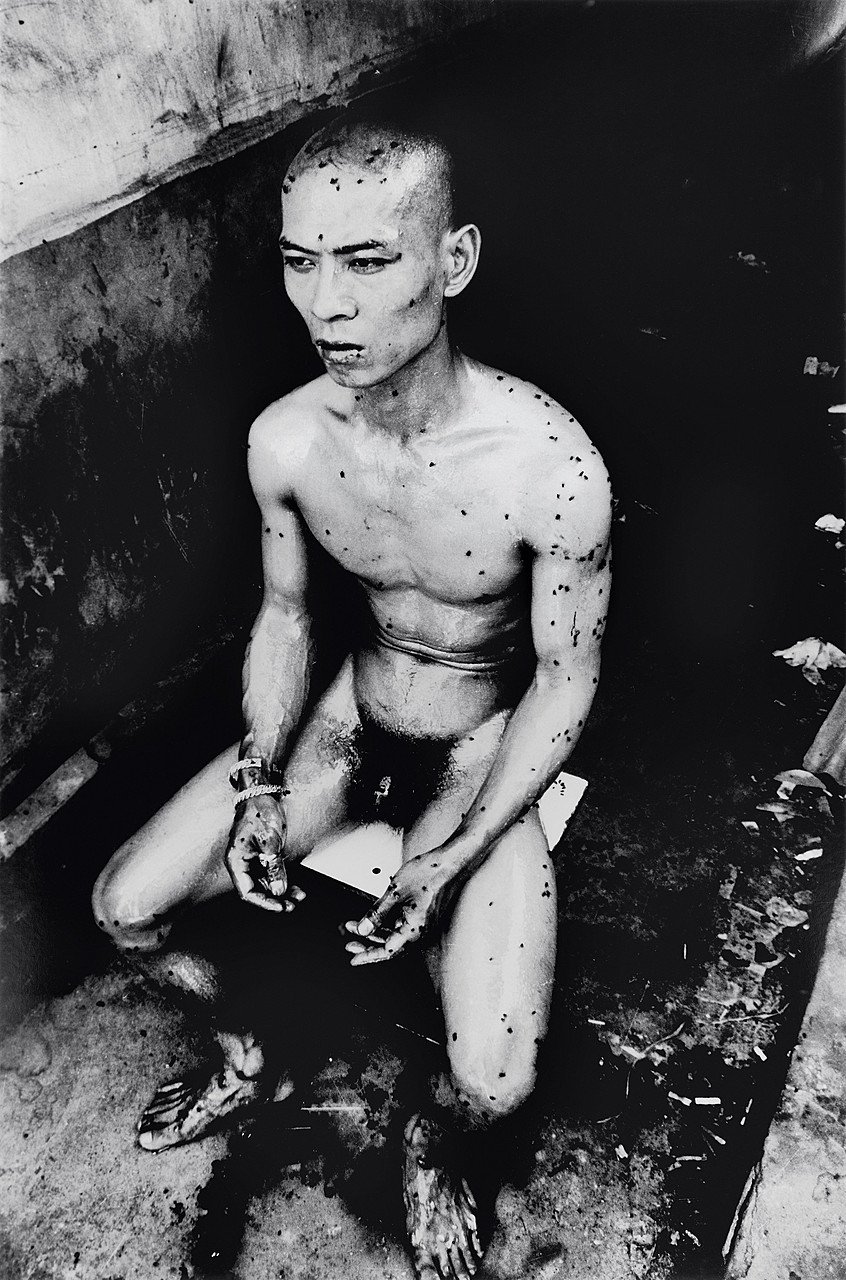
Solomon R. Guggenheim Museum · Solomon R. Guggenheim Museum
A village on the edge of Beijing
In the early 1990s Zhang Huan and a group of performance artists moved to Dashancun, a poor village on the eastern outskirts of Beijing. It served as the city's dumping ground. Cheap rent. Dirt roads. Shared latrines.
They gave the place a new name: Beijing East Village, borrowed from New York's East Village, centre of 1980s vanguard art. The name was half joke, half declaration.
According to the Guggenheim, the group set itself against the commercial artists living in Yuanmingyuan, a more affluent western district. They staged private performances, with few witnesses, which officials and institutions saw as dangerous and subversive. These were the years just after Tiananmen.
One hour in a public latrine
In 1994, at the height of summer, Zhang Huan walked into one of the village's public latrines. He undressed, covered himself in honey and fish oil, and sat on a backless iron stool in the middle of the room. The room measured twelve square metres. The title comes from that number.
The flies came. They settled on his face, shoulders, chest, thighs, held by the sweet and rank smells. He did not brush them away. He sat like that for an hour.
After the hour he stood, walked to an abandoned fishing pond nearby and slowly lowered himself into the water. The flies still clinging to him died in the pond.
No stage. No tickets. What remains are photographs. The Guggenheim holds a gelatin silver print of the work, taken in 1994 and printed in 2000, the image about 150 by 100 cm. In it the artist's body is covered with swarms of settling flies.
The body as the site
12 Square Meters belongs to the series Zhang called Body Experiments. The Guggenheim considers it his breakthrough work. The body is not painted or carved. It is the place where the work happens.
The work speaks about living conditions in Dashancun as directly as possible. No speech about sanitation or poverty. Only a man sitting exactly where villagers had to go every day, longer than anyone would want to stay.
The Guggenheim describes the artist in the photograph as being in a state of heightened awareness. Endurance, for Zhang, is not a display of strength. It is a path toward relief, sometimes toward something beyond the body. Filth and stillness share the same frame.
Around the same time, elsewhere, performance artists also put their bodies into hard situations, as Marina Abramović did when she handed her body to an audience. With Zhang, though, the other party is not an audience. It is flies, smell, heat.
What the photograph cannot hold
Today 12 Square Meters is known mostly through photographs. They keep the shape: the seated man, the iron stool, the wall, the specks of flies. They cannot keep the smell.
Yet smell is half the work. Honey and fish oil were chosen for their smell. A latrine in summer was chosen for its smell. Viewers fill in what is missing from their own memory of such places, and that act of filling in is what makes the image hard to look at for long.
The pond at the end is often overlooked. After an hour of endurance, the artist did not wipe himself or shower. He walked into old, abandoned water. A washing that is not quite clean. The room stayed behind, still twelve square metres, still that smell, for the people who lived there.
Contemporary Art