
Essays · Contemporary Art
Marina Abramović. Rhythm 0.
The objects lie still. Their meaning lies in the hand that lifts them.
Tate · Tate
A table and an invitation
In 1974, at Studio Morra in Naples, Marina Abramović stood beside a table for six hours. On the table lay seventy two objects. Next to it was a sheet of instructions. Its message was brief: there are objects on the table that the audience may use on the artist as they wish; for this time she is an object, and she takes full responsibility.
The objects were chosen to range from pleasant to dangerous. Roses, a feather, bread, grapes, wine, honey. Scissors, knives, nails, a whip. A gun and a single bullet.
Abramović did not speak, react or defend herself. She simply stood. Everything that happened in those six hours was done by the audience.
Rhythm 0 was the last of the Rhythm works she made in the early 1970s, alongside Rhythm 10, Rhythm 5, Rhythm 2 and Rhythm 4. In the earlier pieces she tested the limits of her own body. In Rhythm 0 she handed those limits to others.
Six hours
According to Abramović and those present, the first hour was gentle. Someone gave her flowers. Someone turned her arms, arranging her into a pose. Someone kissed her.
Gradually the gestures changed. Her clothes were cut. Her skin was given small cuts. Someone loaded the gun and raised it towards her. Other visitors intervened. The tension split the room into two sides.
What is frightening is not any single person. It is the speed with which a group of ordinary people in a gallery, given permission and meeting no response, moved from the flower to the blade.
When the six hours ended, Abramović began to move and walked towards the audience. As she later recounted, many avoided her eyes and left. Once she was a person again, they could no longer stand in front of her.
What remains of the work
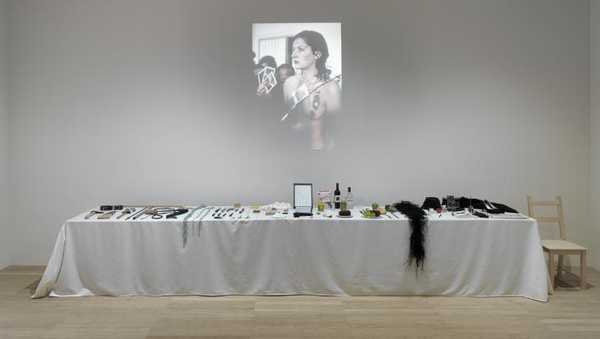
A performance happens once. What remains is documentation. Tate holds Rhythm 0 as an installation: a table with seventy two objects, and a slide projector with slides of the performance and text.
Museum visitors today stand before that table without Abramović. The objects lie still, as if waiting. The projected images show what happened. The gap between the quiet table and the tense photographs is where the work goes on.
The question Rhythm 0 asks does not belong to 1974. It asks the viewer now: if you were allowed, which object would you pick up?
Why it stays
Many see Rhythm 0 as an experiment in violence. It is also a work about responsibility and about objects. Abramović declared herself an object, and the audience treated her exactly so. The work shows how thin the line between person and object can be, when a single sheet of instructions is enough to erase it.
A few years later in New York, Mierle Laderman Ukeles set out to shake the hand of every city sanitation worker and thank them, in Touch Sanitation. Both works place the artist's body in other people's hands, from opposite directions. One is a deliberate touch meant to make people see each other. The other is a permitted touch in which no one would look. Side by side, they ask the same thing: what do we do when the person before us cannot refuse?
Contemporary Art