
Essays · Olfactory Art
Pamela Rosenkranz. Infection (Calvin Klein Obsession for Men).
A seductive smell can be a trap.
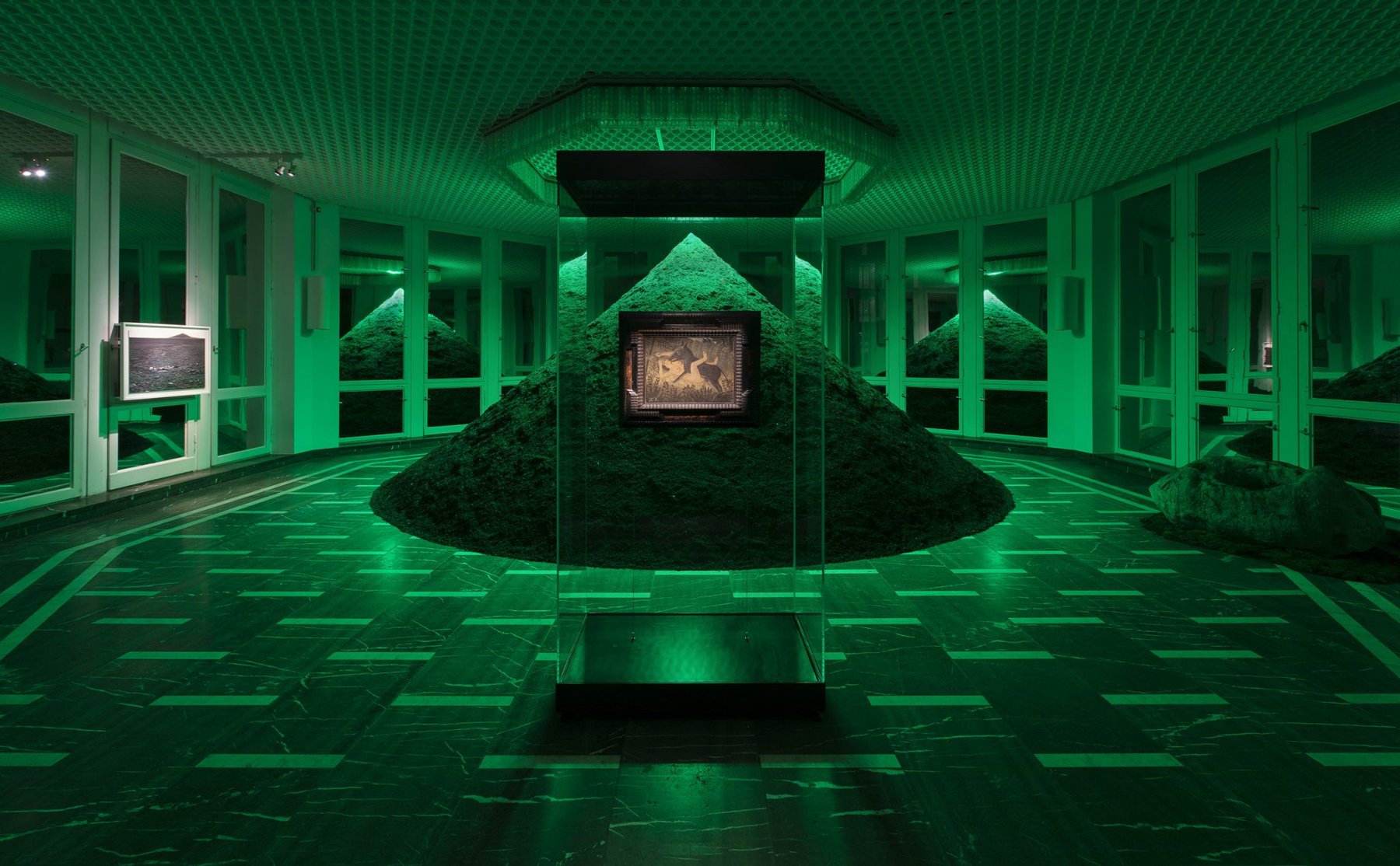
'Sun Rise | Sun Set', exhibition view, Schinkel Pavillon. © Schinkel Pavillon and the artists; photo: Andrea Rossetti · ArtReview
A small mountain indoors
At Schinkel Pavillon, Berlin, in 2021, amid glass and concrete, stood a conical mound of earth. It took up several cubic metres, large enough that visitors had to walk around it. Its peak glowed green under a concentrated coloured light.
The mound was not garden soil. It was a rich, primordial compost: charcoal, human faeces, animal bones. The rawest ingredients of fertile ground, the kind of thing that stays hidden underfoot and is never brought into a gallery.
And it was soaked in perfume. Not a scent made for the work, but a mass market product: Calvin Klein Obsession for Men. The full title of the work states this in parentheses, like an ingredient label.
Anyone entering the room smelled two things at once. Heavy, damp earth. And a men's perfume that many may once have smelled on someone's collar.
Why Obsession
The choice of bottle is deliberate. Obsession for Men contains a synthetic ingredient that acts like a cat pheromone. Wildlife researchers have used this very scent to lure big cats toward camera traps in the forest. Something sold to men to attract others turns out to attract a predator as well.
From here the work links to a long interest of the Swiss artist Pamela Rosenkranz: toxoplasma, a parasite that cats pass on to humans. It lives part of its life cycle in cats and can reside in a human body without obvious signs. It is an example of other organisms quietly living inside us.
By putting a cat pheromone smell onto a heap of dung and earth, Rosenkranz joins the pieces: cat, parasite, soil, human body, and bottled desire. The title is Infection. What spreads first is the smell. It clings to visitors' clothes as they leave.
Rosenkranz has long worked with the materials of consumer industry, as in Our Product, where skin colour and industrial chemicals entered the gallery. Infection continues in that direction, but goes deeper, down to the soil.
Sun rise, sun set
Infection was part of the group exhibition Sun Rise | Sun Set at Schinkel Pavillon, from late February to late July 2021. It gathered nineteen artists across generations, among them Max Ernst, Karl Blossfeldt, Emma Kunz, Jean Painlevé, Pierre Huyghe, Neri Oxman and Ryuichi Sakamoto.
The shared theme was humanity's difficult relationship with the natural world: a sense of planetary precarity, wonder, and cycles that cannot be stopped. Among Blossfeldt's plant photographs and Painlevé's science films, Rosenkranz's mound was the thing closest to the ground.
Compost is a cycle in miniature. What dies breaks down into soil, soil feeds what lives. Rosenkranz adds a market product to that cycle, as if to ask: does human desire, designed and bottled, sit outside the cycle? Or is it just another link, like the parasite, like the cat?
The work does not answer. It glows green, quietly, and gives off its smell. Visitors stand before the mound, drawn in and wanting to step back. That hesitation is what the work asks them to notice in themselves.
Olfactory Art