
Essays · Olfactory Art
Pamela Rosenkranz. Our Product.
Skin is a colour, and also a smell.
ArtReview · ArtReview
A pool of skin colour in Venice
In 2015 Pamela Rosenkranz represented Switzerland at the 56th Venice Biennale. Her exhibition in the Swiss Pavilion was called Our Product, curated by Susanne Pfeffer.
Visitors met a large pool of slightly viscous, pale pink liquid. According to Rosenkranz, it was a solution in the skin colour of Central Europeans. Not the skin of any one person. More like an average, as if the skin of a whole region had been dissolved into one basin.
The liquid was not still. Its surface stirred, the light shifted, sound rose. Speaking to ArtReview, Rosenkranz described the work as something that flows, smells, shines, sounds and moves. In other words, like something alive.
Body fluid, or a drink
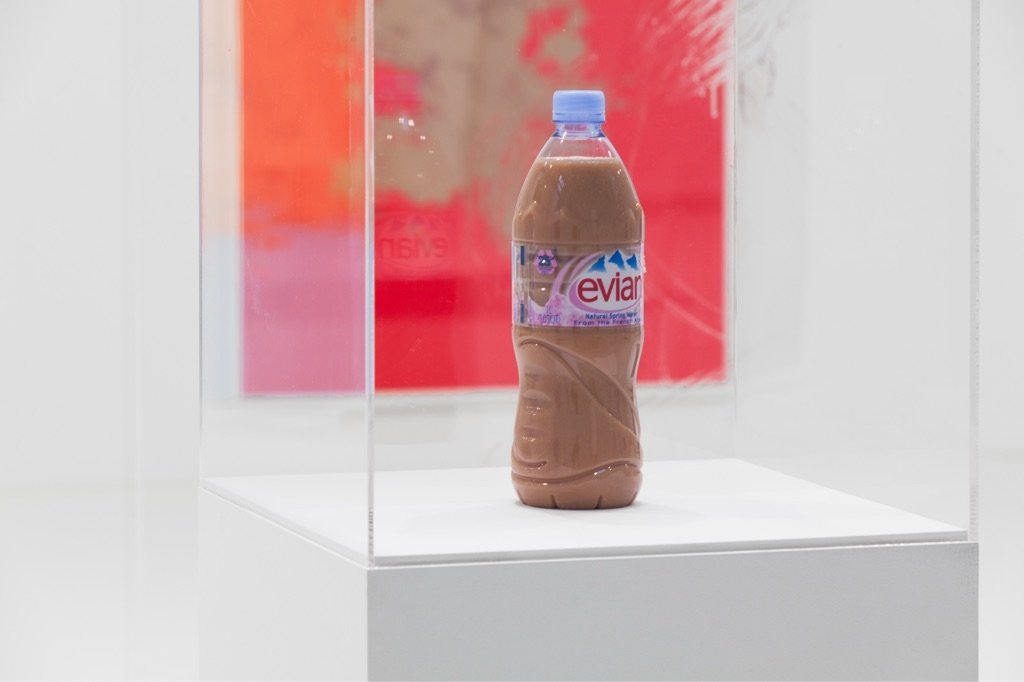
Rosenkranz said the liquid resembled a genetic solution of human bodies, and also a drink. It might nourish you; it might dissolve you.
That double reading is the centre of the work. Skin colour is usually bound to identity, to race, to history. Here it is drawn out of every body and poured into a pool, like an industrial product. Visitors see something very close to themselves, and something strange, almost repellent.
Writing on the show notes that Rosenkranz worked with supposedly immaterial elements: light, colour, scent, sound. Alongside them were organic components such as hormones and even bacteria. Together they questioned the image of the human handed down by religion, history and commerce, setting it against the body's biological origins.
The smell of a colour
The least visible part of the work was the smell. Rosenkranz worked with two figures from perfume, Dominique Ropion and Frédéric Malle, on a scent made for the pavilion.
The aim, as described, was a smell that corresponded to the skin colour in the pool. Molecules were built so that smell and colour would call each other up, a crossing between eye and nose. The result, according to writing on the show, was a smell recalling fresh baby skin, drifting through the rooms.
Baby skin is a sharp choice. It is a smell almost everyone finds pleasant, nearly by instinct. It is also used heavily in consumer goods, in powder, soap and laundry products. Set beside a pool of average skin colour, the pleasantness suddenly becomes suspect.
Ours
The title is Our Product. Rosenkranz has said she is interested in how people relate to one another through the immaterial side of a product, and through the arrival of the Anthropocene, the age in which humans alter the planet itself.
Read this way, skin is no longer only part of a body. It is a product: standardised, given a colour name, sold with scents designed in advance. We buy creams, soaps and perfumes so that our skin has a certain colour and a certain smell. Then we call it natural.
Elsewhere Rosenkranz goes further into smell and instinct, as in Attraction, where synthetic cat pheromone is released into the room. In Venice she kept everything within one pool and one current of air. Visitors stand at the edge, look at a colour, smell a smell, and wonder which of the two is theirs.
Olfactory Art